Freight forwarding is an industry in which one physical object can generate a small civilization of paperwork. A shipment begins as a quote, becomes a booking, enters a warehouse, triggers customs filings, gathers carrier updates, produces an invoice and inspires the customer to ask, again, where it is. In a weak operation, each stage lives in a different inbox or spreadsheet. The same names, weights and container numbers get typed repeatedly. The product moving across the world is often easier to locate than the truth about it.
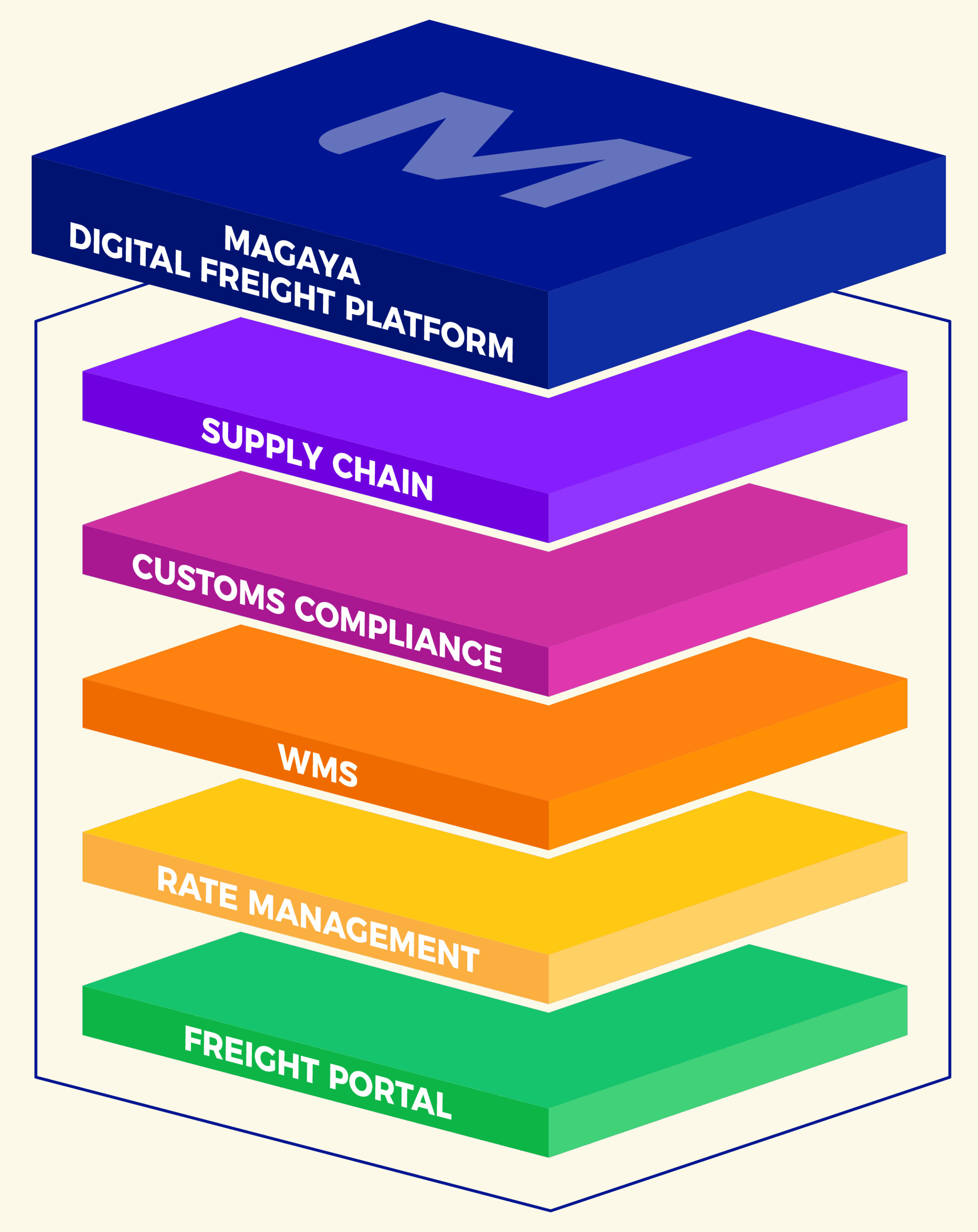
Magaya Corporation sells the antidote: a modular cloud platform that keeps that operational story connected. Its core Supply Chain product handles freight, warehouse, accounting and tracking work. Customs Compliance manages filings. Rate Management turns tariffs and contracts into usable quotes. WMS directs warehouse activity. A branded Digital Freight Portal gives shippers schedules, bookings, documents, payments and status without a ritual phone call. Magaya Connect joins outside systems to the record. Around those sit hosting, implementation, training, support and specialist extensions.
This is vertical software in its purest form. The interface matters, but the real moat is accumulated knowledge of unglamorous exceptions: an airway bill that changes, a customs message that cannot be ignored, a pallet whose dimensions affect the charge, a customer who sees one milestone while an operator sees twelve. General software organizes tasks. Magaya organizes the peculiar sequence by which cargo becomes revenue.
01 / The apartment eraThe customer was in the room before the roadmap
Magaya began in 2001 with three Cuban founders and very little ceremony. Jesus David Rodriguez and Jose Yoniel “Yoni” Garcia wrote the original code. Gabriel T. Ruz Jr. made many of the early sales. Their first office was a family member's apartment, and their first customers were small freight forwarders. Those customers did more than beta test. They supplied the complaints, odd cases and requests that made the system sturdier.
That origin explains the product. Magaya was not conceived as a generic database later dressed in shipping vocabulary. It grew outward from a forwarding desk. The company learned that what fails first is shared memory. Once shipment volume rises, the one experienced operator who “knows where everything is” becomes a bottleneck. Email threads split. Rates expire silently. A warehouse update does not reach billing. A customer calls because self-service visibility never existed.
- Quote
- Booking
- Warehouse
- Customs
- Invoice + track
For a young vertical SaaS company, that is the first copyable move: stand beside the person doing the work and follow one expensive object through the whole business. Count the re-keys, status requests and improvisations. Build the shared record before the dashboard. Early customer intimacy gives a product texture competitors cannot acquire from a market report.
02 / The growth problemUseful was not the same as focused
By 2019, Magaya served more than 1,600 customers across 75 countries. Yet an investor case study describes a blunt conclusion: the company was not growing fast enough to capture the industry's digital shift. The tactics that had created a useful product were no longer sufficient to create a larger company. A roadmap shaped by many customers can become a map of every road.
LLR Partners invested that April. Magaya and the investor compared management attention, research spending and sales effort with the revenue those activities actually produced. The work changed their mind about breadth. They renewed the focus on digital freight forwarding, adjusted product roadmaps and pricing, sharpened sales targets, expanded leadership, stopped less consequential projects and retreated from weaker markets.
“The company wasn't growing fast enough to capitalize on it.”LLR Partners, describing Magaya before the strategic reset
Then came M&A with a shopping list, not a buffet plate. ACELYNK added U.S. customs compliance. Catapult added freight rate management. Qwyk supplied a white-label customer portal. SimpliShip brought API-centered freight procurement connectivity. Each acquisition filled a gap along the same forwarding workflow. Within roughly two years, Magaya had doubled in scale, tripled its employee base and reached more than 2,300 customers in 104 countries.
Apax Digital led an equity recapitalization in January 2023, with LLR and management rolling over stakes. Neither that transaction nor the 2019 investment disclosed a price. The founders remained minority shareholders. Magaya is private, so valuation and audited revenue are not public. A supplied third-party company record estimates annual revenue at $26.8 million, but the company has not confirmed it.
03 / Who pays, and whyThe economics live in minutes, errors and avoided calls
Magaya's buyers are freight forwarders, customs brokers, third-party logistics providers, NVOCCs, warehouse operators, couriers, wholesalers and distributors. They range from specialist shops to international operators. Named users include WTDC, International Food Group, Interglobal Logistics, OSF Freight, Draco Freight Logistics, JJM Customs Broker and OL USA.
The business model is quote-priced B2B software plus services. Magaya does not publish a menu. The cost depends on modules, users, hosting, migration, integrations, configuration, training and support. That makes the sticker price the least interesting number. A buyer should price the implementation team, dirty legacy data, redesigned processes and the temporary productivity dip while employees learn a new system.
The return arrives through repetition. Draco reports cargo check-in time fell 80 percent. OSF says average shipment processing became 58 percent faster and daily throughput rose 300 percent. Hospitality Purveyors International reports fulfillment improved 35 percent and inventory accuracy by more than 90 percent. A 2026 PortPro integration reportedly saves one WM Stone Logistics team at least 15 minutes per shipment by removing duplicate entry between forwarding and drayage.
Treat those as customer-reported outcomes, not universal forecasts. Still, they expose the right buying equation: minutes saved per job, multiplied by jobs, loaded labor cost and error risk. Add fewer “where is it?” calls, faster billing and fewer compliance surprises. If those volumes are real, an integrated platform can pay. If they are not, the elegant workflow may remain expensive furniture.
04 / Where it is differentModular breadth without pretending every tool must be replaced
Magaya sits between focused point tools and heavier global suites. Its obvious platform competitors include CargoWise and Descartes. It also meets GoFreight, Logistaas, Freightos/WebCargo and combinations of warehouse, customs, accounting and home-built software. The most stubborn alternative is the familiar relay race of spreadsheet, email, phone and employee memory.
Its differentiation is the combination of domain depth and modularity. A company can deploy products together as a connected platform or add a module around existing systems. That matters because logistics operators rarely get a clean-sheet technology decision. They have carrier links, accounting rules, customer promises and local compliance processes that cannot simply vanish on go-live weekend.
Recent releases make that stance visible. Magaya Connect links PortPro drayage execution, GLT inland transportation and Coneksion ocean-carrier workflows. A Lune integration puts emissions data into quotes, bookings and shipments. In 2026 the company introduced ACEbridge, an AI compliance agent designed to ground answers in official U.S. Customs and Border Protection material, and added native New Zealand customs filing. The useful idea is not “add AI.” It is put a narrow, auditable capability where someone already makes a regulated decision.
05 / The honest limitA platform cannot standardize a company that refuses to standardize itself
Magaya will not work by logo alone. A small broker with simple, low-volume jobs may never recover migration and training costs. A giant multinational that demands one rigid global template may prefer a different enterprise suite. A buyer expecting software to repair contradictory processes without an empowered implementation owner is purchasing an argument with a login screen.
Conditions that favor it
- High shipment volume and repeatable handoffs
- Multiple modules share the same core data
- A named owner can enforce process decisions
- Customers value self-service visibility
Conditions that fight it
- Low volume and little workflow complexity
- Dirty data with no cleanup budget
- Teams preserve every local workaround
- Integrations have no long-term maintainer
The copyable lesson is therefore more demanding than “build vertical SaaS.” First, let customers reveal the real workflow. Second, identify the single record that every function needs. Third, measure every product and market against the economic center of that workflow. Fourth, buy or build adjacent capabilities only when they remove a handoff. Finally, publish the operating math: time saved, errors reduced, cash collected faster.
Magaya's culture mirrors the same integration problem. It describes itself as OneMagaya, a work-where-you-work-best organization of more than 250 people, joined from several acquisitions and organized around integrity, people, teamwork, innovation and customer success. The Miami office still celebrates cafecitos. That detail is charming, but the serious cultural work is blending acquired teams without turning a connected product into a collection of branded silos.
Twenty-five years after two founders wrote code and a third sold it from an apartment, Magaya remains in a business of small frictions with expensive consequences. Its best insight is that logistics does not need more information. It needs the information it already has to survive the next handoff. Its hardest-earned insight is that a company trying to connect everything still has to decide what not to build.