A carton of milk is a useful antidote to a software sales pitch. It has a destination, a deadline and very little patience for a confused transport department. Kewill built its business around that sort of problem: making the shipment, its instructions and its paperwork agree about what should happen next.
The company’s name has since slipped behind a succession of larger businesses. Kewill and LeanLogistics became BluJay Solutions in March 2017. e2open bought BluJay in 2021. WiseTech Global completed its purchase of e2open in August 2025. Follow the names and you get a miniature history of logistics software: specialist applications gathering into platforms, then networks, then bigger corporate portfolios.
For a buyer, that history matters. A familiar name in an old shipping system does not tell you who owns the business today. Nor does a new parent’s name explain how the application earned its place beside the loading dock. To understand Kewill, start with the parcel.
The label came before the network
Kewill began in 1972 with Kevin Overstall and William Loeffen. Its name joined their first names, a detail preserved in a 2012 account by the Dutch technology publication Computable. Decades before the BluJay rebrand, the business already had the kind of name that makes perfect sense once somebody explains it.
Its place in American postal history is more tangible. Clippership, a multi-carrier parcel product, worked with USPS postage meters and helped support the move to manifesting in the late 1980s. For large-volume mailers, that meant a simpler way to account for parcels. Later, the product participated in the Postal Service’s early certification of barcode labels and internet package tracking.
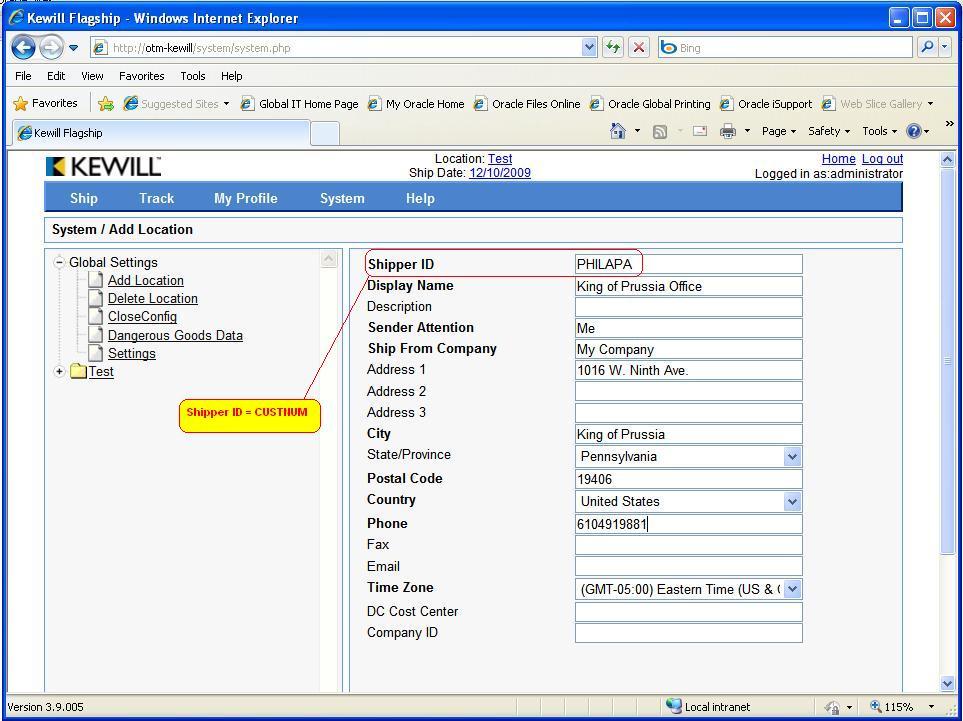
A shipping label looks like an output. In practice, it is the point where several systems must agree. Oracle’s warehouse documentation describes a Kewill interface exchanging package dimensions, estimated weight, rates and tracking details. Once actual weight became available, the information could be updated; shipment confirmation then updated the manifest. The quiet achievement was keeping these steps attached to the same carton.
That gives Kewill’s expertise a concrete shape. It understood the unglamorous transactions between warehouses, carriers and business systems. A beautifully planned order is still unfinished if the parcel cannot leave with the right information.
Six verbs, one shipment
In September 2013, Kewill announced MOVE, with availability scheduled for October. Its organizing vocabulary was unusually direct: trade, transport, store, comply, manage and integrate. Those verbs covered forwarding and shipment handling, movement by air or sea or rail or road, warehouse operations, customs processes, visibility and connections to trading partners.
The intended customers included logistics service providers, manufacturers, retailers and distributors. Historical customer announcements named businesses as different as Bayer, DHL and UPS. Some companies needed to ship their own products; others needed software to run shipping operations for somebody else. Both had to coordinate work beyond the walls of a single business.
MOVE was offered through both on-premises and software-as-a-service deployments. That distinction matters when reading the company’s history: the portfolio was not uniformly a cloud subscription from birth. It included specialist products, installed systems and integrations that customers had built into their daily routines.
One shipment. Several organizations. A shared information trail.
Flagship shows how specific the proposition could get. In 2012, its enterprise parcel shipping software achieved validated integration with Oracle E-Business Suite 12.1. Kewill also worked with Oracle Transportation Management on parcel functionality. The commercial attraction was a shipping application that could join an existing business system without requiring the buyer to replace everything around it.
Milk exposes the paperwork problem
At dairy operator HP Hood, acquisitions had left disjointed transportation processes and paper-based work. Plants, customer service, carriers and transport staff were not collaborating effectively. The initial weakness was organizational: a growing company had accumulated several ways of doing the same job.
Kewill’s 2014 case study described a common transport system rolled out across the business and acquired companies. It reported 99.6 percent on-time delivery, 95 percent automated freight payments and a 20 percent reduction in less-than-truckload shipments. These are customer-case results, not a guaranteed return for every installation.
“we have to go from cow to customer”
Heidi Henderson · Logistics analyst, HP Hood · 2014
On-time delivery
Freight payments automated
The practical inference is to standardize the process before expecting an application to standardize the outcome. Give transport and customer service a common shipment record. Decide who handles an exception. Measure service and payment performance. That is a more useful starting point than buying a dashboard and hoping the organization will arrange itself around it.
The $115 million route to a new name
Francisco Partners completed its take-private acquisition of Kewill in July 2012. Its stated investment case centered on growing trade volumes and increasing complexity. In May 2016, Kewill agreed to buy LeanLogistics from Brambles for $115 million. Brambles subsequently recorded the sale as effective May 31.
The seller’s reasoning is revealing. Brambles said it had reached the limit of the value it could contribute as owner of a specialized software business. It expected to remain a customer. Kewill and its private-equity backer offered a different setting for expansion: logistics software was the main business, rather than a smaller activity inside a broader group.
By March 2017, the combined companies were ready to introduce BluJay. Their explanation went beyond fresh graphics. In different regions, customers associated the old names with individual products or acquired businesses. The company wanted its identity to reflect a more unified operation.
The new Global Trade Network put those connections at the center of the sales argument. At launch, BluJay said it connected more than 40,000 participants, including carriers, shippers, forwarders and suppliers. The useful proposition was access to trading relationships and shared information across company boundaries. Network size was part of that proposition; whether the right partners were connected was the buyer’s more immediate question.
Lineage Logistics supplied a concrete application that month. Its partnership with BluJay offered food and beverage customers managed transportation using the software alongside Lineage’s cold-storage operations. Software and operating expertise could be bought together, giving customers another way to organize the work.
A global company, with local families
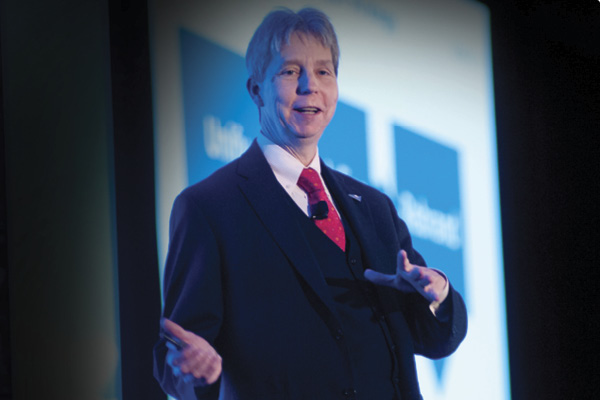
Braun, who joined Kewill as CEO in 2015, described a deliberately personal management approach in a 2017 interview. He aimed to visit every office each quarter and said he managed it about 95 percent of the time. An Indian office’s family day welcomed spouses, children and grandparents as well as employees.
Recognition trips included people from accounting, human resources and professional services, rather than being reserved for sales staff. Braun also described removing management layers and adding four weeks of paid parental leave beyond US legal requirements. These were the CEO’s account of the organization, but they offer specific evidence of the culture he wanted to build.
There was an operational argument underneath the gestures. A company selling coordination across borders needed its own offices and departments to work together. Unifying a product portfolio could require changes to incentives and relationships as well as engineering.
Three prices that describe different things
What did Kewill cost a customer? MOVE’s launch directed buyers to a representative for a quotation. Deployment choice, implementation and integrations belonged in that conversation. Historical investor commentary also described reliance on uneven software-licence revenue, alongside recurring income. The business model evolved; a single modern SaaS label smooths away that history.
Funding had its own vocabulary. In 2017, BluJay secured an additional $200 million in capital from TPG Specialty Lending and BlueBay’s private-debt group, then received a minority investment from Temasek. Reports that it had access to more than $500 million for growth did not mean Temasek had written a $500 million equity cheque.
e2open’s May 2021 acquisition announcement valued BluJay at approximately $1.7 billion. The transaction mixed cash and shares. It closed on September 1, and later financial statements recorded approximately $1.5 billion in purchase consideration. The announcement value and the accounting amount describe the deal at different stages and on different bases.
- 2017Kewill + LeanLogistics
BluJay Solutions - 2021BluJay acquired by
e2open - 2025e2open acquired by
WiseTech Global
WiseTech’s subsequent e2open purchase carried an enterprise value of $2.1 billion and closed on August 3, 2025. That price covered e2open’s broader business. It cannot be plotted beside Kewill’s earlier transactions as though each number valued the same collection of products and customers.
The connection has to be useful
Kewill occupied the execution side of supply-chain software: the work of organizing movement, documents and operational information. Buyers considering those functions today can also examine Oracle Transportation Management and Descartes TMS. Both offer overlapping transport capabilities. Kewill’s Oracle relationship is a reminder that a supplier can be an alternative in one purchasing decision and a partner in another.
Its distinctive history combined parcel expertise, customs and forwarding applications, a broader MOVE proposition and the LeanLogistics network. That combination explains its market position more accurately than a claim that it alone could connect a supply chain. Other vendors built their own networks and integrations.
For an operator, the lesson is to test the proposed connection against an actual working day. Can the carrier return the information you need? Can a customer-service colleague see the exception? Does the completed shipment reach the payment process correctly? Ask the demonstration to follow your order through those handoffs.
The economics become less convincing if a simple shipping operation must fund extensive integration for capabilities it rarely uses. A network also cannot deliver reliable visibility from missing or inconsistent partner data. Those are practical conditions to evaluate, not reasons to dismiss the software. Kewill’s enduring subject was the handoff: the moment one organization’s completed task becomes another organization’s responsibility.
Follow the shipment
COMPANY CHANNELS & FURTHER READING