The pink mustache was doing serious work. Attached to the front of a car, it announced that the stranger approaching you belonged to a recognizable system. Early Lyft passengers climbed into the front seat and exchanged a fist bump with the driver. A transaction acquired a little ceremony. Getting into somebody else’s car became easier to imagine.
The ride, in brief
- Lyft matches passengers with drivers, taxis, bikes, and other ground transportation.
- Its repeat customers include commuters, travelers, employers, and healthcare organizations.
- The useful lesson: solve a recurring uncertainty, then make the promise precise enough to deliver.
01 The mustache had a job
Logan Green and John Zimmer had already tried organizing longer-distance carpools through Zimride, their 2007 precursor. College students could find someone heading home and share the journey. The idea addressed empty seats, but the trips required coordination. Lyft, launched in San Francisco in 2012, brought the exchange into the city and onto the phone: somebody needs a ride now; somebody nearby can provide it.
The founders later described Lyft as emerging from a mobile experiment inside Zimride. In 2013, they sold the older business to concentrate on the newer one. The lesson was less about abandoning carpooling than discovering a different rhythm of demand. Holiday trips happen occasionally. Getting across town keeps happening.
Today, Lyft’s expertise lies in matching those requests with available transportation, estimating arrival times, processing payments, and managing a marketplace whose two sides need each other. Riders want short waits and reasonable fares. Drivers need trips worth accepting. A charming brand can introduce the parties. It cannot balance their interests indefinitely.

02 The product is a less anxious Tuesday
Consider the commuter who takes the same route at roughly the same hour. For that person, a changing fare complicates a household budget. Lyft’s Price Lock, introduced in September 2024, charges $2.99 a month to cap eligible fares on a chosen route during a selected one-hour pickup window.
The boundaries matter. Current help terms limit savings to $50 a month per pass. If the market fare is lower, the rider pays that lower price. The locked fare can change at monthly renewal. This is a practical tool for a repeated US trip, with rides paid separately. Someone whose destinations change daily has much less reason to buy it.
Other products address different frictions. Riders can request immediate trips or schedule ahead, choosing among locally available vehicle options. Employers can fund rides with Lyft Pass. Through Concierge, healthcare organizations can arrange non-emergency transportation for patients who do not have smartphones. The person needing the ride no longer has to be the person operating the app.
That distinction gives Lyft customers beyond individual passengers: clinics, health plans, transportation brokers, and businesses managing employee travel. Bikeshare adds another choice for shorter journeys. The company operates systems including Citi Bike and Divvy, while supplying technology to other programs.
One regular route. One pickup window. Up to $50 in monthly savings per pass. Rides cost extra.
03 The expensive part of getting simpler
In April 2023, incoming leadership gave way to a difficult reset. David Risher became CEO, succeeding Green. Lyft announced cuts affecting approximately 1,072 employees, or 26% of its workforce. Its initial estimate for severance and employee benefits was $41 million to $47 million.

“We need to be a faster, flatter company”
David Risher · April 2023
Risher’s explanation linked a smaller organization to competitive pricing, faster pickups, and better driver earnings. Those were management’s stated priorities; the subsequent growth does not establish that layoffs alone produced it. His operating argument was straightforward: improve the experience people encounter each time they open the app.
The financial machinery deserves equal attention. Lyft primarily collects service fees and commissions from its marketplace. Rentals, advertising, bikeshare, and business offerings add revenue. In the second quarter of 2026, $5.50 billion in gross bookings translated into $1.84 billion in revenue and $50.3 million in net income. These are different measures. The booking total includes money that never becomes Lyft’s revenue.
Q2 2026 · Three different measures
Bars share one scale. Bookings measure transaction value; this is not a breakdown of costs.
Growth also carries obligations. In September 2026, Lyft agreed to a $272.5 million California settlement over alleged driver misclassification during 2016-2020, subject to court approval. It is a reminder that a transportation marketplace’s economics depend on labor rules and insurance as well as software. Lower fares cannot settle every tension between passengers, drivers, and shareholders.
04 The map gets bigger. The promise gets specific.
Uber remains the obvious North American comparison. Lyft’s portfolio now extends into European taxis through Freenow and global chauffeuring through TBR. Buying established networks gives it existing supply and local operating knowledge. On September 30, 2026, North American app users gained early European access in Barcelona and Hamburg; more cities were scheduled through October. European residents continued using the local apps.
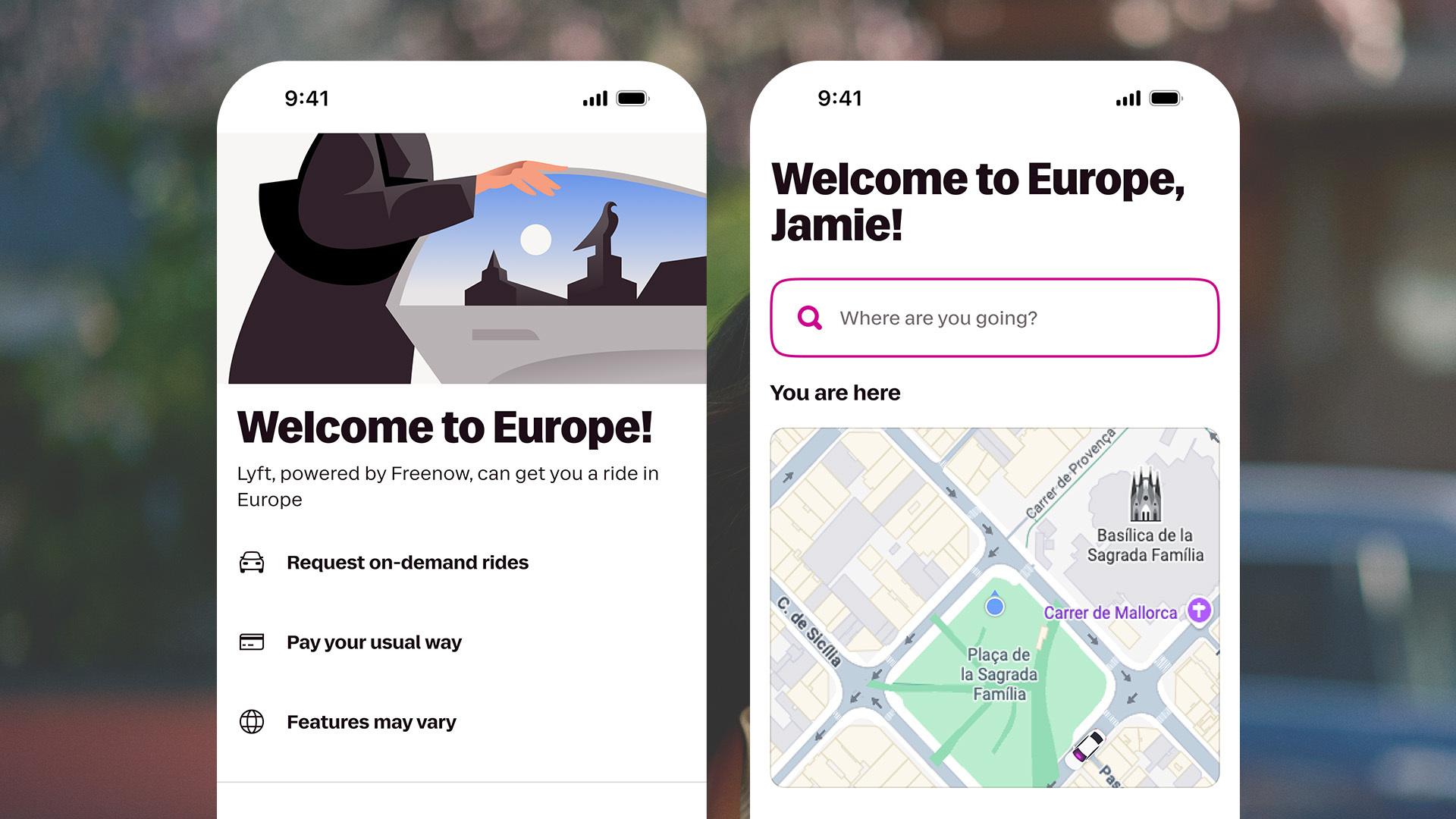
Partnerships broaden the approach. Curb adds licensed taxis. DoorDash and United put ride benefits near customers’ existing routines. Lyft said approximately 30% of North American rideshare trips were linked to partnerships in Q2 2026. Association does not prove those trips were all newly created, but it shows how much distribution can happen outside the ride app.
Autonomy offers another revealing choice. Lyft sold its Level 5 development division to Toyota’s Woven Planet in a transaction announced at about $550 million in 2021. Its later strategy includes operating vehicles with partners: Nashville fleet operations with Waymo began in June 2026. Running a fleet and inventing its driving system require different capabilities.
On October 15, Lyft announced another destination for that strategy: Alcove, a global chauffeur brand planned for early 2027. It would combine TBR’s existing service network with new booking technology for corporate travel. A multivehicle event and a trip home from work need different levels of coordination. The expansion suggests Lyft wants to serve both, using distinct brands where expectations differ. For now, Alcove is an announced plan; the existing chauffeur operation remains TBR.
The transferable idea is to choose the repeated problem carefully. A commuter wants a predictable price. A clinic wants a patient to arrive. A traveler wants a familiar account to work abroad. Each promise depends on local supply and workable costs. Where drivers are scarce or a cheaper train serves the trip, the app has less to offer. The pink mustache earned attention. The next pickup has to earn the next booking.