A filmmaker can have a camera, a subject and an excellent idea, and still spend the next ten minutes attending to a piece of metal. Something needs attaching. Something needs releasing. The picture waits. Lukas Colombo has built two businesses in the space between imagining a shot and getting it made: Moai Films, which produces the work, and Kondor Blue, which supplies the equipment around the camera.
His career becomes more interesting when you keep both businesses in view. The director who works on commercials and music videos is also the founder and CEO who thinks about handles, cables and filters. A finished film invites an audience to forget its machinery. An equipment company requires someone to remember it in considerable detail.
Colombo keeps a foot in each world. You can follow the commercial credits, watch the trailers and examine the rigging. They belong to the same working life. The accessories have supporting parts, which is fitting: filmmaking gives supporting parts plenty to do.
The business before the blue cables
Colombo was raised in Santiago, Chile, and works in English and Spanish. His early commercial instincts had a decidedly modest inventory: he recalls selling popsicles to his father’s co-workers and helping run family garage sales. Later, short budgets sent him to hardware stores for materials to build his own dollies and sliders. The equipment could be cumbersome. It did the job.
There is a pleasing continuity between those enterprises. A popsicle has to find a buyer before it becomes a puddle. A production has to get its shots before the day disappears. Neither occupation offers much comfort to someone who enjoys planning indefinitely.
He studied Cinema and Television at Palm Beach Atlantic University, where he was honored as Outstanding Graduate in Entertainment Media. He has served as chief executive of Moai Films since January 2008. The company gave his directing and cinematography a business structure: clients, crews and projects that had to leave the realm of promising ideas.
Moai’s work extends across commercial production, narrative films and documentaries, with post-production services alongside the shoots. Its Los Angeles base is part of a career with an international working range. The business of making pictures includes a surprising amount of work that happens nowhere near a lens.
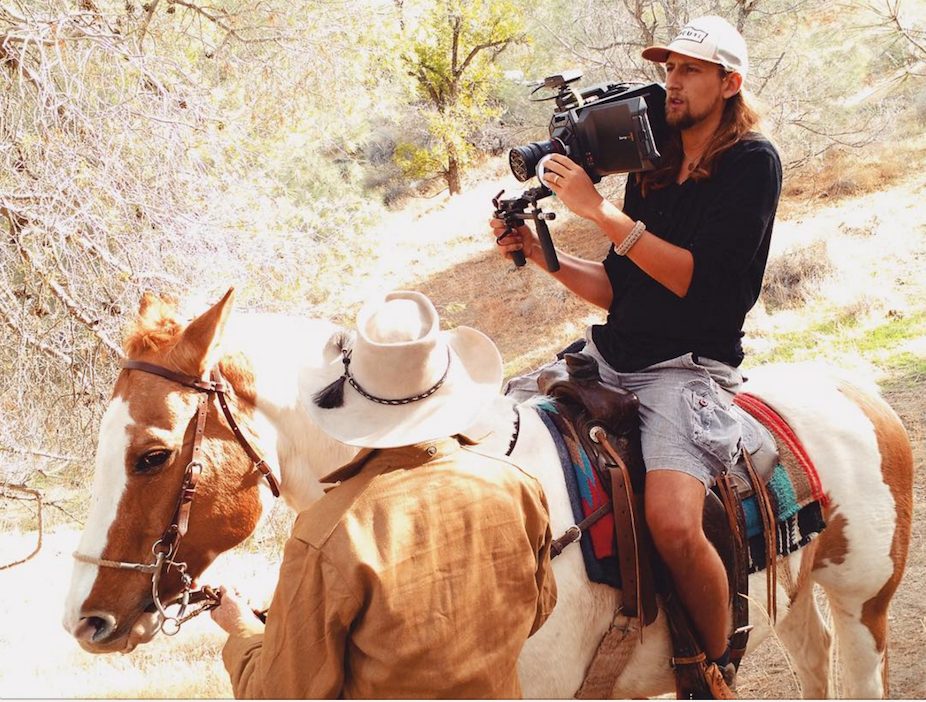
His personal portfolio makes that range tangible. A Steve Vai music video sits alongside an Apple iPhone 11 campaign and advertising for Kia. A Canon commercial film, Enmity, credits him as director and cinematographer. These are different assignments, each asking for a particular kind of attention. A musician, a car and a fictional character will not all benefit from the same treatment.
An idea in 2018. A launch in 2019.
The opening for Kondor Blue arrived around a particular camera. In late 2018, Colombo and filmmaker Vincent Laforet were preparing for a production using the Blackmagic Pocket Cinema Camera 4K. The available support equipment disappointed Colombo. One frustration was a D-Tap power cable available from one supplier for more than $80.
The detail is small enough to sound comic until you consider what it means to someone who wants to shoot. Buying a camera creates a series of further decisions. How will it receive power? Where will the operator hold it? How will the rest of the equipment attach? The box containing the camera cannot answer every question raised by the day ahead.
In 2019, Colombo launched Kondor Blue with products including a Mini Quick Release, a Pocket 4K cage and top handle, and XLR cables. By the end of that year, Kondor Blue had brought 60 products to market and partnered with B&H for distribution.
The step from making something for a shoot to putting it into distribution deserves a little attention. A useful object for one production can tolerate its maker standing beside it, explaining a peculiarity. A product sold to somebody elsewhere has to make sense after the maker has left the room. The founder’s practical knowledge has to become something another person can use.
“I’m my own customer.”
Lukas Colombo
That short description carries an advantage and an obligation. He understands the work from doing it. Continuing to do it gives him fresh opportunities to find out whether the products suit the task. The founder can return to the circumstances that prompted the company in the first place.
CEO role begins
product launch
short film
acquisition
A handle with a job to do
One early example helps explain the sensibility. In 2020, Colombo presented Kondor Blue’s cage for the Panasonic Lumix S1H. Its quick-release arrangement allowed the camera to slide into place and lock with a lever. A safety pin kept it from coming free if that lever was disengaged. The top handle incorporated a recording control.
These are small mechanical choices with consequences for the person operating the camera. Releasing the body, holding the assembly and beginning a take are ordinary actions. They also happen repeatedly. A design that attends to them is making a claim about whose time matters.
There is something quietly revealing about a director taking an interest in a locking lever. The finished image supplies the romance. The lever is expected to behave itself. Someone has to give it that education.
The broader point reaches beyond any particular camera model. Colombo’s business grew from a working familiarity with equipment as something people assemble, carry and rearrange. A product photograph captures one configuration. A shooting day supplies many more.
Four days at a roadside motel
The film work continues to give this founder story its texture. In No Vacancy, a 2024 short, Colombo shares directing credit with Jay Sherer and serves as director of photography. Moai Films produced it. The premise sends investigative journalist Leigh Larson, played by Colleen Trusler, to a remote motel where her past begins to catch up with her.
The production took four days. The finished short runs 21 minutes. Those two numbers sit well together: a compact schedule producing a compact film, with very little room in either for a casual detour. The film was conceived to show what audiences could expect from the proposed feature The Harlequin.
No Vacancy · 2024
Co-directed with Jay Sherer
The recognition is specific. No Vacancy won Best International Short Film at the 2025 Paris Art and Movie Awards. Synergy Film Festival lists it as a thriller winner for 2025; ICE Movie Awards includes it among its cinematography winners. Each belongs to the film’s record, rather than to a vague cloud of acclaim.
For a profile of an equipment founder, this is useful evidence of a continuing creative practice. There are collaborators and performances here, along with lighting, framing and a story to complete. The CEO title has company. He remains responsible for pictures an audience will actually watch.
Watch the trailer after looking at his commercial work and the breadth becomes easier to grasp. An advertisement has a client’s brief. A thriller has a viewer’s attention to hold. Both require a sequence of decisions that ends with a finished piece, available for other people to judge.
The next decision is made of glass
In April 2026, Kondor Blue announced its acquisition and integration of Element Filters. It is a development with a particular relevance to a cinematographer: the company’s work now extends further into the glass through which the image passes.
The relationship had begun with collaboration on Opaline diffusion filters. Element founder Tucker Anderson and Colombo had already discussed their shared work publicly. That earlier partnership gives the acquisition a practical prehistory. The businesses had experience putting their products together before bringing them under one company.
“We’ve spent years building everything around the camera.”
Lukas Colombo, on the Element Filters acquisition
The deal brings filter intellectual property and manufacturing relationships into Kondor Blue, with products moving under its brand. Diffusion and full-spectrum neutral-density filtration expand the kinds of decisions the company can help a filmmaker make. A mounting point determines where an object sits. Optical filtration participates in how a picture looks.
That expansion connects naturally with Colombo’s existing work, although it brings its own demands. A useful rig has to function together as an assembly. Filters enter the visual result itself. For a director and cinematographer running an equipment business, the distance between product development and the finished frame has become shorter.
Back to the next take
Colombo lives in Southern California with his wife and four children. His work has crossed commercial campaigns, music videos and independent film, while the two companies give those activities different forms. Moai makes productions possible. Kondor Blue supplies tools to the people making them.
There is no need to turn the relationship into a tidy graduation from artist to entrepreneur. His credits keep accumulating on the creative side. The company keeps adding responsibilities on the business side. Each has a way of reminding the other that an idea eventually needs to work in somebody’s hands.
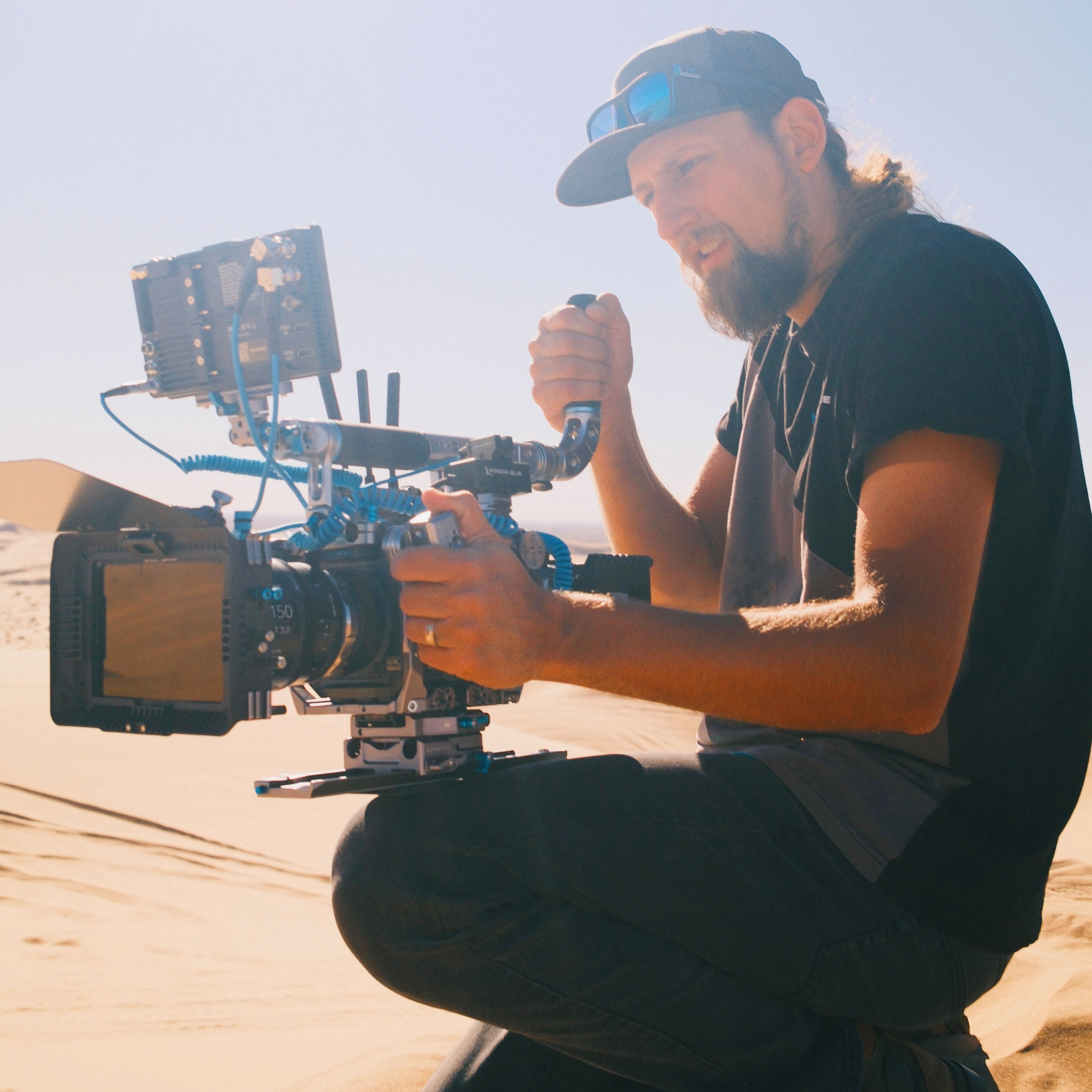
The most revealing picture may be the ordinary one: Colombo holding a camera rig, attending to the thing in front of him. The equipment is visible. So is the person using it. Somewhere beyond that arrangement is the next shot, waiting for everyone to be ready.