A factory can be finished long before its business case is settled. The steel is up. The equipment is installed. Someone has arranged the ribbon and found scissors large enough to make a point. Then comes the less photogenic work: winning orders, managing costs and getting a return on everything that now occupies the site.
For Luis Rojo, president and chief executive of Stepan Company, that distinction has become a useful way to understand the job. In April 2025, the company began production at its new alkoxylation facility in Pasadena, Texas. Rojo had been CEO for about six months. Before that, he had spent more than six years as its chief financial officer.
He had crossed from explaining the numbers to being responsible for the whole enterprise. Pasadena gave that change a physical address. It also supplied a demanding question: what happens after a company builds the capacity it has been promising?
Before the factory, the shampoo bottle
Rojo’s route to the corner office ran through consumer goods. He joined Procter & Gamble in 1997 and spent 21 years there, taking on finance responsibilities across North America, Latin America and Asia. His assignments included China. By April 2014, he was finance director for North American hair care; in early 2018, he moved into the global hair care finance role.
Hair care sounds a long way from a Gulf Coast chemical plant. On a supply chain diagram, the distance is shorter. Stepan makes ingredients used by other manufacturers, including surfactants for cleaning and personal care. Rojo’s career carried him from a business concerned with finished consumer products to one supplying some of the chemistry behind them.
His education had already brought together two relevant disciplines. He earned an industrial engineering degree at Andrés Bello Catholic University in 1996, followed by a master’s in finance at IESA in 1999. Engineering asks how a system works. Finance asks what it costs, what it earns and whether the next investment deserves its place in the queue.
That combination gives his career a particular shape. The plants, purchasing decisions and customer accounts are connected to the financial results. A change in one travels through the others. At a chemical manufacturer, the spreadsheet has quite a lot of plumbing attached.
Six years learning the company from the inside
Stepan announced Rojo’s appointment as vice president and CFO on April 10, 2018, with an expected start later that month. He succeeded interim CFO Matthew Eaken, who continued as corporate controller. The move placed Rojo inside an international manufacturer with operations across the Americas, Europe and Asia.
Its customers buy ingredients rather than a single familiar household brand. Surfactants go into cleaning products and agricultural and oilfield applications. Polyurethane polyols serve insulation and other materials markets. It is a business whose products often do their work without their maker’s name appearing on the finished object.
On October 30, 2024, Stepan announced Rojo’s promotion to president and CEO, succeeding Scott Behrens. He also joined the board. Chairman F. Quinn Stepan Jr. pointed to the understanding of the business Rojo had developed as CFO and to his attention to commercial and operational opportunities.
The expectation was explicit: improve profitability and deliver value. An internal appointment brought continuity, but the assignment itself required changes. Knowing where the money goes is a useful qualification when deciding where the company should go.
“Together we will work to deliver profitable growth based on customer-centric innovation and operational excellence.”
Luis Rojo, on becoming CEO, October 2024
The project that crossed three chief executives
Pasadena was already well underway when Rojo took the top job. In October 2021, under then-CEO Quinn Stepan, the company announced a planned $220 million investment in new alkoxylation capacity. At the time, it expected the plant to come online in late 2023. Construction was underway by May 2022, and the published plan still pointed to that completion window.
Production ultimately began in early April 2025. The chronology matters. This was a multiyear commitment passing through successive leadership teams, with Rojo serving as CFO during its development and CEO when it began operating. Calling it simply his new factory would erase much of the work that preceded him.
The facility added annual capacity of 75,000 metric tons of alkoxylates, with both ethoxylation and propoxylation capabilities. Its Gulf Coast location put it near important raw materials. In practical terms, the investment expanded what Stepan could make and the flexibility with which it could supply customers.
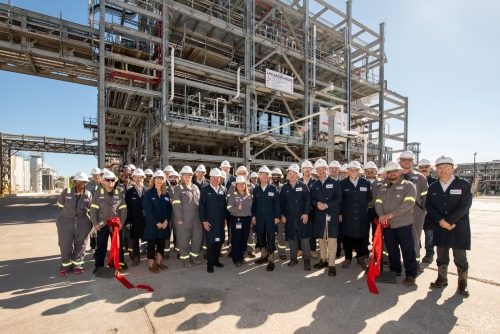
Getting a plant ready also meant getting people ready. By the April 2025 production announcement, Stepan had hired more than 40 employees for Pasadena and recorded more than 27,000 hours of training. Those figures offer a welcome correction to the habit of describing a factory entirely in tons. Capacity requires people who can operate it.
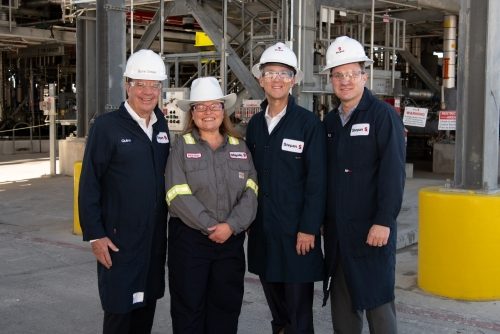
When Stepan published its ribbon-cutting account in December 2025, Rojo was among the leaders who spoke, alongside Quinn Stepan, supply chain executive Rob Haire, surfactants leader Sean Moriarty and site director Martina Hudoba. The gathering made visible how many responsibilities converge at a single site. A CEO can announce an ambition; bringing it into production takes a team.
The first year refused to move in a straight line
Rojo’s first full year began with encouraging results. In the first quarter of 2025, global sales volume rose 4% and adjusted net income increased 32% from a year earlier. He highlighted growth in agricultural and oilfield markets and the start of operations in Pasadena. Yet free cash flow was negative as working capital requirements increased.
The second quarter offered another mixed picture. Adjusted net income rose 27%, while free cash flow remained negative. Stepan was holding inventory for growth, anticipated tariffs, hurricane season and preparations around a new labor agreement at its Millsdale site. A supply buffer has a financial cost even when there are sound reasons to keep it.
By the third quarter, free cash flow had improved to $40.2 million. Adjusted EBITDA rose 6%, while adjusted net income fell 54%. Higher taxes, depreciation and interest weighed on the latter measure. Pasadena’s start-up was part of the cost picture. The same quarter could look better or worse depending on which question the reader asked.
This is where Rojo’s finance background becomes relevant to the story. Earnings measures describe different parts of an operating business. EBITDA leaves out interest, taxes, depreciation and amortization; adjusted measures remove additional specified items. Cash flow asks another question again. A useful account of his tenure has to keep these distinctions intact.
For full-year 2025, Stepan reported $2.332 billion in net sales. Adjusted EBITDA increased 6%, but adjusted net income declined 17%. The company sold its Philippines and Lake Providence plant sites. There was progress, and there were costs still reaching the accounts. Rojo’s first full year ended with an operating business being rearranged around its investments.
A catalyst with consequences
In February 2026, Stepan announced Project Catalyst, targeting approximately $100 million in pre-tax savings over two years. The plan included closing Fieldsboro, New Jersey, and decommissioning selected assets at Millsdale, Illinois, and Stalybridge in the United Kingdom. Production would be consolidated within the remaining network.
That makes the relationship between expansion and retrenchment quite concrete. A company can add modern capacity in one location while deciding that other assets no longer fit demand. Rojo’s task involves both decisions. The savings figure remains a target, with restructuring costs incurred on the way toward it.
The consequences reach employees as well as equipment. In July, Stepan announced plans to reduce its global salaried workforce by around 100 roles. Rojo said the company had sought to limit the impact through attrition, paused external hiring and an emphasis on internal talent. His accompanying commitment to support affected colleagues belongs beside the efficiency figures.
The next call is already on the calendar
The second quarter of 2026 brought stronger earnings: reported net income reached $22.9 million, with organic sales volume up 6%. Rojo attributed improvement to volume, recovering margins and Catalyst savings. He also said customer purchases brought forward because of geopolitical conditions may have helped. Even a good quarter came with a timing question.
There is a fitting restraint in that observation. A manufacturer needs repeat orders after customers finish buying ahead. It needs savings that survive the restructuring period and new capacity that earns its keep. These are useful tests of Rojo’s stated ambition for profitable growth.
On October 28, 2026, he and CFO Ruben Velasquez are scheduled to discuss the next quarterly results. The ribbon-cutting is behind him. The plant is running. For a former finance director who now leads the whole company, the work is becoming visible in the most familiar place of all: the next set of numbers.