Luis Roig arrived at illustration by being unable to do it. He has said, with the genial frankness of somebody who knows his lane, that he is terrible at drawing and envies people who are not. Around him were illustrators and comic artists with an inverse difficulty. They could make the pictures. Making a professional home for those pictures on the web was another matter. Code, hosting, domains, responsive layouts and maintenance stood between an artist and the deceptively simple sentence: “Here is my work.” Roig saw the nuisance clearly because software was his craft. He decided to remove it.
The result was Drawfolio, a portfolio builder shaped for illustrators and other visual professionals. Its proposition was pleasingly concrete: choose a design, upload work, customize the presentation, connect a domain and have a site that behaves on a desktop, tablet or phone. The artist should not need to learn programming, and the software should not compete with the images. The frame exists to serve the picture.
That sounds obvious now. Obviousness is one of good software's more expensive illusions. In 2013, Roig had to decide whether the irritation he had observed was merely a complaint or the beginning of a business. He brought the habits of an engineer to a creative market, then added something engineers occasionally misplace: conversations.
The beta before the biography
Before committing to the full product, Roig tested the assumptions underneath it. Did illustrators genuinely struggle to establish a professional web presence? Was the problem important enough to solve? Would they pay for relief? He ran experiments, spoke with people and studied competing products. Only then did he put a small version in their hands.
The early Drawfolio loop
Roig began working on Drawfolio full time in September 2013. The beta arrived in October. It was intentionally minimal, less cathedral than folding table. Its value was not only what it did, but what it made possible: many more discussions with illustrators, sharper decisions about the product and the first paying customers. Instead of waiting for certainty, he designed a version that could manufacture evidence.
“Antes de empezar a construir el producto, lo primero de todo es validar que la necesidad que has detectado realmente existe.”Luis Roig on testing the need before building
His own route had prepared him for the combination. Roig trained as a telecommunications engineer at the Universitat Politècnica de València. His final engineering dissertation involved visualizations from a collaborative-filtering recommendation system, a curious early marriage of data and display. He later completed a master's in the creation and management of innovative and technology-based companies at the Universitat de València. Drawfolio grew out of his final master's project.
Between theory and product sat years of client work. From 2010 to 2014, under the Nectio Labs name, he helped startups and entrepreneurs with software, web design and strategy. He also participated in projects including Worodu and Portal del Rock. This was useful apprenticeship: other people's businesses provide an abundant education in requirements, revisions and the distance between an elegant idea and a Tuesday afternoon problem.
Software polite enough to step aside
Drawfolio's early pitch combined restraint with a fairly complete view of an illustrator's working life. A site needed attractive templates and mobile layouts, but also domains, image storage, contacts and statistics that did not require an analyst to interpret. Roig spoke repeatedly about customer support. The promise was not simply that somebody could publish a page. It was that the portfolio could become the professional front door: a place to show work, communicate seriousness and invite the next assignment.
The focus on illustrators mattered. Generic builders could address everybody who needed a website. Drawfolio could notice the peculiarities of visual work: images with different ratios, collections that need ordering, presentation that must be distinctive without becoming noisy, and creators who would rather be drawing than troubleshooting a layout. A niche is sometimes described as a smaller market. Here it functions as a more precise vocabulary.
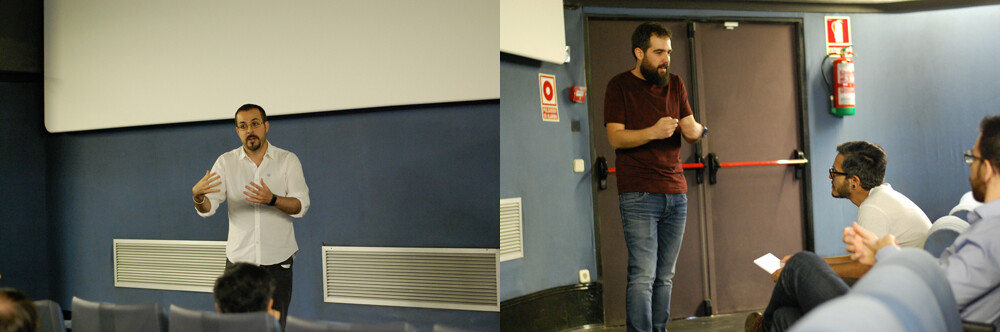
Cinema Challenge made that vocabulary physical in 2017. Drawfolio joined Letra Salvaje and Aragó Cinema to organize an illustration competition and display selected work in the cinema's lobby in Valencia. Roig presented the origins of the project and joined a discussion about film and illustration. The event carried online portfolios into a public room, where people could stand in front of the work together. A product devoted to display had briefly become an exhibition maker.
Build for the work around the artifact. Drawfolio does not only publish an image. It helps the artist organize, present, own and use that image in a professional relationship.
Ambition with the receipts attached
Roig's description of entrepreneurship has always contained a useful tension. He wanted to make his own decisions, influence the strategy and direction of the company, and solve real problems for a group he admired. He also rejected the notion that working for yourself was easier than working for somebody else. It was harder, he said, but more rewarding for him.
His advice followed the same pattern: go ahead and start, but do it with your head on. Understand the bet. Understand the sacrifice. The encouragement comes with its own invoice. In Drawfolio's early days, Roig said savings and contributions from friends and family helped get a solid product into the market and secure the first customers. Validation was not a slide in a pitch deck. It was a way to spend limited resources with fewer fantasies.
“Lo que me motiva principalmente es tomar mis propias decisiones, influir en la estrategia y rumbo del proyecto empresarial.”Luis Roig on why he chose his own product
Recognition arrived early. Drawfolio collected awards for an online business project, a master's final project and a business proposal, followed by an IEBS prize in the 2015 #ElGranPitch competition. The more interesting arc is what followed the applause. Roig kept explaining the unglamorous substance of the work: personal marketing for illustrators, portfolio strategy, web independence and the stages a real company passes through after its name is printed on a certificate.
He presented Drawfolio at publishing and illustration events, including LIBER in Barcelona in 2016 and Dibumad in Madrid in 2019. The Dibumad subject was especially revealing: use a portfolio website to find clients and reclaim your internet. Social networks are rented stages with restless landlords. An independent site can be quieter, slower and more durable. It lets an artist decide how the work is grouped, what surrounds it and where a visitor goes next.
In 2020, Roig returned to the Universitat de València master's program as an alumnus. He described how Drawfolio had started from his final project and walked students through the company's stages, including lessons and errors. In 2023, he represented Drawfolio in the university's Chebec program, a gathering about internationalization for Mediterranean cultural and creative organizations. The engineer who entered the art world through a technical inconvenience was now part of a wider conversation about how creative work travels without losing its identity.
A founder with an archive
Roig's personal portfolio gives the story an unexpectedly charming tail. He calls himself a “Business Bootstrapper, Software Developer and Graphic Designer,” a title with more elbow grease than glamour. Alongside Drawfolio and freelance projects, he preserves personal websites dating from 2000, an old photoblog from 2006 to 2008, the data visualizations from his engineering dissertation and assorted experiments. Most founders polish their history into a straight road. His looks more like a workbench.
That archive explains why Drawfolio feels less like a sudden conversion and more like a convergence. Websites, pictures, data, client service, identity and business strategy had been sharing his desk for years. The illustrators around him supplied the missing constraint: a specific person with valuable work and an annoying obstacle. Once the constraint appeared, the scattered skills had somewhere to go.
The enduring lesson is modest enough to miss. Roig did not need to become an illustrator to serve illustrators. He needed to respect their craft, notice what interrupted it and remain curious after launch. The beta was a conversation device. The templates were frames. The statistics, domains and support were parts of a larger promise: the artist should own a professional corner of the internet without donating months to its plumbing.
There is wit in the arrangement. A person who says he cannot draw has spent years helping drawings look better online. But the joke works because Roig never makes himself the punch line's hero. The work stays in focus. The software steps aside. Somewhere, an illustrator gets back to the page.