Before Lucio Di Rosa had an agency, he had people over for dinner. After the Milan fashion shows, guests would come to his home, where he cooked and they could stop performing for a while. Sharon Stone saw a business in the arrangement. Why, she asked, couldn't he do something similar in Los Angeles? It was a useful suggestion to make to someone who already knew how to dress a celebrity and feed one.
That conversation sits at the beginning of LDR22, the agency Di Rosa founded in 2023. Its showrooms in Los Angeles, Milan and New York carry a recognisable idea of their owner: Italian furniture, art, places to sit, and clothes presented as part of a room someone might actually enjoy occupying. Hospitality gives his work its setting. The work itself is the careful business of bringing a brand and a person together.
For a career spent around red carpets, it is an unusually domestic founding story. There is no shortage of spectacle in his past. But when the time came to put his initials above the door, Di Rosa borrowed from the part of his life that happened after the show.
A teenager calling Milan, then hanging up
He grew up in Forte dei Marmi, on the Tuscan coast, with an early appetite for Versace. At thirteen, he spent money from his grandmothers on its printed shirts. He also telephoned the company's Milan switchboard, listened to the greeting, and hung up. The office was still a distant world; hearing someone answer made it briefly accessible. As methods of researching a future employer go, it was economical, if rather hard on the receptionist.
His recollections of school clothes are suitably colourful: lilac jeans and fluorescent green shirts. Miami appealed to him, as did the printed-shirt idea of a life with fewer inhibitions. The ambition was specific. He wanted to work for Versace. The teenager was choosing an atmosphere as much as an occupation, long before he would start designing atmospheres for other people.
England came after school. Di Rosa studied marketing and communications at the London School of Economics, then entered fashion through an internship at Giorgio Armani. Press-office work and editorial requests gave him a practical education in how a fashion house deals with the outside world. Admiring a collection and taking responsibility for its public life are different exercises. He had to learn the second.
Donatella's entrance examination
A communications executive's move from Armani to Versace opened the route he had wanted. Di Rosa joined Versace in 2005. His account of meeting Donatella has the precision of a scene replayed many times: the sound of her approach, her arrival at his office, the surprise that someone so recognisable would introduce herself.
The introduction came with a change of assignment. She sent him to the celebrity office in Via Gesù. The Oscars would be his first examination. It was quite an onboarding programme. An ordinary new employee might be shown the stationery cupboard; Di Rosa was being sent towards Hollywood with dresses to deliver and very little room for error.
He worked on dressing seven actresses for the 2006 Oscars. Over the years that followed, celebrity relations became his field, with Donatella his mentor. The lessons he describes combine tailoring knowledge with the ability to respond when plans come apart. Fashion's finished picture depends on people who can remain useful while the picture is still being assembled.
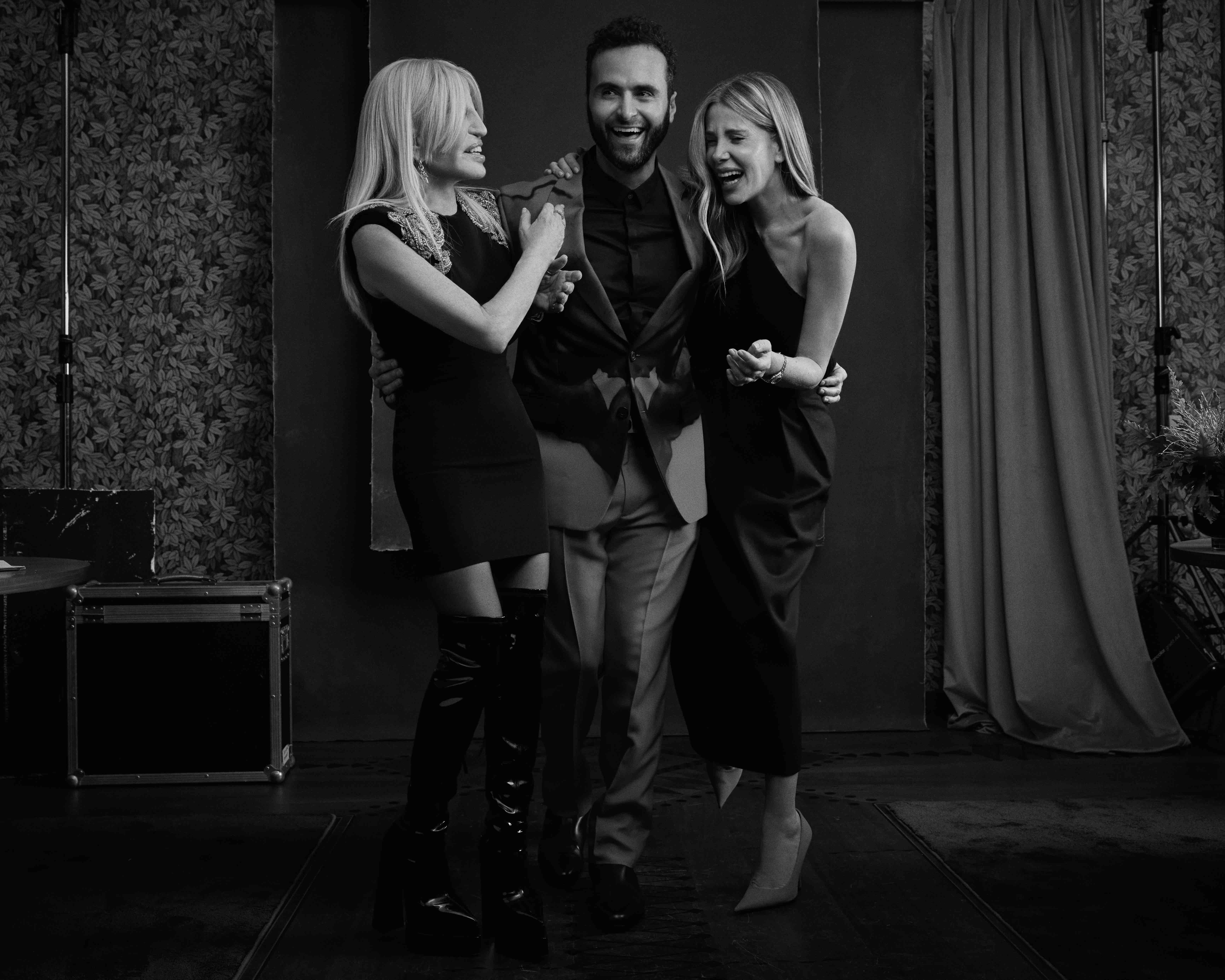
His career also took him to Elie Saab and, in 2020, Dolce & Gabbana. Across those houses, the task required understanding the people on both sides of a proposed appearance. A designer has a collection and an idea of who might express it. A celebrity has preferences, commitments and collaborators. A successful introduction has to survive all of them.
The friendship with a needle in it
Di Rosa dates his friendship with Sharon Stone to a 2007 Los Angeles tribute marking ten years since Gianni Versace's death. During a fitting, a seamstress was struggling to secure a gold chain on Stone's outfit. Stone took the needle and fixed it herself. Di Rosa remembers their exchanged glance as the beginning of a connection that continued through conversations and calls over the years.
The detail is worth keeping. A relationship that would eventually help prompt his own business began with somebody solving a small, awkward problem. In the machinery around a famous person, competence can be a particularly attractive social quality. So can knowing when to let the person handle the needle.
“I love to cook and they wanted to relax.”
Lucio Di Rosa, on hosting guests after the Milan shows
His fondness for hosting gave those relationships another place to exist. Dinner removed some of the ceremony surrounding a professional encounter. Years later, when Stone suggested taking the atmosphere to California, she was pointing to something he was already doing. LDR22 would give that habit a business address.
Three cities, with room to sit down
Look at the New York showroom and the domestic argument becomes visible. Clothing rails stand against patterned walls. A curved ochre sofa takes up an unapologetic amount of space. Books and flowers occupy a low table. The garments are present, but the furniture has clearly negotiated a substantial share of the lease.
Di Rosa personally curated the agency's spaces, including a collaboration with Fornasetti. They make his interest in interiors tangible. Taste is often something a communications adviser asks a client to take on trust. Here, a visitor can walk around it. The choices offer an introduction before he has explained a strategy or opened a rail.
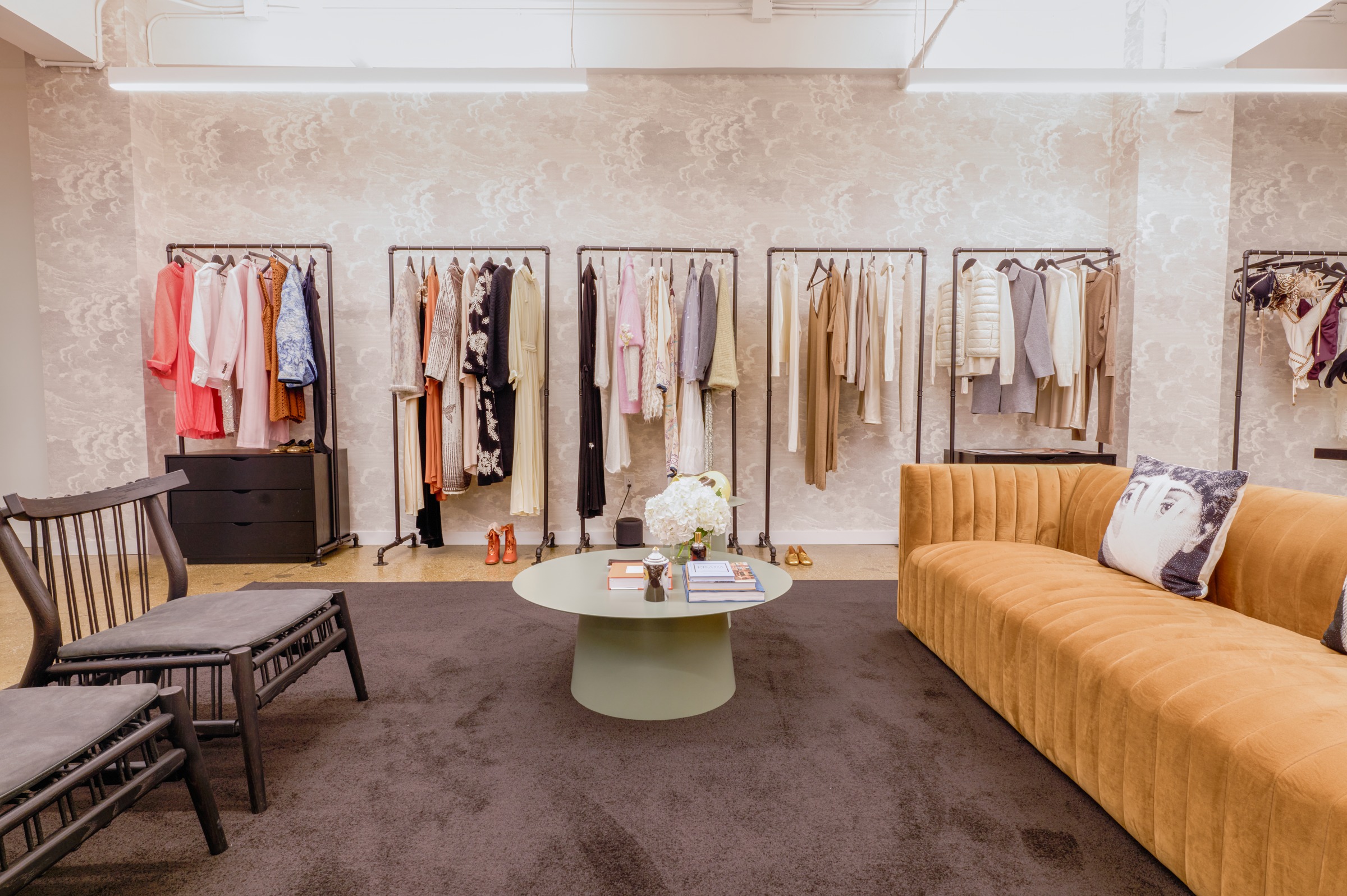
New York joined the business in May 2025, following Los Angeles and Milan. For Di Rosa, it was familiar ground from his years working in the United States. He has described Los Angeles as his first American home and New York as a second. The expansion brought the agency into another city where fashion and entertainment repeatedly cross paths.
Three showrooms. Two countries. One recognisable taste.
What he learned to leave on the wall
Art had a place in his life before fashion became his work. His grandfather, Attilio Di Rosa, was a painter whose pictures filled the family homes. Later, spending time in Gianni Versace's Milan house sharpened his curiosity. Ancient objects, architectural decoration and modern life occupied the same rooms. It offered an education in how apparently separate things could belong together.
In Milan, LDR22 occupies rooms in Palazzo Meli Lupi di Soragna, a space previously used by Galleria Milano. Di Rosa brought in curator Jessica Tanghetti for the Art Glance programme. Its opening exhibition featured Mattia Bosco. The building's earlier life as a place for art gave the fashion business a neighbour already living under its roof.
Subsequent exhibitions made the commitment more concrete. David Begbie's sculptural work appeared in Steel Lives in 2024, in collaboration with Cris Contini Contemporary. In December 2025, the programme presented photographer Bastiaan Woudt's Into Details, with MC2gallery and Tanghetti. These were named exhibitions with artists and curatorial partners, giving visitors reasons to look beyond the clothes.
Di Rosa's collecting is personal, too. He has described artworks as markers of particular stages in his life. A work by Quayola reached his collection through a connection involving his brother; he has also discussed acquiring Sophie Ko's work. The interest helps explain why an office designed around his own taste would struggle to remain merely an office.
The discipline behind the invitation
There are commercial limits to this sociability. Di Rosa has explained that he studies a prospective brand's potential, its ambitions and where it belongs before working with it. A small label may have only a handful of dresses. Selecting the right piece and the right person matters when there is little product to spare.
LDR22's work now includes press, campaigns, events and digital strategy alongside celebrity dressing. That range puts the introduction inside a longer sequence: deciding what a brand wants to communicate, finding collaborators, producing material, and following through after an appearance. The room may encourage a visitor to settle in; the business still has to know what happens next.
His observations in 2026 also acknowledge a faster marketplace. He has discussed celebrity agreements becoming shorter, sometimes covering a month or a single evening. A carefully developed relationship operates alongside a public appetite that moves quickly. For someone whose professional education began before today's social platforms, that change is part of the job.
In October 2026, he was among the guests at Falconeri's New York gathering at the Peter Brant Foundation, an evening bringing cashmere together with art and design. It is a fitting intersection for his interests. His career has repeatedly moved between the making of an object and the people invited to encounter it.
The young Di Rosa called a switchboard to hear the world he hoped to enter. The founder has spent considerable effort deciding what happens when somebody enters his own. There should be something to look at, somewhere to sit and a reason to keep talking. He has built the rooms accordingly.
Keep the conversation going
- His early fashion ambitions and the founding idea, in conversation with Vogue Italia
- On mentorship, small brands and hospitality: the L’Officiel Italia interview
- A conversation about collecting and the Milan space, with exibart
- The New York opening, in L’Officiel
- Watch Di Rosa tour the Milan showroom
- Galleria Falconeri in New York, October 2026