Louis Summe was being invited to look back when he stopped to fix the arithmetic. In an April 2021 conversation about LiveVox, the interviewer described a company journey of roughly sixteen years. Summe made it twenty. Before discussing a public listing, market opportunity or the next round of investment, he wanted those extra years put back.
It is a small moment, but a useful entrance to his career. A contact-center software company does not usually arrive with a story people can tell over dinner. It arrives through procurement, implementation and the steady business of making a telephone call lead somewhere useful. Summe had spent a considerable portion of his working life inside those mechanics. Four missing years were quite a lot of mechanics.
By then, LiveVox was preparing to enter the public markets through a combination with Crescent Acquisition Corp. Summe, its co-founder and CEO, had a larger platform to explain. The business had grown beyond its early voice services into software connecting communications, customer information and workforce tools. To understand the route, though, it helps to begin with a less glamorous destination: a collections operation.
The customers who set the terms
Collection agencies were LiveVox’s foundational market. Summe described them as customers who pressed the company on compliance, security and scalability. Their requirements helped shape what the software had to withstand. For a young technology business, a demanding customer can function as a rather severe curriculum. The examinations arrive during working hours, and the customer expects the system to keep running throughout.
An early description of LiveVox already contains much of the problem Summe would keep working on. Managers wanted to see and allocate resources across several locations, including operations run by outside partners. The company offered hosted voice applications that could work with existing infrastructure. Customers could decide when to retain or replace other systems according to their own plans.
That last detail matters. Buying new technology can oblige an organization to rearrange itself around the purchase. Summe was describing a way to introduce capabilities while allowing customers to keep control over the surrounding machinery. There is a certain courtesy in software that does not demand a complete change of furniture before agreeing to be useful.
His preparation combined technical and commercial work. He earned a bachelor’s degree in physics at Xavier University and an MBA at Columbia. His early career included EDS and Merck-Medco, followed by a vice presidency covering product and business development at Physicians Online from 1997 to 2000. Product and business development would remain closely connected in the company he helped build.

A wider job for the same company
In March 2014, LiveVox announced a majority investment from Golden Gate Capital. The announcement described plans to expand products, services, infrastructure and partnerships. A business associated with outbound voice had the backing to pursue a wider set of uses. The company would continue operating independently within the investor’s portfolio.
There was an interesting turn in the investment story. Golden Gate had initially considered LiveVox as a cloud platform for another contact-center business it owned. Further examination persuaded the firm to invest in LiveVox on its own. What began as a possible supporting part became a standalone investment. Even in enterprise software, casting decisions can change.
The strategy laid out afterward was specific: develop the broader contact-center platform, extend into customer care and telesales, and reach enterprise customers. That meant expanding the job the software could do. A business built around calls needed to handle more of the work surrounding a conversation, from the information an agent sees to the tools a supervisor uses.
By 2022, Summe described three previously separate areas brought together: communication channels, customer relationship management and workforce engagement management. The common data model was central to the argument. A conversation changes shape when the person answering can see its history. A manager’s decisions change when relevant information can be reached without a separate expedition through another system.
His practical ambition was to reduce the complexity of implementing and optimizing contact-center technology. It is a brief enough objective to survive a meeting. It also sets a demanding standard. A system can become more capable while becoming harder to use. Keeping capability and usability moving together is work that continues long after a product announcement.
We reduce complexity in contact center technology implementation and optimization.
Louis Summe, 2022
The public moment, and the years behind it
LiveVox completed its combination with Crescent on June 18, 2021. The transaction brought net cash proceeds of $157.4 million after transaction costs. A public listing gave the company another way to finance its next stage. For Summe, the milestone followed years of building a business whose essential work often happened far from public attention.
When asked later which company accomplishment made him proudest, he chose going public in the second quarter of 2021. He credited employees, customers and partners. The answer brings the company’s long development into view: a listing date can sit neatly on a calendar, while the labor that makes it possible spreads across years and many people.
LiveVox completes its combination with Crescent Acquisition Corp.
The public-company version of LiveVox still had to solve ordinary adoption problems. In discussing its future, Summe emphasized making customer information accessible to agents, including information gathered through automated interactions. A person moving between voice, email and text should remain recognizable to the business. The objective was continuity across those changes of channel.
He also expected contact centers to combine remote and on-site work. That expectation placed fresh importance on shared information and tools that managers could use across locations. An office had once supplied proximity almost by default. A distributed operation needed more deliberate ways to give people context, feedback and a common view of their work.
A company needs room to think
Summe built LiveVox with fellow founder Larry Siegel. Their concern extended to how the organization would behave as it grew. They had worked in large technology firms and wanted to preserve an entrepreneurial culture. The principles they developed became known inside the company as the LiveVox Way, intended to guide decisions about work, investment and collaboration.
The phrase sounds comfortably corporate until one considers the difficulty underneath it. Efficiency rewards repeatability. New ideas require room for things that have not yet become repeatable. A growing business needs both. The founders’ stated intention was to keep the search for new approaches alive while building an organization capable of delivering its existing commitments.
The company’s description of its work paired customer experience with agent experience, risk mitigation and ease of use. Those priorities brought the employee into the same picture as the buyer. An agent spends a working day inside the software. Making that day less cumbersome is part of the product’s purpose, alongside helping the organization handle its customers.
Another chair, a familiar problem
On November 1, 2022, John DiLullo succeeded Summe as LiveVox CEO. Summe continued into a board role, with the company’s later proxy recording his vice chairmanship from January 2023. After a long run in the chief executive’s seat, he described an interest in returning to entrepreneurial work while continuing to support products and technology.
VanillaSoft announced him as executive chairman in September 2023, alongside a growth investment from Tritium Partners. The company’s work sat in adjacent territory: helping sales and fundraising teams manage engagement and follow-up. Summe said he would help prioritize expansion opportunities across emerging businesses and large enterprises. AI adoption formed part of the opportunity he described.
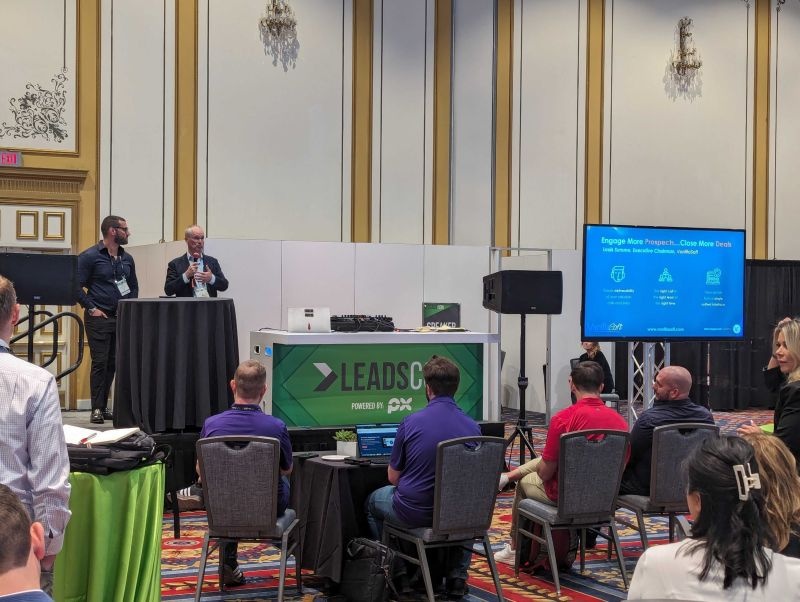
In April 2024, VanillaSoft featured him speaking at LeadsCon with Seth Dorne. The photograph has the familiar furniture of a business conference: a screen, a microphone, seated listeners and laptops. The setting suits the work. Software eventually has to be explained to people who have a day’s responsibilities waiting when the presentation ends.
LiveVox itself entered a different chapter. NICE announced the completion of its acquisition in December 2023, bringing the business into a larger customer-experience software group. Summe had already handed over the CEO role. The company’s subsequent ownership story belongs alongside his career, with the dates kept in their proper order.
In January 2026, Aspect announced his appointment to its independent board. The announcement identified him as based in San Francisco and still serving as VanillaSoft’s executive chairman. Aspect’s workforce-management focus brought another part of the contact-center operation into his board work: organizing the people and schedules behind the interactions.
Read together, these roles suggest a career held together by a recurring practical question: how can a business make it easier for people to communicate and do the work around that communication? The answer has taken different forms as the technology changed. Summe has approached it through voice services, a broader software platform, an executive chairmanship and board service. The vocabulary has become newer. The person trying to get something done still needs the system to help.