Consider a familiar customer-service puzzle. You send an email, receive a text, then call. The person who answers knows nothing about either message. Three channels have produced three beginnings. LiveVox built software around the idea that this discontinuity is fixable. Put the customer’s record beside the conversation. Let the next agent see what happened before. It sounds almost embarrassingly reasonable. Yet the architecture needed to make it happen became a business large enough to interest NICE, which completed its acquisition of LiveVox in December 2023.
- Cloud software for inbound service and proactive outbound contact.
- Voice, SMS, email and chat connected to a native customer record.
- A history in collections and regulated outreach; now part of NICE.
The missing piece was the memory
LiveVox’s roots run through co-founders Louis Summe and Laurence Siegel. Public company materials commonly use 2000 as the founding year; SEC biographies trace the predecessor to 1998. The enduring problem was the collection of disconnected applications between a customer and someone trying to help. Its answer grew into contact center software delivered through the cloud, combining communications with customer relationship management and workforce tools.
For an operator, this means handling incoming calls, organizing outbound campaigns, offering digital conversations and giving supervisors tools to review performance. Its customers include enterprises, business process outsourcers and collections organizations. Public case studies name First National Bank of Omaha, Hunter Warfield and Eastern Account Systems. This is operational software for teams whose working day consists of thousands of small interactions.
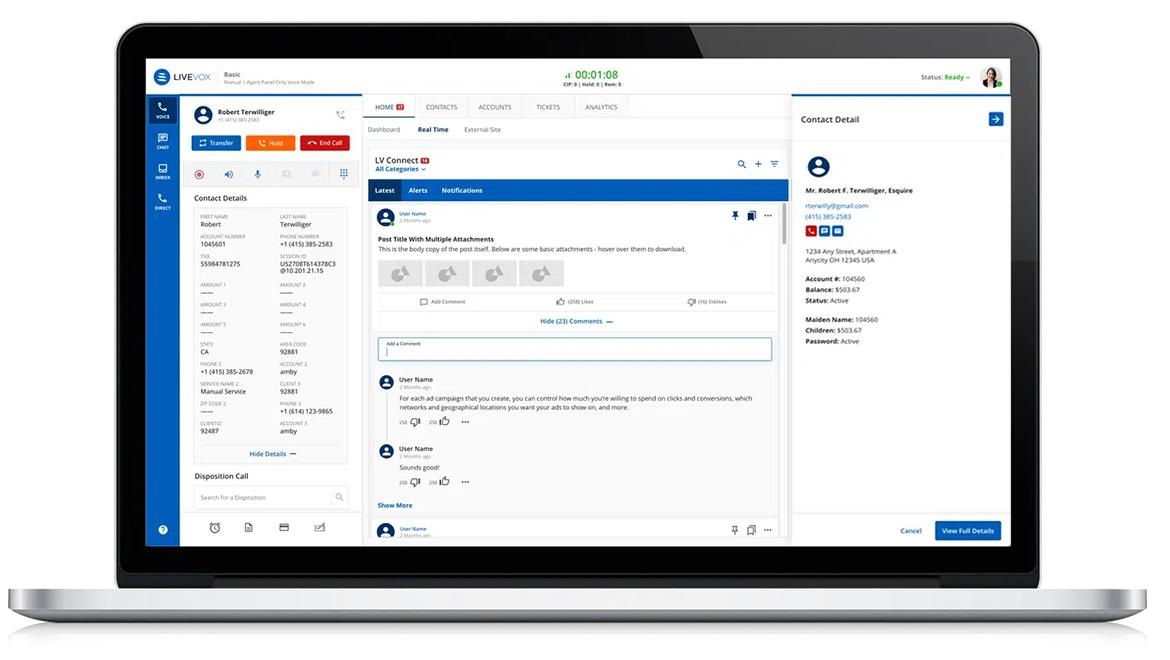
The CRM is the connective tissue. LiveVox’s product brief describes universal customer profiles bringing interaction data together across channels. Scripts and screen pops place relevant information in front of agents. Customer preferences can follow the record into later campaigns. The platform can sit alongside an existing CRM, allowing a business to connect its systems without first replacing its established system of record.
Conceptual illustration of the platform’s data flow.
That matters particularly in outbound work. A customer changing a channel preference creates information the next campaign needs. LiveVox built preference and consent tracking into its workflows. The attraction is coordination: a change made during one interaction can inform another. Controls still need appropriate configuration and operating procedures. Buying the software does not settle every compliance question.
A report can count calls and still miss the point
There is a revealing episode in LiveVox’s analytics history. Initially, its reports concentrated on voice measures such as volume and handle time, then expanded into agent activity. GoodData’s account describes the limitation: some customers needed to investigate questions that pre-packaged reports could not answer. In 2016, LiveVox recognized demand for deeper reporting and self-service analysis.
The response was to work with GoodData and bring more datasets into the picture, including digital interactions, CRM information and workforce data. Customers could build dashboards around their own operations. The shift illustrates a product decision worth copying: listen when the standard report becomes the thing users must work around. The next useful feature may be the ability to ask a different question.
“Everyone manages their center differently but you can still benefit from the collective experience of our entire customer base.”
Brian Backer · LiveVox analytics leader · 2022
Other tools extend that feedback loop. SpeechIQ analyzes interactions to help supervisors identify risks and coaching opportunities. Workforce engagement tools address quality and performance. Virtual agents and bots handle automated exchanges. Their value depends on the surrounding operation: useful account data, sensible routing and a human handoff when the automated path runs out.

Growth had a bill attached
LiveVox historically sold through contracts typically lasting one to three years, with minimum monthly usage commitments. Depending on the service, charges could be based on minutes, calls or agents, with additional consumption above the minimum. That structure makes workload important. A buyer needs to model busy periods, quieter months and the mix of services before judging the bill.
The company’s own economics offer a second caution. Revenue reached $136.0 million in 2022, up 14.1%, while net loss was $37.5 million. Fourth-quarter adjusted EBITDA turned positive at $0.5 million, but the quarter still carried a $5.9 million net loss. The distinction matters: an improving operating measure is useful evidence, and it has limits.
Reported fiscal 2022 results, rounded. Revenue and net loss measure different things.
The outbound skill that NICE wanted
LiveVox became publicly traded through its 2021 combination with Crescent Acquisition Corp, announced as an $840 million transaction. By October 2023, NICE had agreed to acquire it for $3.74 cash per common share. The deal closed that December. NICE’s subsequent annual filing recorded total consideration of $424.117 million. Those figures describe different transactions and measures; they should not be stacked into a funding total.
NICE’s stated rationale centered on combining its CXone platform with LiveVox’s proactive outreach. Earlier in 2023, LiveVox had also announced an integration with CGI’s CACS X debt management system, connecting collections data with contact center workflows. Both moves point toward the same specialty: starting a conversation with enough information to make it useful.

Start with the handoff
LiveVox sits in a crowded market alongside alternatives such as Five9, Genesys and Talkdesk. Buyers willing to assemble more themselves can consider developer-oriented options such as Amazon Connect or Twilio. LiveVox’s case rests on bringing outbound expertise, channels, records and workforce tools together. Its former website now leads to NICE’s proactive outbound engagement page, while dedicated LiveVox support resources remain available.
The practical test is refreshingly small. Follow one customer from an email into a call. Check what the agent sees, whether a changed preference survives, and what the supervisor can measure afterward. Start with a pilot. If records cannot be matched or integrations leave gaps, adding another channel will preserve the confusion. The useful lesson in LiveVox’s story is to inspect the handoff. That is where an organization reveals what it remembers.