At an airport, lunch must survive indignity. It is jostled through security, balanced above a suitcase and opened beside a stranger. Lorena Cantarovici has spent much of her life preparing a food for precisely this assignment, though she began long before Denver International Airport gave Maria Empanada a place near Gate A24. An empanada carries its own plate. It keeps warm. It asks for no fork. In Cantarovici’s hands, it also carries a family.
The name on the shop belongs to her mother, Maria. The method reaches further back, to the women who cooked around Cantarovici in Argentina and taught her to begin when she was four. The founder herself came to food by an indirect route. She studied accounting, worked full time, became a young branch manager in Argentine banking, later audited banks in Mexico and earned a master’s degree in marketing. Finance gave her a respect for controls. Family gave her a taste worth controlling.
She came to Denver around 2000, initially expecting to improve her English and stay only a few months. The city interrupted the itinerary. She arrived at night. Morning revealed the mountains, and she stayed. Without fluent English, she worked her way through restaurant jobs from dishwasher to busser to server. Each job offered a different view of the same machine: how plates move, how a room turns over, how hospitality sounds before one knows every word.
The window full of corn
By 2010, necessity sharpened an old memory. Cantarovici missed the empanadas that in Argentina appear as readily as pizza when friends gather. She made them for people she knew. A caterer asked for a larger order. Dozens became a hundred, and a hundred suggested that the idea might be sturdy enough for a storefront. Friends and family helped turn the garage into a working kitchen. She took a workshop through a Small Business Development Center, wrote a formal business plan and created operations and employee manuals before she had employees to read them.
The recipes still required negotiation with Colorado. One night, a corn filling kept bursting through the pastry in the oven. Altitude was editing the dough. At one or two in the morning, Cantarovici pulled out another ruined tray, asked the empanadas why they were doing this to her, and threw them at the window. Corn empanadas slid down the glass. The scene acquired humor only after there was a next batch.
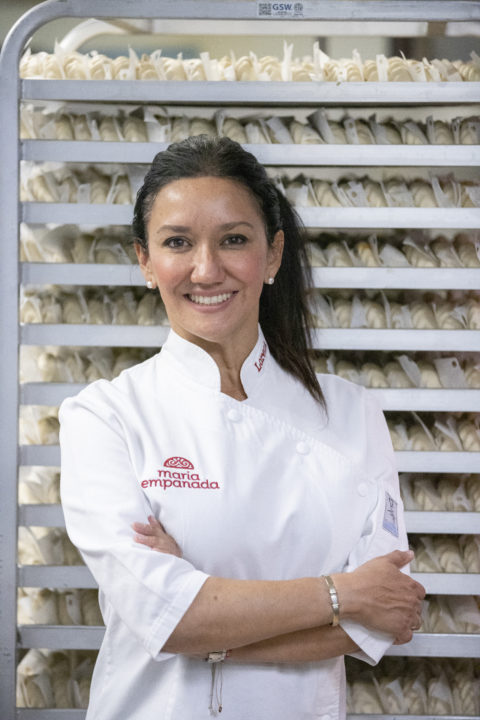
In 2011 she opened a tiny Lakewood shop with three tables and six seats. The address was obscure, and the cultural translation went poorly. Many neighbors knew a sweet Mexican empanada; hers was Argentine and savory. Customers entered with one expectation and left with another. A woman even offered a family recipe that might have fit the neighborhood better. Cantarovici declined to steer away from the food she meant to make.
She tried spectacle instead. Short of marketing money, she put on an empanada costume and danced outside. People thought she was a taco. The joke contains the whole early problem: the product had arrived, but the audience lacked the category. Cantarovici used the shop as a laboratory, testing recipes and methods while selling at events. Victor Arango encountered her at a food truck, heard the story and began helping with marketing, first without pay beyond a persuasive quantity of empanadas.
A recipe changes addresses
Home orders
Lakewood shop
South Broadway
Major funding
Airport gate
A bankable fold
Lenders repeatedly said no. One suggested a Mexican restaurant. The Colorado Enterprise Fund eventually supplied a microloan, and in 2014 Maria Empanada moved to a visible, 3,500-square-foot corner on South Broadway. Customers began saying they had found the shop simply by seeing it. Location accomplished what the costume could not. Within two years, traditional lenders considered the business bankable, and an SBA-backed loan helped open another location.
Recognition followed operations. Food Network brought Guy Fieri to South Broadway in 2015. The U.S. Small Business Administration named Cantarovici Colorado’s Small Business Person of the Year in 2017. That year the Colorado Impact Fund invested $3.5 million. PBS later devoted an episode of Start Up to her story. These moments made the founder visible, yet her most revealing obsession remained at the pastry’s edge.
Every filling has a particular repulgue, the folded seam that lets an experienced customer read an empanada before biting it. Training the hand takes weeks. Machines can close dough faster, but Cantarovici has insisted that the final touch remain human. Slight variations are evidence of authorship. The operating challenge is deliciously awkward: build a repeatable company around an object that should never look entirely repeated.
The edge is an edible label
A simplified look at the visual idea behind repulgues. Maria Empanada uses distinct hand-finished patterns to signal different fillings.
Her banking past turns out to be present tense. Process, systems and manuals were what she carried “in my backpack,” she said in 2026. The craft has a curriculum. New workers learn the catalog of folds, the recipes and a framework for decisions. Her formal business education continued through Goldman Sachs 10,000 Small Businesses at Babson University and Stanford’s Latino Entrepreneur Leaders Program. The lesson from her career is less a pivot from numbers to food than a reunion of the two.
Good vibes, written as procedure
Maria Empanada calls its culture buena onda, good vibes. The phrase risks floating away unless attached to behavior. Here it means eye contact, a welcome, patience while a guest deciphers unfamiliar fillings and a founder who pauses an interview to greet regulars with hugs or blown kisses. A group has met in the restaurant to practice Spanish. The shop sells food, but it also lends Denver a little Argentine social architecture: coffee, conversation and permission to stay.
Cantarovici’s idea of employment carries family history. She has spoken about watching her mother struggle to find work and about deliberately welcoming older women who might otherwise be overlooked. In her formulation, creating jobs is another ingredient, invisible in the pastry but present in how it was made. In November 2025, Maria Empanada baked and donated 6,000 empanadas for five local nonprofits to distribute to 750 families. Community, in this company, tends to arrive by the tray.
The relationships around the company have often begun before a contract made them official. Arango started with unpaid marketing help and later became the brand ambassador. Colorado Enterprise Fund chief Ceyl Prinster backed the move that gave Maria Empanada a visible home, then told Cantarovici when the business had grown ready for a conventional bank. Prinster’s description of the founder holds two temperatures at once: “a force of nature” and “a gentle breeze.” The combination fits a woman who can demand a precise fold, greet a regular with a kiss and laugh at the memory of pastry stuck to glass.
She also teaches. Her master classes turn guests into temporary apprentices, with wine nearby and the repulgue under inspection. During a 2023 visit to Argentina, she led a seminar for entrepreneurs about building an empanada business in the United States. The direction of travel is pleasingly circular. The immigrant who once needed help drafting an American business plan can return home with an operating case study, then come back to Denver and put strangers around a table with dough.
Tradition does not prevent mischief. Cantarovici has paired empanadas with beer and wine, experimented with mango and mozzarella, and more recently embraced fillings such as miso chili crisp steak, roast corn with cotija and an Italian-inspired combination. She calls this a second wave of migration. Spain sent the format to Argentina; Argentina adapted it; Denver receives another revision. Her grandmother, she joked, would kill her over the miso steak. Fortunately for the menu, grandmother is not here to file the complaint.
The founder makes room
By 2025, the company had opened at Denver International Airport, a setting that makes the product logic almost comic in its neatness. No utensils. Quick handoff. Warm filling sealed for a journey. Maria Empanada also began serving soccer crowds at Dick’s Sporting Goods Park. When Lionel Messi’s Inter Miami visited Colorado, the Argentine captain ate the restaurant’s food. Cantarovici had dreamed of handing him the empanadas herself. She missed the meeting but accepted the feeding as a respectable consolation prize.
The organization changed with the route map. Former Snooze executive Andrew Jaffe joined to lead the company as CEO, while Cantarovici remained owner and founder. Her comment about the handoff was strikingly free of founder theater: she had been waiting for someone who knew more than she did about the next stage. After years of proving that bankers had underestimated her, she could choose expertise without treating it as a threat.
The transition clarifies what she means to keep. Maria is her mother. The folds remain handmade. Buena onda remains a cultural pillar. The founder can release a title while guarding the authorship embedded in those choices. Systems, properly built, allow a thing to travel beyond the person who began it.
Cantarovici once said she could not wait to see her mother’s name everywhere. At an airport gate, the sentence stops sounding figurative. Travelers carry Maria onto planes. Soccer supporters take extras home. A dish learned at four, disciplined by banking and corrected at altitude now moves through Denver in small sealed parcels. Each has a different crease. Each knows where it came from.