A table ordered online still has to reach the twenty-second floor. Lokendra Singh Ranawat once offered that Mumbai predicament as an explanation of the furniture business. On a website, a table is a photograph, a price and a few dimensions. In an apartment building, it becomes a negotiation with lifts, doorways and gravity. Gravity has yet to be impressed by a checkout button.
Ranawat’s account of WoodenStreet keeps returning to such practical complications. He and his co-founders began selling furniture online in 2015. Making a promise was comparatively straightforward. Keeping it required designers, carpenters, warehouses, delivery arrangements and people who could install the finished piece. The distance between those two activities became much of his working life.
There was another distance he had already chosen to close: the journey from London back to Udaipur. That decision put him near Rajasthan’s makers and far from some of the usual places a founder went looking for money. It gave the business its starting point, along with a question that still runs through it: how much of the work should you take into your own hands?
The business at the end of the homecoming
Ranawat had worked in IT services in India and Britain before furniture became his occupation. His career included Axis IT&T and Birlasoft UK, with client relationships and sales among his responsibilities. He had trained in electronics and communication at GSET in Jaipur, graduating in 2004. The route from that education to furniture passed through the business of understanding what other people needed.
He also co-founded Cognus, a digital marketing venture. Earlier entrepreneurial experience mattered: WoodenStreet would need to find customers online as well as make something worth buying. His acquaintance with technology was useful, but a wooden table would introduce a different set of tolerances from an online campaign.
Udaipur was his hometown. His father had served in the navy; there was no inherited furniture enterprise waiting for him on his return. He explored opportunities in Rajasthan and met artisans in Jaipur and Jodhpur. Their work suggested a business that could connect local making with demand farther away.
The location came with trade-offs. By 2020, Ranawat was describing frequent trips to Mumbai and Bengaluru to stay connected with other founders, executives and investors. The company also offered satellite offices to people who would not move to Udaipur. Building near the makers did not exempt him from travelling to everybody else.
“It helped being close to my artisans, who were creating all this furniture.”
Lokendra Singh Ranawat · 2020
Four founders, several kinds of experience
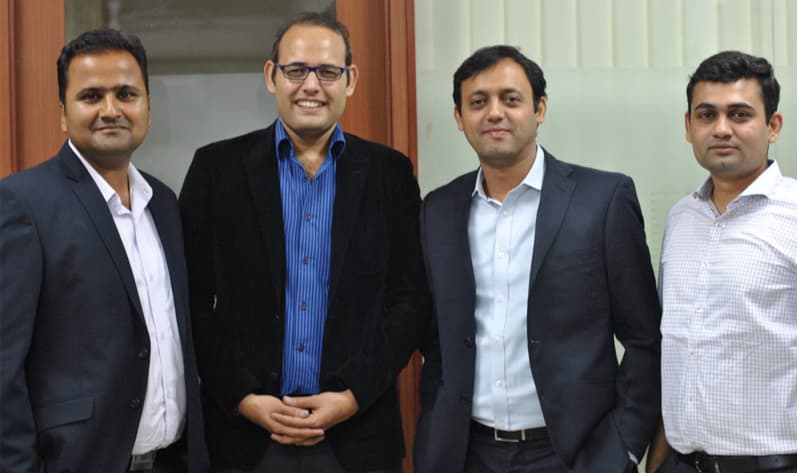
WoodenStreet brought together Ranawat, his brother Virendra Singh Ranawat, his cousin Dinesh Pratap Singh and their friend Vikas Baheti. The family connections were part of the story, alongside a mixture of professional backgrounds. Procurement, management, finance, sales and furniture sourcing all had a place around the table.
Lokendra and Virendra had already worked on Shilpa Mantra, an online handicrafts portal. Dinesh brought experience from P&G and CSC, as well as study at NIT Jaipur and IIM Kozhikode. Vikas had worked at Dell and Vertex and had experience in furniture sourcing and manufacturing. The new venture assembled people who knew different parts of a transaction that would eventually involve all of them.
The early company chose to carry inventory and work closely with production. That meant accepting costs and responsibilities which a lighter intermediary business might leave elsewhere. The founders wanted oversight of the finished furniture and the service around it. Their decisions made quality a matter of operations as well as taste.
Customization gave the proposition its particular shape. A buyer could ask for furniture suited to a room and personal preferences. The attraction is obvious to anyone who has found a nearly suitable cupboard: a few inches can separate a useful purchase from an expensive obstruction. Translating those preferences into something repeatable was the harder task.
The twenty-second-floor test
In 2020, Ranawat described the early trouble with outsourced delivery and returned products. WoodenStreet developed its own logistics support and a dedicated installation team. He put the difficulty plainly: “It gets quite difficult to deliver and install a table on 22nd floor in Mumbai.”
That example explains why his business expanded beyond a catalogue. Delivery and installation could undo the care spent on a design. The customer’s experience continued after the sale, through the wait, the arrival and the point at which the furniture could actually be used.
A custom order also had to travel through people before it travelled through a city. Ranawat described designers working on customer suggestions and carpenters making the resulting piece. Each handover needed enough information to preserve what the customer had asked for. A finish is a small detail until it is the wrong finish.
A simplified view of the responsibilities behind the purchase.
A shop where the screen runs out
WoodenStreet opened its first experience store in Bengaluru in 2016, a year after launch. The timing is revealing. The online venture acquired a physical place where buyers could examine what they were considering. Texture, proportion and the feel of a seat acquired room to make their case.
A store also gives uncertainty somewhere to go. Customers can ask questions, compare finishes and judge scale. For a high-value purchase that will occupy a home for years, that is useful work. The shop becomes part of the buying process even when a screen introduced the product.
The network grew. In November 2020, WoodenStreet had 26 stores across 17 cities. By July 2025, it had 104 stores in India. Those dated snapshots show the change in physical reach without turning a future opening plan into an accomplished fact.
Experience stores in November 2020 and July 2025. The later count is four times the earlier one.
For Ranawat, the multiplication changed the assignment. One store can be watched closely; a network needs people and processes capable of working beyond the founder’s sight. Every new location gives the customer another place to judge the business. It also adds another promise to the production and delivery system.
Capital has to earn its floor space
The financing came in stages: $1 million from Rajasthan Venture Capital Fund in 2018, a $3 million round led by IAN Fund in 2020, and a $30 million Series B led by WestBridge Capital in 2022. In December 2024, WoodenStreet raised ₹354 crore, approximately $43 million, from Premji Invest.
The announced uses of that last round included stores, manufacturing, a wider product range and the supply chain. These are tangible demands on money. A new location needs stock and staff; additional production needs somewhere to happen. The investment story has a floor plan attached.
Expansion also brought financial pressure. WoodenStreet posted a ₹10.9 crore loss in the financial year ending March 2024, after several profitable years. Growth had not abolished the cost of serving the next customer. For a founder taking responsibility for more of the operation, the accounts supplied another measure of how the pieces fitted together.
In July 2025, Ranawat spoke about reaching ₹1,000 crore in revenue and profitability over three years, with a possible public listing ahead. Asked about the prospect of an acquisition, he gave independence a place in his ambition.
“The target is to make it a sustainable and long-term independent brand.”
Lokendra Singh Ranawat · July 2025
Dinner, with a side of pool
A smaller detail offers a less formal introduction to his interests. On a 2016 podcast, Ranawat’s favourite piece of furniture was a dining table that converted into a pool table. It is a pleasing answer from someone selling furniture that adapts to its owner. The dining room could finish one engagement and immediately host another.
His early interviews also show an interest in exchanging ideas with other entrepreneurs. He named LinkedIn, Google Analytics and Google Calendar among the tools he used. The combination is agreeably ordinary: people to talk to, numbers to inspect and a reminder of where to be next. A furniture founder still has meetings.
Outside work, he enjoys spending time with family. Alongside the talk of factories and funding, that detail gives home a meaning beyond the category he sells. A room can contain an expanding market; it can also contain the people with whom he wants to spend an evening.
The next order is a whole home
By late 2025, the business was extending its physical offer into complete interiors. A 10,000-square-foot studio in Marathahalli, Bengaluru, presented model flats, modular kitchens and walk-in closets. A 5,000-square-foot Hyderabad studio followed. The buyer could consider how the pieces worked together in a larger setting.
In April 2026, Ranawat discussed collections built around different design ideas, including Udaipur’s heritage and the Veda collection’s emphasis on balance and minimalism. In May, he described plans to deepen the business in southern India and broaden kitchens, wardrobes and interior solutions. The ₹1,000 crore turnover ambition remained a target, alongside profitability.
The change enlarges his original undertaking. A custom table asks the company to understand an object and its dimensions. A whole home asks it to coordinate rooms, materials and execution. The appeal to a customer is fewer separate arrangements to manage. The operational burden gathers on the other side of that convenience.
Ranawat began with a homecoming and a group of makers. He now talks about furnishing much more of the home. Between those points lie the unglamorous decisions that make the story his: where to base the company, whom to build it with, what to make internally and how far to follow an order. Even an ambition measured in crores must eventually get through a doorway.