A cheese maker has an awkward relationship with the future. Tillamook’s product portfolio includes cheese that can age for up to eight years. By the time a customer decides what to put in a sandwich, someone else has already spent years living with a production decision. A forecast, in this business, has a very long afterlife.
- Logility connects demand forecasts to inventory, supply and order decisions.
- Its buyers are manufacturers, retailers and distributors with networks too complicated to plan casually.
- Tillamook’s published customer story reports 75% less finished goods inventory.
- Aptean took the company private in April 2025.
Eight years is a long time to be wrong
Tillamook was expanding its range and customer base. Its Excel-based planning needed to give way to something that could support that growth. It also wanted a company-wide fill rate of 99%: the ambition to supply almost everything customers ordered. More products, more buyers, slow-aging stock. These are three quite different clocks to keep in time.
Logility’s customer account describes the move to more sophisticated, connected planning and reports a 75% decrease in finished goods inventory. That is a result from a particular customer, rather than a reduction every buyer should pencil into a budget. Still, it gives the software a wonderfully concrete subject. The outcome lives in a warehouse.
Think of inventory as money wearing a label. It can reassure the sales team while troubling the finance team. Too little creates missed orders; too much adds storage costs and the risk of products losing their usefulness. The quantity that makes everyone comfortable is rarely the quantity that makes the whole business efficient.
This is the territory Logility occupies. It sells enterprise software for planning demand, inventory and supply, with tools for network design, scenarios and allocation. Its expertise joins data science to manufacturing and distribution problems. The buyer is paying for a better way to make interdependent decisions.
The forecast has to survive the factory
A forecast says what customers might buy. A supply plan must decide whether the business can actually provide it. Between those two statements sit suppliers, capacity, transport constraints and stock in the wrong place. A useful planning system has to carry an assumption through those obstacles without quietly forgetting them.
DemandAI+ is Logility’s forecasting offering. Its demand-driver view lets planners examine events and promotions; anomaly detection flags unusual history for review. Demand sensing brings shorter-term market signals into the picture. That matters because an exceptional sales spike should not automatically become next year’s ordinary expectation.
InventoryAI+ addresses the next question: how much stock should exist at each stage? Its multi-echelon approach considers raw materials, work in process and finished goods together. In plain English, one warehouse’s comfort blanket can change what another location needs. Optimizing every location separately can leave the network with a remarkably expensive collection of locally sensible decisions.
Illustrative index: before = 100. A 75% reduction leaves 25. Vendor-published customer result; absolute quantities and timing are not plotted.
Supply optimization turns demand into purchase, production and distribution plans that account for operating constraints. Scenario planning lets teams compare alternatives. Sales and operations planning, usually abbreviated to S&OP, helps align resources with commercial goals. The practical appeal is that changing one assumption can be considered alongside its consequences elsewhere.
Then there is the uncomfortable final question: who gets the available stock? Intelligent Order Response automates allocation within the fulfillment window and surfaces recommendations when demand and supply disagree. Logility also offers allocation rules and workflows for placing merchandise across locations and channels. A shortage requires a policy, even when nobody enjoys writing it.
The warehouse is where the argument lands
The customers are businesses with physical products and complicated routes to market: food and beverage companies, consumer goods makers, industrial manufacturers, apparel businesses, retailers and distributors. A cheese producer’s aging problem differs from a component distributor’s assortment problem. The software’s value depends on representing those differences.
Farnell’s customer story provides a useful second view. The electronics and maintenance-products distributor wanted to cross-sell across businesses, let orders draw from multiple warehouses and support new warehouse locations. The published account reports a 5% inventory reduction while improving customer service. Here, coordinating a network was central to the problem.
Reynolds Consumer Products offers another version. Its Logility account describes a move from disparate systems to a shared digital platform, with improvements to forecasting and reductions in inventory and freight costs. The common thread is coordination: a forecast has more value when the people ordering, making and moving goods can work from it.
“Building more accurate and more granular forecasts has allowed the supply chain team to have more credible conversations”
Brad Blasi / Tillamook demand planning manager
That observation gets close to the organizational problem. A number becomes useful when colleagues trust it enough to make a commitment. A shared plan gives people something specific to dispute: an assumption, a demand driver, a capacity limit. Disagreement can become a decision instead of another spreadsheet attachment.
A chat window meets a physical constraint
Logility’s AI portfolio includes forecasting and optimization as well as conversational tools. Logility Expert Advisor, or LEA, provides a conversational interface for supply chain information. It received the AI Breakthrough program’s supply chain solution award in June 2025. The proposed benefit is easier access to relevant answers for people who do not want to navigate every report.
Its current platform pages also describe vertical AI, AppCentral and an Orchestration Center that connects signals, decision logic, governance and execution. Read these offerings through the work they promise to support: finding a problem, considering a response and coordinating action. A fluent answer is useful only if the underlying inventory and capacity information is dependable.
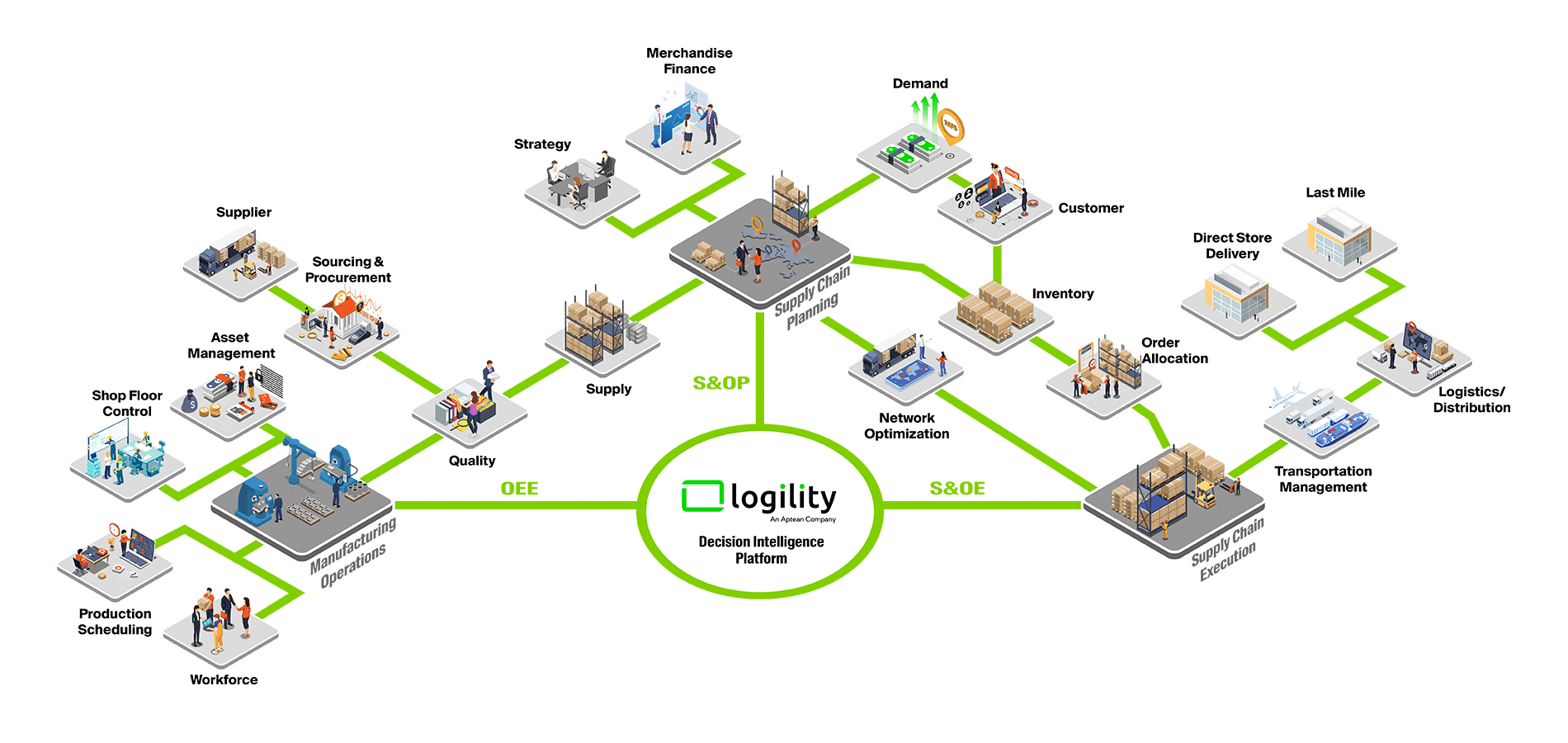
Its competitive pitch is breadth: planning functions, inventory optimization, scenarios and allocation within a connected portfolio. Alternatives include Blue Yonder, Kinaxis, o9 Solutions and OMP, along with planning tools from SAP and Oracle. AI alone offers little basis for choosing among them. A prospective buyer needs to test its own products, constraints and existing systems.
Logility’s data-management offering includes standardized connectors and transformation tools. Those connections matter because enterprise planning must coexist with the systems recording orders, materials and transactions. For a buyer, the revealing demonstration is an awkward real example: a delayed supplier, an unreliable lead time, an item that sells intermittently.
The subscription has a history
There are two beginnings to keep straight. The Logility operating business was incorporated in 1996. American Software, its former parent, traces its origins to 1970, when James C. Edenfield and Thomas L. Newberry IV formed its predecessor. In October 2024, American Software adopted the name Logility Supply Chain Solutions. The brand and the corporate lineage run on different clocks, too.
The business model combines SaaS subscriptions with professional services and legacy license and maintenance revenue. The then-parent’s fiscal 2024 filing reported $102.515 million in continuing-operations revenue; subscriptions accounted for 54%. Those are historical corporate figures, not a current estimate for the private business.
For customers, the cost calculation extends beyond the subscription. Implementation, integration, staff training and the work of changing planning practices belong in the business case. The fiscal 2024 filing describes subscription contracts typically lasting three to five years. A purchase therefore deserves a measured operational test and a contract-specific budget.
Logility supplies advisory and data science services, support and training. Its Microsoft Azure collaboration brought the platform to Azure Marketplace in 2021. A January 2025 alliance with Proudfoot Consulting paired planning technology with operational consulting for manufacturing and minerals. These relationships acknowledge that installing software and changing how a business operates are separate pieces of work.
Aptean completed its acquisition on April 4, 2025. Logility became a wholly owned subsidiary and left the public market. The combination places its planning business inside a wider enterprise software company serving manufacturers and distributors. The transaction is an ownership event; customers still have to judge the product by what it helps them accomplish.
Borrow the decision, then buy the software
The lesson a reader can copy begins before procurement. Choose a decision that repeatedly causes trouble: safety stock, a promotion forecast, an allocation rule. Establish the current result and the service commitment it must preserve. Bring the relevant teams into the same conversation, then test whether a connected plan changes their actions.
The order of that work matters. Inventory can fall because planning improves, but it can also fall because orders go unfilled. A useful evaluation watches service, inventory and operating cost together. For a long-aging product, it must also respect the time required to make the goods. An attractive short-term result can conceal a future shortage.
There are clear limits. Poor data can spoil the calculation. Teams can keep using different assumptions after the new system arrives. A forecast can identify demand that a constrained supplier cannot satisfy. These are reasons to test data, decision ownership and feasibility alongside the interface. Logility’s strongest case is a business complex enough to need those connections, with people prepared to act on them.
The cheese will still take its time. The planner’s opportunity is to understand the consequences sooner.