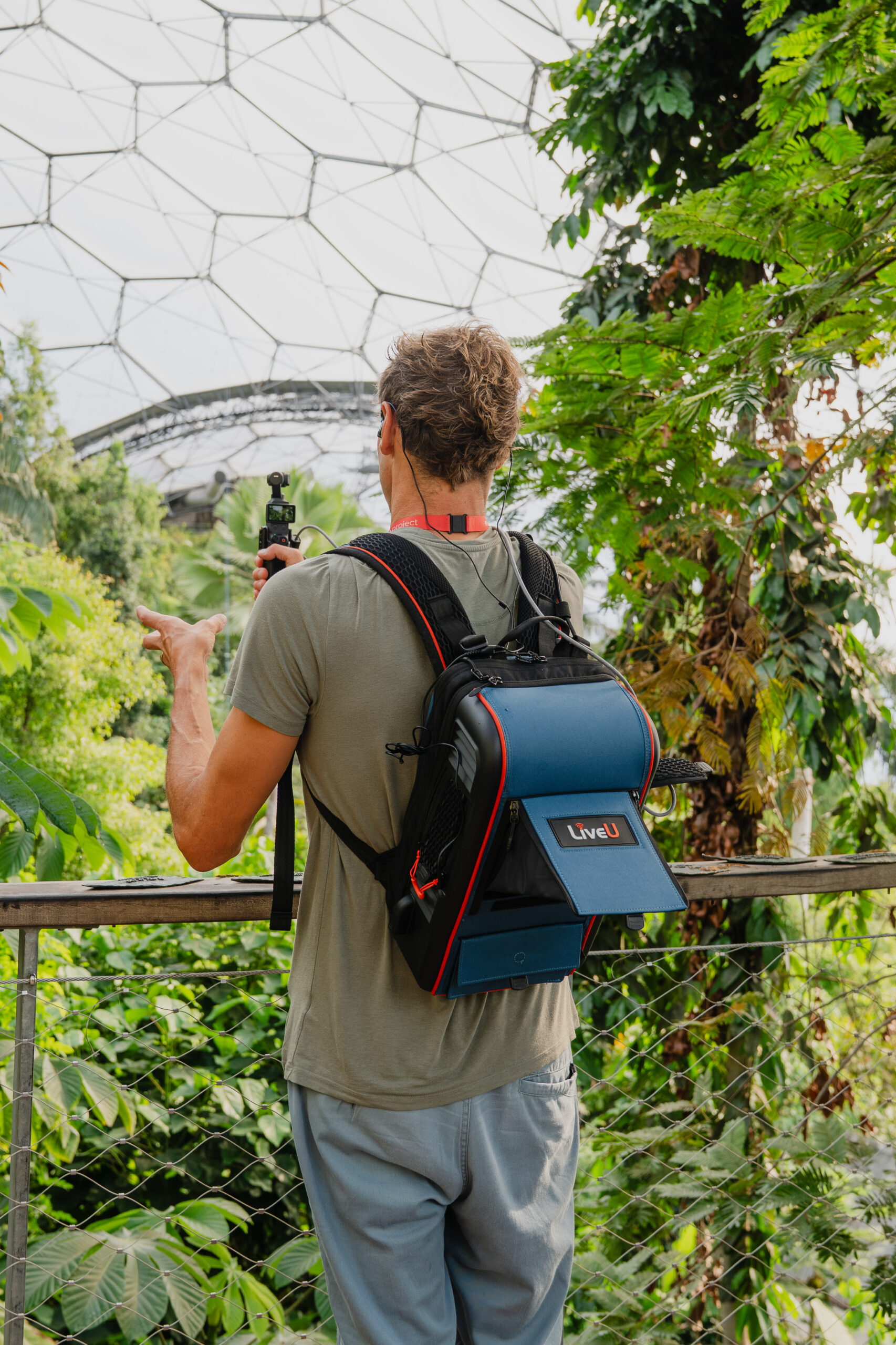
The Eden Project had a classroom problem. Its lessons could travel from Cornwall to children overseas, but the presenters could not reliably travel around their own site. A phone and existing Wi-Fi had helped reach more than 75,000 young viewers in 2025. The connection was inconsistent. The rainforest had more to show than the network could comfortably carry.
- Carry the connection. Portable encoders send live video over several network paths.
- Keep production elsewhere. Pictures can reach a control room or a browser-based studio.
- Budget beyond the backpack. Hardware, data, cloud tools and support all belong in the calculation.
In October 2026, Eden described its new arrangement: a LiveU LU900Q, cloud production through LiveU Studio, and Audio Connect for conversation between colleagues. Anniversary funding and a successful proof of concept made the upgrade possible. The important change was freedom to teach from more of the site.
Give the picture several ways home
LiveU’s founding question was about a different kind of luggage. In the company’s account, engineer Avi Cohen noticed satellite trucks outside a football stadium in 2006. He had computing power and cellular service in his pocket. Why did getting pictures out require so much equipment parked outside?
Cohen co-founded LiveU with Samuel Wasserman and Rony Ohayon. Their answer involved cellular bonding: combine several connections into one managed route for video. A camera operator could carry a transmitter instead of depending on a truck for the uplink. That changed the logistics of reaching a story.
The difficult part is making an untidy network behave predictably. LiveU’s proprietary Reliable Transport protocol, LRT, orders packets, requests missing data again, applies error correction and adjusts the encoding bitrate. Several paths supply capacity; the protocol manages the complications of using them together.
One feed. More ways through.
Available links work together to carry the video.
Illustrative model, not a speed test. Continuity depends on remaining capacity and configuration.LiveU IQ adds a separate decision: which operators should those connections use? It uses eSIMs and network performance data to switch operators as conditions change. Bonding joins the paths. IQ changes the available mix. Neither removes the need for usable bandwidth.
A camera is only the beginning
A newsroom wants a clean feed. A sports producer may need several synchronized cameras, communication with operators, graphics and a return picture. LiveU sells equipment and services around those jobs. The LU800 handles multi-camera field production; the newer LU900Q incorporates IQ and supports two camera feeds. Solo PRO serves smaller crews and creators.
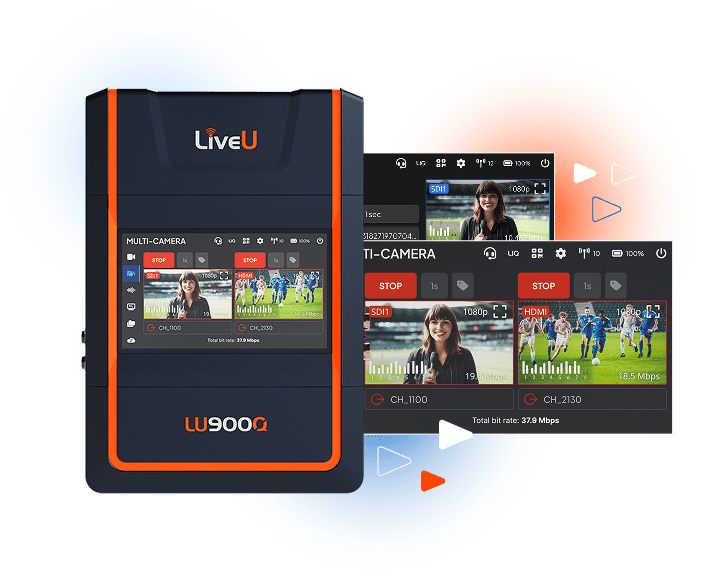
Further along, Studio handles production in a browser. Matrix distributes feeds. Ingest records incoming material and attaches story metadata. Actus Digital, whose business and technology LiveU acquired in May 2025, adds monitoring and compliance logging. These products let the company sell more of the journey between capturing a picture and knowing what happened to it.
This expansion has a history. LiveU bought browser-based production company easylive.io in 2022; Studio followed in 2023. The acquisition brought switching, audio mixing and graphics closer to the arriving field feeds, giving customers another way to assemble a show.
The Associated Press provides a concrete example. Its September 2026 announcement described a rollout taking its LiveU fleet beyond 100 encoders, alongside Ingest, transceivers and IQ. Ingest was integrated with AP’s cloud media asset management system, supporting up to ten simultaneous live channels. Faster transmission becomes more useful when the newsroom can find and distribute the material promptly.
Encoders in AP’s planned global LiveU fleet after the rollout announced in September 2026.
There are direct alternatives. TVU Networks also supplies bonded cellular transmitters and cloud workflows. LiveU’s pitch rests on its LRT-based system, hardware, services and integrations. Buyers are choosing a working production chain, with a competitor’s complete setup among the sensible comparisons.
Its April 2026 Sony collaboration follows a related thread: transferring native camera files through supported LiveU units, starting with the LU300S. Live footage and recorded files have different newsroom uses. Supporting both gives a crew more options for getting its work back while using familiar cameras.
What the crowd does to the plan
At the Tour de France, CRD Audiovisuel wanted more coverage from stage starts: mechanics, paddocks and conversations around the race. Earlier plans had been constrained by limited connections and competing demand from spectators and media. In LiveU’s October 2026 account, CRD used the LU900Q and IQ over public 4G/5G networks.
“We had exactly zero problems.”
Stéphane Reibre / Managing Director, CRD Audiovisuel
On this Tour de France deployment, October 2026
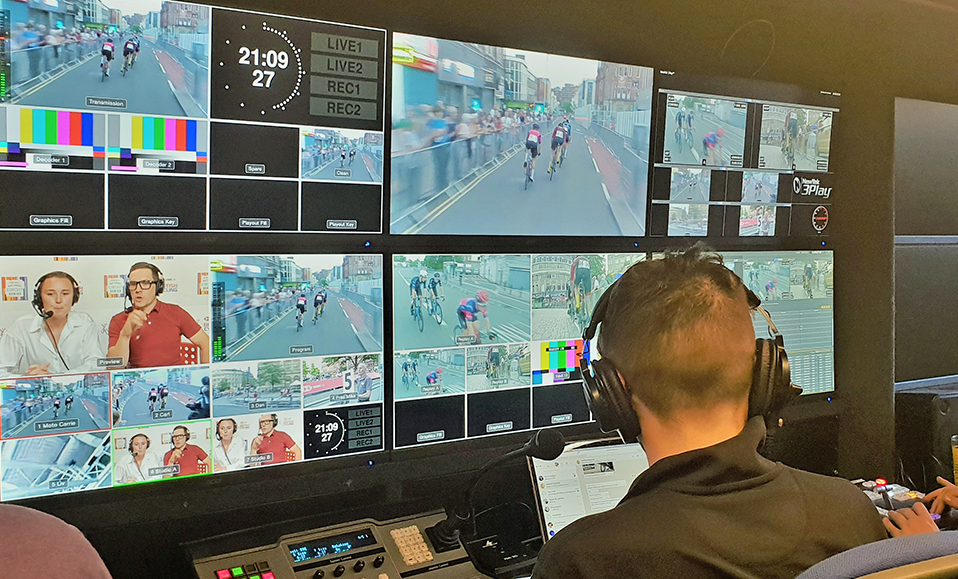
That is a customer’s report about one deployment. Its useful lesson is narrower than a promise of universal coverage: adapt the connection mix to the location. Another LiveU customer, Cyclevox, used five to seven units for British Cycling coverage, including one on a motorbike, with production handled through a remote gallery.
The bill follows the workflow
LiveU makes money through equipment and services. Its official Solo PRO landing page advertises HDMI hardware starting at $1,555; distributor Broadfield lists $1,795. Neither number buys an entire broadcast operation. Bonding subscriptions, modems, mobile data, receiving infrastructure and production tools can add to the bill. Studio offers usage-based purchasing.
The business grew large enough to attract successive private equity owners. A $27 million financing in 2012 brought disclosed cumulative fundraising to about $50 million. Francisco Partners and IGP acquired a majority in 2019. Carlyle announced its acquisition in 2021, when annual sales had passed $100 million. Official terms were undisclosed; the widely reported $400 million sale figure is historical deal reporting.
Buy the missing connection
The practical starting point is a site test. Identify where video stops being dependable, how much delay the production allows, and whether alternative paths really fail independently. Check power, receiving systems and crew communication. A presenter who cannot hear a producer still has a production problem, even with a clean picture.
When every available network loses usable capacity, bonding has nothing left to combine. Fiber, satellite or a different production plan may be needed. LiveU’s attraction is the coverage it makes practical with less equipment on location. For the people carrying cameras, that can mean permission to walk a little farther.