A flame moves through France. The pictures follow it. For the viewer, this is the ordinary promise of live television: something happens elsewhere, and a screen makes it present. For Paul Shen, the interesting question concerns everything travelling behind the flame. How many people? How much equipment? How much of a television operation must physically accompany the thing it wants to show?
In 2024, France Télévisions worked with his company, TVU Networks, to cover the Olympic torch relay using cloud production, mobile connectivity and Starlink. Production could be directed remotely from the broadcaster’s headquarters. The event supplied an unusually public test of a proposition Shen had spent years advancing: broadcast work could become less attached to the machinery and geography that traditionally organized it.
There is something pleasingly awkward about an engineer trying to make his own industry carry less equipment. Equipment is reassuring. It occupies rooms, comes with instructions and provides somewhere to stick a label. Shen’s career keeps returning to the possibility that the label might survive even when the box becomes optional.
Before the backpack, the CherryPicker
Shen’s technical education took him through the New York Institute of Technology, where he earned a bachelor’s degree, and MIT, where he earned a master’s and studied under William Schreiber. At General Instrument, he worked on hardware architecture for digital television and high-definition television systems. He also represented the company in MPEG standards work, chairing its MPEG4 Syntax Group.
He subsequently founded Imedia. Its CherryPicker statistical re-multiplexer helped cable and satellite operators organize digital television distribution. The name sounds like something borrowed from an orchard; the business concerned deciding how television signals could share constrained capacity. In 1999, Terayon agreed to acquire Imedia in a stock transaction valued at $100 million plus transaction costs.
The acquisition fits a recurring pattern in Shen’s work: video presents a practical constraint, and engineering changes what can pass through it. He also co-founded and led Open Harbor, which provided web services for international trade. The subject changed, but the company belonged to the same period in which networked services were beginning to reorganize established business routines.
Imedia’s CherryPicker organized digital video distribution.
TVU’s portable transmitters brought live feeds onto mobile networks.
Cloud production lets teams operate across locations.
A rather uncomfortable introduction
TVU began in 2005. Its early public identity was a peer-to-peer television service: someone with a computer and broadband could distribute or watch live programming. By early 2007, Shen said more than five million people had downloaded the player directly from TVU. That was an audience large enough to attract attention, including the kind a founder might prefer to receive after lunch.
CBS engineering executive Bob Seidel described TVU’s message-board site, viidoo.com, as the “Napster of TV.” The site was subsequently shut down. Shen said he would close streaming feeds when rights holders requested it; HBO, ESPN and ABC had made such requests. His intended customers were the networks themselves, which made the reception particularly uncomfortable.
That episode complicates a tidy company-origin story. Shen’s early technology gave viewers new access while unsettling the organizations he wanted to serve. The later TVU business, supplying professional broadcast tools, put those organizations at the center of the relationship. The change matters to a portrait of its founder: an engineering possibility still has to find a workable place among people, permissions and customers.
A television connection you can carry
Portable transmission became a defining part of TVU’s professional work. TVUPack and later TVU One allowed crews to send live video over mobile networks. In 2017, Shen received NewBay’s Industry Innovator Award, with the announcement recognizing his work on portable HD transmission and IP-based routing and distribution.
He responded by crediting his colleagues. “Our success and selection for this award is due to their creativity and commitment to customer service and innovation.” For an award bearing one person’s name, it was a useful redistribution of the applause. A transmitter needs considerably more than a founder’s conviction when a crew switches it on.
Shen has described the engineering demands of live video in concrete terms. Ordinary browsing is forgiving compared with a sustained, high-speed video upload. TVU worked with Qualcomm during early 5G testing, examining the transmission path from the cellular tower to the chip. A mobile connection that feels perfectly adequate for a telephone user can present a different proposition to a television crew.
A 2021 sports production offered a simpler demonstration for anyone outside that technical world. A US media company used 5G phones on stabilizing gimbals to send high-definition pictures into TVU’s cloud infrastructure. Producers could work with the incoming footage remotely. Shen recalled that viewers had difficulty believing phones and cloud production had made the pictures.
George Harrison enters the workflow
Shen’s own writing offers a more unexpected route into his interests. In a 2020 essay about video search, he began with an online search for the lyrics to “Yesterday.” The Beatles then became the cast of a hypothetical editing problem. How would someone locate a particular clip of George Harrison speaking about Paul McCartney?
A conventional keyword search could return many nearby answers. Shen proposed combining speech recognition with recognition of faces and objects to find the desired scene more precisely. Its purpose was to make a technical problem visible: recognizing a word does not establish who said it or what was happening.
It is a revealing choice of example. The founder usually associated with moving pictures from place to place was also concerned with the time a person spends looking for the right pictures. An archive can be full and still be frustrating. Giving an editor another hundred plausible results is a curious way of offering assistance.
His interest in automation predates today’s conversational AI interfaces. In a 2017 interview, Shen described audiences choosing different programs, at different times, on different devices. He argued that satisfying that demand required producing more material at lower cost, with automation taking on parts of the workflow. His attention was already moving along the production chain, beyond the transmission link.
“Our goal is to make broadcasting more efficient, more sustainable, and more accessible.”
Paul Shen, 2024
The 2024 introduction of TVU MediaHub addressed another practical nuisance: managing incoming and outgoing video in different formats. The platform combined cloud operation with support for equipment in local facilities. It could accept signals from familiar broadcast systems and internet services, then route them toward different destinations. For Shen, this was another place where an established workflow had accumulated machinery and complexity. His proposed solution allowed customers to combine what they already used with services they could call on as needed. An industry does not replace everything on the same Tuesday.
The partnership before the prize
The relationship with France Télévisions makes that broader ambition tangible. In 2023, its TechLab director Romuald Rat described three months of joint work on a broadcast looking ahead to Paris 2024. He singled out Shen’s appetite for questioning established practice and the company’s willingness to work alongside the broadcaster’s engineers.
One part of that workflow subsequently helped with a Mick Jagger interview. The presenter could not travel to London, so an engineer went with a computer and connected to the cloud system, returning the signal to Paris. It is a small, useful episode: the infrastructure developed for one ambitious broadcast could serve a different editorial opportunity. Rock stars may be difficult to arrange; their television connections need not add to the difficulty.
The torch relay extended that approach. France Télévisions announced ten hours of daily live coverage for its dedicated Paris 2024 channel, using AWS infrastructure and a combination of cloud, 5G and Starlink technologies. Cameras still had to reach the action. The team directing and assembling the coverage could work from elsewhere.
The collaboration received an IBC Innovation Award in the Environment and Sustainability category in 2024. TVU reported that the workflow avoided more than 600 tons of carbon emissions compared with a traditional approach. In 2025, the torch-relay project also received a NAB Show Project of the Year award in Acquisition. Those were honors for a shared production undertaking, involving a broadcaster and several technology partners.
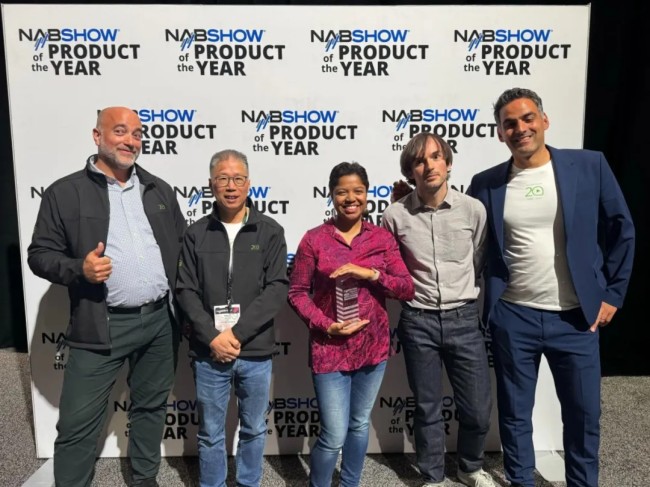
Daily live coverage announced by France Télévisions for its Paris 2024 channel.
What he wants the next experiment to cost
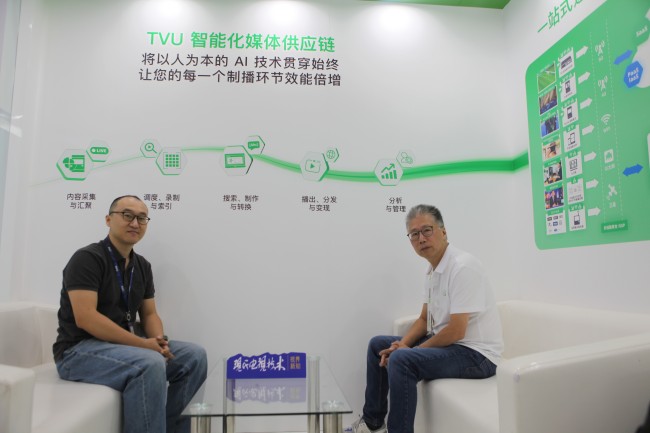
Shen’s account of cloud adoption includes the resistance. In his BIRTV 2024 interview, he recalled broadcasters’ doubts about entrusting consequential production work to the cloud. He described earning confidence gradually through IP-based transmission, then extending the approach into production. He also discussed monitoring tools that let operators inspect a workflow’s condition, rather than simply trusting an unseen system.
At TVU’s twentieth anniversary in 2025, his stated focus was helping customers experiment. A library of small software services could let them assemble and test production approaches without first committing to a substantial hardware installation. The aspiration has an unglamorous appeal: make the next idea affordable enough to try. A commissioning meeting is difficult enough before it acquires an equipment procurement meeting.
In April 2026, TVU announced a partnership with Tencent Cloud for a production and distribution platform. Shen described the goal as connecting content production with audience engagement and monetization. The announcement included automated subtitles, editing assistance and distribution infrastructure. It carried forward a concern already present in his earlier work: making something live is one step; making it useful to a media business involves several more.
That spring, TVU also credited him with conceiving TVU Today, a live NAB trade-show program for people beyond the exhibition floor. The company reported 26 hours of coverage over three days, with guests from more than 30 companies. A founder who sells tools for distributed production had proposed another occasion to use them. Somewhere inside all the infrastructure is a pleasantly direct impulse: there is something happening here, and more people ought to be able to see it.
Watch, read, follow
- TVU Networks ↗Company website
- Paul Shen on LinkedIn ↗Professional profile
- TVU Networks on YouTube ↗Company channel: interviews, workflows and demonstrations
- Watch Shen’s 2017 predictions interview ↗Streaming Media interview and transcript
- Watch the BIRTV 2025 interview replay ↗TVU’s replay page; interview in Chinese
- Read Shen’s contextual-search essay ↗His Beatles example and video-search argument
- France Télévisions’ Paris 2024 announcement ↗The broadcaster’s cloud-production plan
- The 2026 Tencent Cloud partnership ↗Production, distribution and audience engagement
- TVU Today at NAB 2026 ↗The company’s live-show recap
- TVU’s early peer-to-peer chapter ↗The 2007 Fast Company feature