In Moscow, a football match was still unfolding. In Los Angeles, an editor could already work with its footage. During the 2018 World Cup, FOX Sports used IBM Aspera to make material from Russia editable in California in under ten seconds. The distance remained considerable. Its influence on the working day had shrunk.
That is a useful introduction to Aspera, because file transfer sounds like a minor administrative chore until it decides where people must live, which facilities must be built, and when somebody else can start work. A progress bar can become an organizational chart.
- The job: move large files and streams across distant networks.
- The engine: FASP, Aspera’s patented transport technology.
- The payoff: earlier editing, simpler delivery, fewer physical handoffs.
The editing room stayed home
FOX’s problem had an expensive physical dimension. It needed coverage of 64 matches while preserving the usefulness of its Los Angeles postproduction facilities. Aspera’s streaming technology, integrated with Telestream’s systems, helped put incoming material directly into the editors’ workflow. IBM reports more than two petabytes transferred over unmanaged internet.
The economics were broader than a faster download. Moving footage could reduce the need to move production resources. Telestream’s account of the following year’s Women’s World Cup describes the next step: all postproduction could happen remotely, with no editing suites required at the Paris broadcast center. The earlier Russian deployment had still needed two craft editors and two suites there.
Success in Russia gave FOX confidence to expand the approach. The Paris system also added automatic archiving. It was a joint construction involving Telestream, Levels Beyond and Aspera. The transferable lesson is to connect capture, delivery and editing before celebrating a speed test.
The network had a waiting problem
Michelle Munson and Serban Simu founded Aspera in 2004. Their specialty was the awkward relationship between available bandwidth and useful throughput. A connection can have plenty of nominal capacity while long-distance transfers make disappointing use of it. Latency and packet loss complicate the journey.
FASP addresses that transport problem. IBM documents a TCP connection for control and a UDP connection for data, with encryption protecting the transfer. The cleverness is in managing delivery over difficult routes. Merely sending packets aggressively would leave the receiver with another problem.
Consider Egyptian broadcaster DMC. Its episodes could reach 25 GB, with files going to several broadcasters under tight schedules. IBM’s case study reports typical transfer rates rising from 20 Mbps to 100 Mbps with Aspera Enterprise. That is a specific customer result, and a more useful buying clue than treating every advertised acceleration multiplier as a promise.
IBM announced its agreement to buy Aspera in December 2013 and completed the acquisition in early 2014. Munson subsequently described access to IBM’s life-sciences relationships as an expansion of opportunity. A specialized transport engine had acquired a much larger route to customers.
A premiere cannot wait for a parcel
Munich’s film festival supplies a less glamorous, equally revealing example. Films are sometimes finished only days before screening. Historically, delivery meant physical drives, labor and logistical complications. The festival needed to accept sensitive, last-minute material without turning delivery into another production.
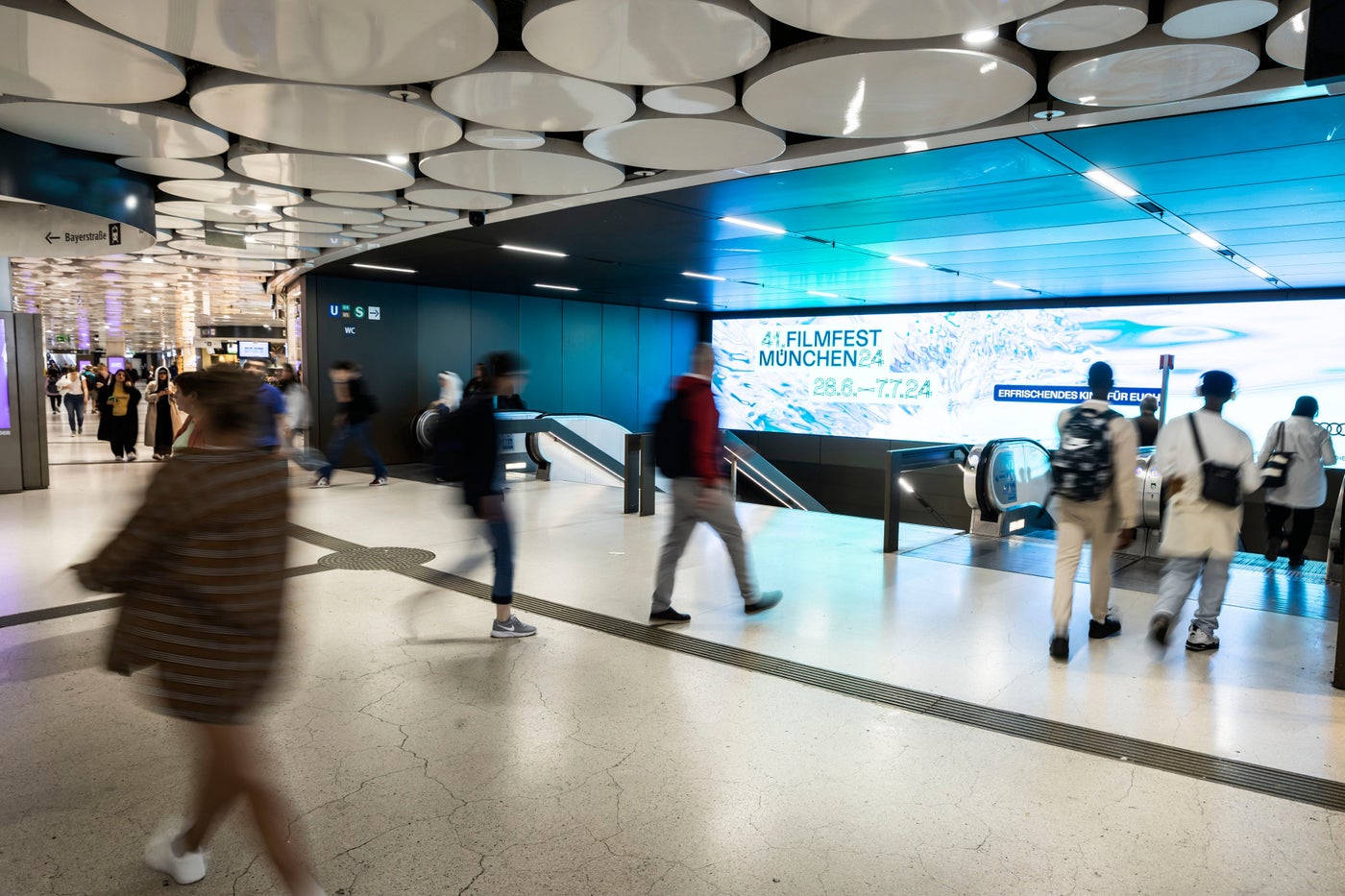
The implementation used Aspera High-Speed Transfer Server, Faspex and HTTP Gateway on premises. Files could go directly to local storage, avoiding additional cloud storage. IBM reports that 150 films from more than 50 countries were transferred digitally for the 2024 edition, with zero cancellations. Its account describes handling a 300 GB movie file without a hard disk shipment.
The initial weakness was the physical handoff: a finished film still needed a delivery operation. Aspera gave the festival a way to remove that step while retaining control of storage. For a team considering the same move, storage location belongs near the beginning of the discussion.
Speed needs somewhere useful to land
Aspera now spans hosted and self-managed software. Aspera on Cloud offers file sharing and package exchange across storage systems. Enterprise supports broader transfer and synchronization needs. Faspex handles package delivery; Orchestrator connects collection, processing and distribution into workflows. APIs and the open-source CLI give developers routes into those operations.
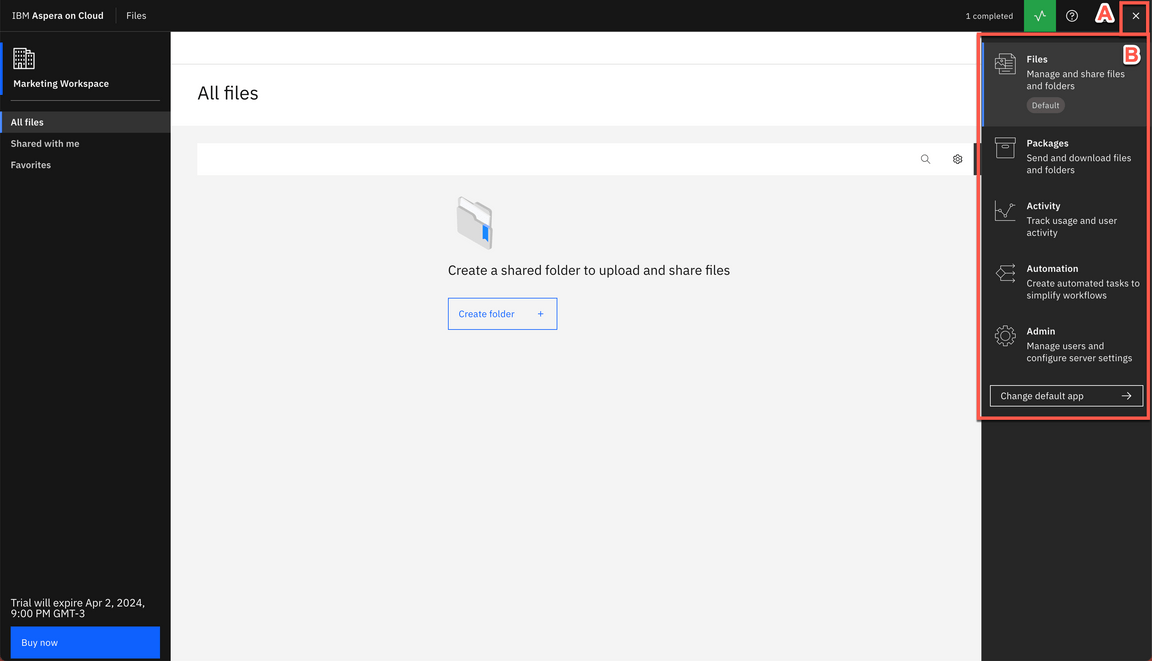
This places Aspera among enterprise data-movement tools and established media-delivery systems. Signiant Media Shuttle is a direct alternative in accelerated media exchange. For occasional, modest transfers, conventional file-sharing tools may be sufficient. The meaningful comparison includes recipient setup, existing partner requirements and the workflow around delivery.
IBM’s indicative US prices, checked in October 2026, put pay-as-you-go transfers from $1.07 per GB per month. Essentials starts at $22.10 monthly with 1 TB per year; Standard Plus starts at $660 monthly with 6 TB per year. Those are different commitments and feature bundles. Storage, infrastructure and contract terms belong in the calculation too.
A progress bar can become an organizational chart.The production lesson
Test the whole journey
There is a useful distinction between removing delay and removing work. A transfer service can deliver the file promptly; somebody still needs to know whether it is complete, correctly named and ready for processing. Orchestrator’s connected steps, monitoring and failure outcomes address the coordination surrounding that arrival.
Faster transport still requires a usable route. IBM’s troubleshooting documentation identifies blocked UDP traffic as a cause of transfers stalling at zero. Its technical paper describes storage becoming the next bottleneck once network constraints are addressed. A slow disk can inherit the job of keeping everyone waiting.
A practical evaluation therefore uses a representative file, the actual recipient network and the intended storage. Measure elapsed time through the final handoff. IBM offers a trial capped at 14 days or 50 GB, whichever arrives first; external package sending has trial restrictions. Start with the handoff that is currently late, then compare the time saved with the full cost of operating the system. If a small attachment already arrives comfortably before it is needed, acceleration has little room to help. The right result is an earlier start for the person waiting at the other end.