The inconvenient thing about a cloud is that somebody else can turn it off. When Microsoft announced the retirement of Azure Media Services, companies using it faced a thoroughly unglamorous problem: keep their videos working while replacing the machinery underneath. MediaKind, a business with roots in television equipment, saw an opening. The opportunity was to make a compulsory move feel smaller.
- The job: turn live feeds and video files into services people can actually watch.
- The opening: help Azure customers move without rebuilding their video libraries.
- The bet: keep cloud software and on-site equipment working together.
A deadline beats a sales pitch
David Arbuckle, the engineering executive who led MK.IO’s launch, had wanted to build a video SaaS business for years. In a 2024 interview, he explained that customers and the industry had not been ready. Microsoft’s decision changed the timing. MediaKind already had video technology; it needed to connect those capabilities through interfaces customers could use themselves.
“I had wanted to build a video SaaS for years”
David Arbuckle · MediaKind engineering executive · 2024
MK.IO arrived in July 2023 with support for existing Azure Media Services assets, familiar application programming interfaces and a migration route. The attraction was practical. A library already encoded and sitting in Azure storage could remain useful. MediaKind’s migration documentation describes bulk importing assets and related settings. Customers could preserve work they had already paid for.
Read that as a product lesson: a new feature can attract attention, but removing a transition chore can unlock a purchase. The first thing to disappear here was a customer’s existing service dependency. MediaKind built around the deadline. The inference is straightforward: when the buyer must move, make the move less expensive in time, effort and uncertainty.
The company inside the play button
MediaKind occupies the space between a camera and an audience. Its technology compresses video, prepares versions for different devices and connections, packages streams, protects playback and supports advertising. Broadcasters and sports services buy it. So do pay-TV operators and organizations for which video is simply part of the job. The consumer usually sees somebody else’s brand.
This explains an amusing customer roll call. In July 2025, MediaKind reported more than 500 active MK.IO customers, including Japan’s GSTV, Yoga Download and CalFire. Jewellery shopping, stretching and emergency response do not share an editorial strategy. They do share a need to get usable video through a complicated technical chain.
- 01CaptureCamera or file
- 02ProcessEncode & package
- 03ProtectRights & access
- 04DeliverScreen & player
A simplified workflow, not a product architecture diagram.
For a developer, MK.IO supplies self-service controls and APIs for live and on-demand processing. VOS360 supplies managed cloud streaming. MK.IO Platform goes further into running a branded service, including content management and viewing entitlements. Multiview lets operators combine feeds into one viewing experience; MediaKind’s Spectrum TV case study describes up to four simultaneous games.
The cloud still has a front door
MediaKind’s history helps explain why its catalogue includes both software services and physical systems. The name launched in 2018 as the new identity of Ericsson Media Solutions. In February 2019, Ericsson completed the sale of a majority stake to One Equity Partners, retaining 49% at closing. This was an established engineering operation acquiring a new corporate address.
Its expertise includes the less visible parts of television: compression and signaling. In 2021, MediaKind announced two Technology & Engineering Emmy Awards covering event-signaling APIs and AI optimization for real-time compression. Those are useful credentials when the product is expected to perform while millions of people are looking elsewhere.
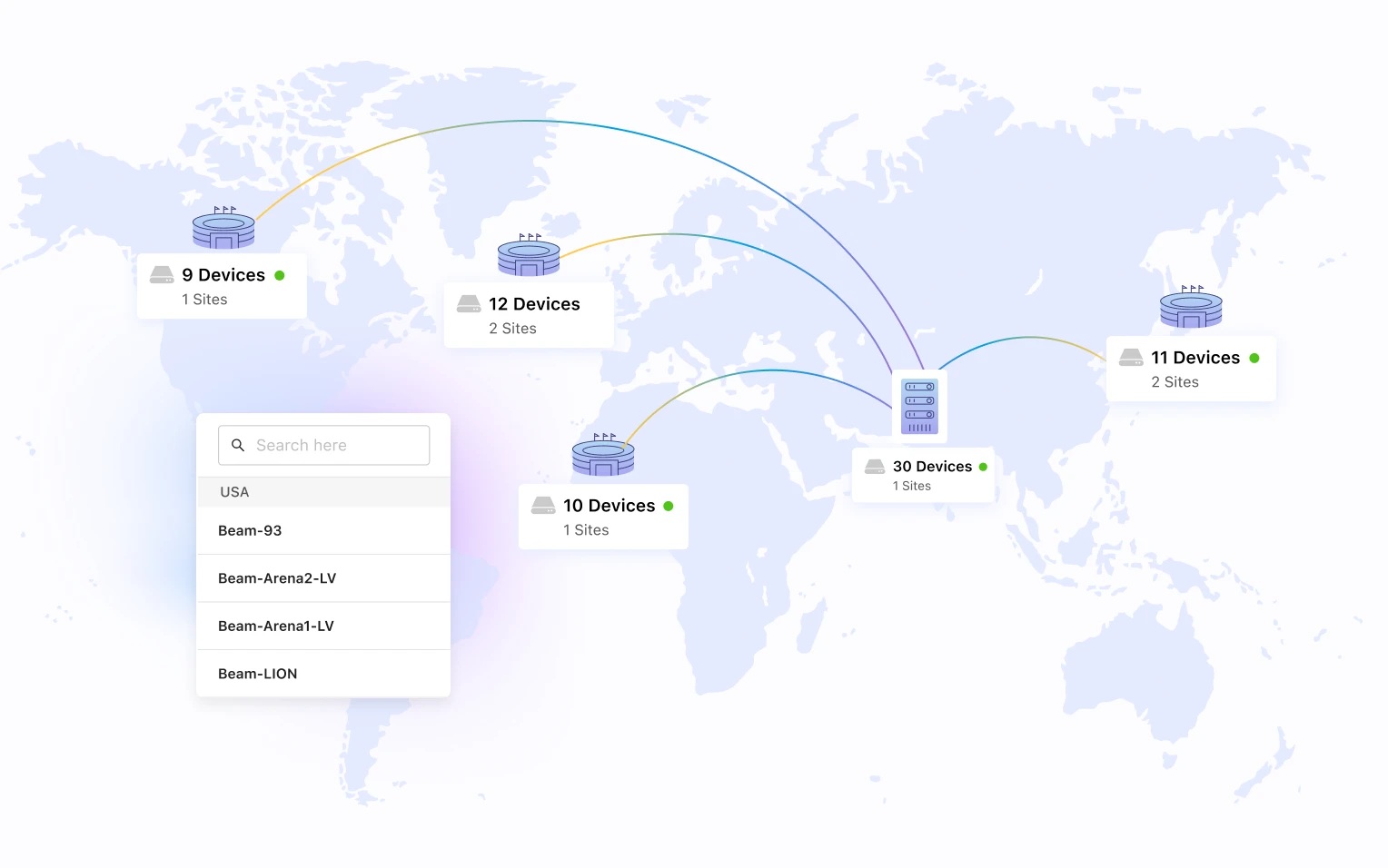
Beam makes the connection between that history and the current offering explicit. It runs video workflows on site while adding centralized cloud management and flexible licensing. An operator can process contribution feeds or decode incoming signals without treating every equipment decision as a wholesale cloud migration. The boundary between the building and the cloud becomes something to manage.
The $145 million clue
In June 2026, MediaKind completed its acquisition of Harmonic’s video business for $145 million in cash, subject to customary adjustments. Harmonic kept its broadband business. The distinction matters: MediaKind bought a video portfolio and team, expanding the business around its existing specialty.
Annual revenue reported by MediaKind
Illustrative 100:150 proportions using the announced lower bounds; not an audited revenue mix.The deal suggests a market living at two speeds. Customers want the convenience of software while still operating equipment and established television services. MediaKind competes across those needs. Alternatives vary: Bitmovin overlaps in cloud video, while AWS Elemental and Ateme offer other processing and delivery routes. MediaKind has also partnered with Bitmovin. In this market, overlap and cooperation coexist.
Count the whole journey
The business model follows that mixed reality: cloud usage, managed services, equipment and software licenses. MK.IO’s public starting rate for 1080p live encoding is $0.053 a minute. An hour at that rate is $3.18. Shared streaming output starts at $64 a month. Those figures describe pieces of a service, with storage, data transfer and other fees excluded.
A sensible first project therefore starts with a budget and a real playback test. Connect storage, prepare a source encoder, create a live event and check the target devices. MK.IO’s documentation also tells users to stop live events and streaming endpoints after testing because running resources incur charges. The off switch belongs in the operating plan.
Nor does a working stream automatically create a complete subscription business. In September 2026, Accedo and MediaKind announced an operator offering combining applications with MediaKind’s backend. That partnership fills the distance between delivering video and presenting a service people can browse and buy.
The most useful thing to copy is MediaKind’s attention to that distance. Preserve what customers have already built. Make the next step manageable. Then test the whole route, including recovery: its October discussion with Akamai emphasizes advance capacity planning and rehearsed responses. The viewer presses play once. Everything behind that small gesture needs its own plan.
Follow the signal
Explore MediaKind, MK.IO pricing, the developer guides and the migration tool.
Keep up through news, the Akamai engineering discussion, LinkedIn, X, Instagram and Facebook.
↗ Watch the IBC engineering session↗ MK.IO video walkthroughs