Every time a video snaps to a sharper picture the moment your Wi-Fi improves, some piece of software just made a decision on your behalf. It picked a quality, requested the right chunk of footage, and handed it to a player - all in a fraction of a second, all invisibly. A large share of the code that governs those decisions traces back to a standard called MPEG-DASH. And three of the people who helped write MPEG-DASH went on to found Bitmovin.
That is the unusual thing about this company. Most startups pitch themselves into an existing market. Bitmovin's founders - Stefan Lederer, Christopher Mueller and Christian Timmerer - helped define the market's ground rules first, during their PhD research at the University of Klagenfurt in Austria, then built a business selling the tools that operate inside those rules. It is a bit like helping draft the traffic laws and then opening the best driving school in town.
Bitmovin sells video infrastructure. Not video - infrastructure. It is the layer other companies bolt into their apps so they never have to build the hard parts of streaming themselves. Three products do most of the work: an encoder that shrinks raw footage into deliverable files, a player that runs on almost any screen, and analytics that explain why a stream misbehaved. The BBC, Hulu, fuboTV, Discovery, Sling and Red Bull Media House are among the roughly 250 companies paying for it.
01 / The originFrom a PhD lab to a Y Combinator batch
In the late 2000s, streaming was a mess of proprietary players and stuttering downloads. Adaptive bitrate streaming - the idea that a video should quietly switch quality to match your connection - was still being standardized. Lederer and Mueller were doing doctoral work on exactly this problem, and they contributed to the MPEG-DASH standard along with the reference implementation, libdash, which the company still maintains as open source.
The research became a company around 2013. The first two products even had different names: the encoder was called "bitcodin" and the player was "bitdash." In 2015 Bitmovin joined Y Combinator, which pulled its center of gravity toward the United States while the engineering roots stayed in Austria. Today it runs offices in Denver, Klagenfurt, Vienna, London and Berlin.

"During our PhDs we co-created the MPEG-DASH video streaming standard, which is used by YouTube, Netflix, Hulu."
Stefan Lederer, CEO & Co-Founder02 / The productsEncode, play, measure - then repeat
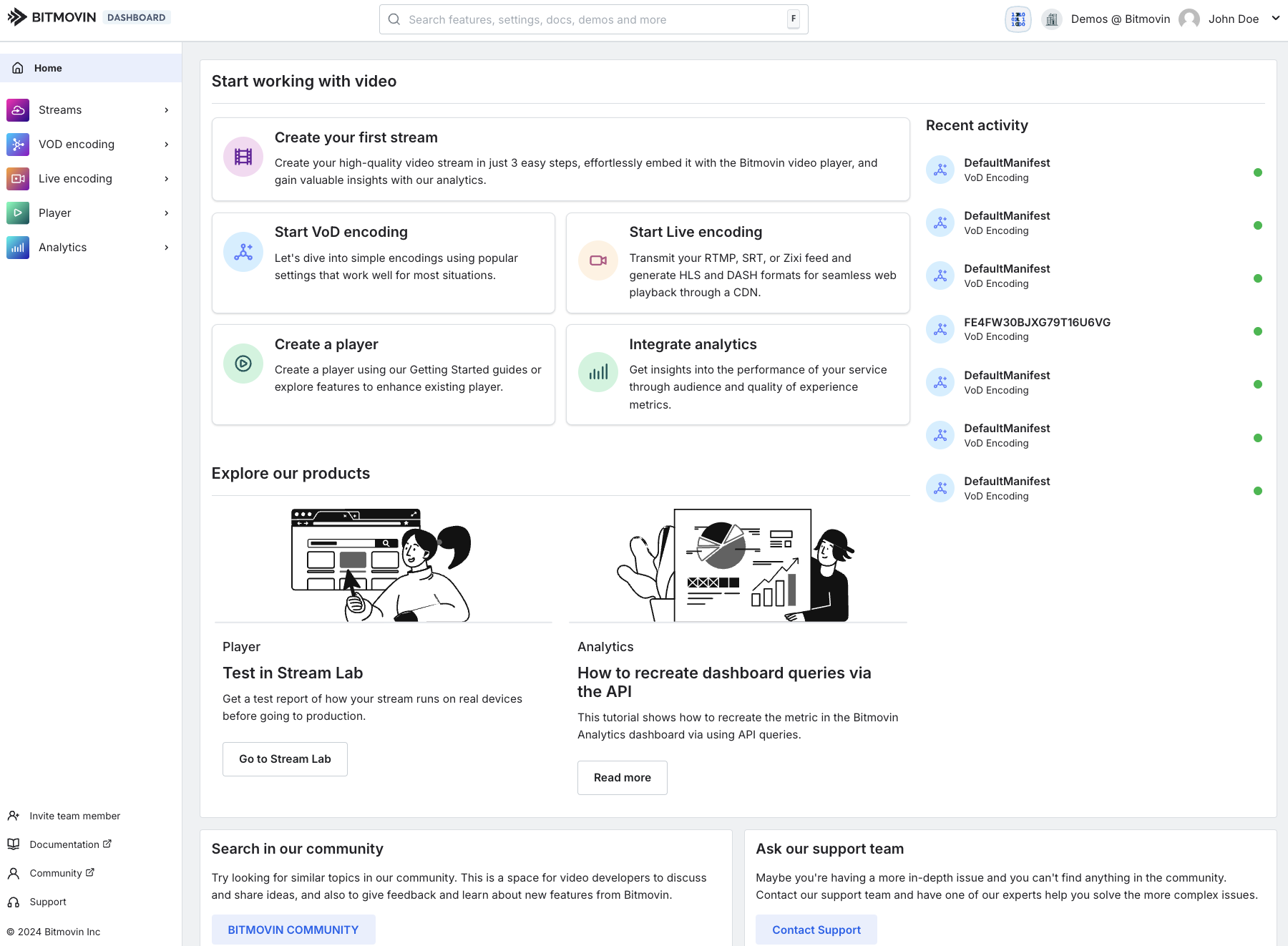
If you want to understand Bitmovin, understand the pipeline a single video travels through. It gets encoded into many versions at different qualities. It gets delivered and played on whatever device the viewer owns. And then someone needs to know whether the whole thing worked. Bitmovin sells a product for each stage.
Encoding 2014
Cloud VOD and live encoding with content-aware, per-title compression. Outputs HLS and DASH, supports AV1, HEVC and VP9 up to UHD, and runs across AWS, Google Cloud, Azure, Oracle and Akamai.
Player 2014
An adaptive HTML5 player for browsers, mobile, Smart TVs, Roku and game consoles, with DRM handled through Encrypted Media Extensions.
Analytics 2018
A player-side SDK that captures quality-of-experience data - startup time, rebuffering, errors, engagement - so teams can find out why a stream stumbled.
Streams 2022
An end-to-end live and VOD product that bundles encoding, player and analytics behind one workflow, with a Stream Lab test environment.
The piece that earned the trophy is per-title encoding. The naive way to compress video is to apply the same settings to everything. But a still, talky interview and a fast, grainy action scene do not need the same treatment. Per-title encoding analyzes each piece of content and tailors the compression to it - better picture where it matters, smaller files where it doesn't. In 2021 that class of innovation won Bitmovin a Technology & Engineering Emmy.
03 / The businessGetting paid to be invisible
Bitmovin is a B2B, usage-based platform. Encoding is billed by the minute of video processed, the player is licensed, and analytics is a subscription. It sells directly and through the AWS, Google Cloud and Azure marketplaces. None of its logo ever needs to appear in front of a viewer, which is exactly the point - infrastructure is most valuable when nobody thinks about it.
That model has a quiet economic advantage. When a customer like the BBC or fuboTV grows its audience, Bitmovin's usage grows with it. Third-party estimates put annual recurring revenue around $29M in 2024, though the company does not publish official figures. What is public is the funding: roughly $68M across four rounds.
Funding history (rounds, USD)
The differentiator: where rivals like Mux compete on simplicity, Bitmovin competes on depth - production-grade AV1, broad DRM coverage, SOC 2 Type II compliance and enterprise support. It is the option teams choose when "just works" isn't enough and they need to control the codec-level details.
04 / The peopleTwo founders, one standard, one lab
Lederer runs the company as CEO; Mueller is CTO; Timmerer, who is also a professor at the University of Klagenfurt, leads research and keeps the academic pipeline flowing. That last part is not decoration - being close to the researchers pushing video codecs forward is a genuine edge in a field where the standards keep moving.


The culture is remote-friendly and values-driven, with a list of principles that reads like a working document rather than a poster - "attack the idea, not the person" is one of them. In 2020 Austria named Bitmovin its #2 Great Place to Work.
05 / What's nextThe video-plumbing company discovers AI
For most of its life Bitmovin talked about codecs and bitrates. Lately it has been talking about agents. At NAB 2024 it showed AI-powered encoding optimization, Super Resolution upscaling, and automatic subtitling and translation. In 2025 it migrated its Analytics AI Session Interpreter to Amazon Bedrock, launched a real-time Observability suite, and released an Agentic AI Hub with tools for vertical short-form clipping, voice-operated seeking and LLM-driven summarization.
It is a logical extension. A company that already sits in the middle of the video pipeline is unusually well positioned to add intelligence to it - the footage is already flowing through its systems. Whether that turns into a durable second act or a set of features depends on execution, and on how quickly the broadcasters on its customer list actually want their video clipped and summarized by machines.
For now, Bitmovin remains what it has been for a decade: the specialist you hire when video is your product but codecs are not your job. It won't show up in your app's credits. It rarely shows up in the headlines. It just quietly decides, over and over, which version of the video to send you next.