A résumé is a seductive little document. It lines up dates, titles and institutions until a life appears to have behaved itself. Liv Anderman knows better. She studied English at Oxford, trained as a lawyer, practiced as a barrister in London, moved into international development in Oregon, became a product marketer and eventually arrived in San Francisco as the chief marketing officer of an artificial intelligence company. Read as a list, the route looks eccentric. Read as an argument, it is almost suspiciously coherent.
The connecting tissue is evidence: how it is gathered, framed and made persuasive. Barristers assemble facts into a case. Product marketers assemble capabilities into a reason to care. Findem, where Anderman leads marketing, assembles data about careers, companies and networks into context for talent decisions. Each discipline begins with an unruly pile of information and ends, when handled well, with a clearer view.
Anderman's professional story also gives her an unusually literal relationship with the phrase “making a case.” In a 2021 interview, after Findem co-founder Hari Kolam introduced himself, she offered the condensed version of her own path: “I started my career as a lawyer and attorney in the UK. So pretty different.” The interviewer corrected the category to barrister. “Yeah, that's right,” she replied. The exchange was brief, dry and revealing. Some people polish a pivot until it resembles destiny. Anderman let the oddness remain.
The useful parts of an old life
Her formal education began with English Language and Literature at the University of Oxford from 2004 to 2007. Legal training followed at City, University of London, including a Graduate Diploma in Law earned with distinction and the Bar Vocational Course. By 2009 she was at 2 Pump Court, now 187 Fleet Street, practicing in London. Her public record also includes a year as a pro bono legal adviser to the Children's Rights Alliance for England.
The law did not become her permanent address. After relocating to the United States, she worked in international development at Vacasa, then joined Smarsh, a technology company serving regulated organizations. There, from 2017 to 2020, she moved from product and product marketing manager to director and then senior director of product marketing. The subject matter had changed from briefs to software, but the central exercise had not: understand a complicated system, identify the consequential detail and make the logic travel.
She made the connection explicit in a 2019 article titled “Home Court Advantage,” which opened with a leap from legal arguments to software products. Her work outside the day job followed the same broadening arc. Publicly listed roles include advising ScoutSavvy on marketing and business development, working with State of Place on marketing and growth, and serving on a steering committee for a Girls Inc. of the Pacific Northwest fundraiser. None of these entries supplies a grand conversion scene. Together, they show the patient accumulation of a second professional language.
In September 2020, Anderman joined Findem as head of marketing. The company was young, remote-first and trying to explain a product built on what it called “3D data.” Instead of searching only by conventional keywords, its platform was designed to organize attributes and relationships across people and companies. The marketing difficulty was obvious. Infrastructure can be impressive to the people who built it and invisible to everyone else.
Anderman rose to vice president in 2022 and is now listed by Findem as chief marketing officer. Her remit expanded as the company did. What began as a way to source candidates became a broader talent intelligence platform, then an intelligence layer designed to serve AI agents and the systems where HR work already happens. The vocabulary changed quickly. The human problem underneath it remained stubbornly familiar: a person is more complicated than a row in a database.
“The result reflects what Findem is ultimately about: helping organizations see and unlock human potential.”Liv Anderman on Findem's brand
Context is a product feature and a moral
Findem's 2026 rebrand gave that problem a cleaner shape. The new system was built around the thought that careers are dimensional. People are formed by journeys, teams, pressures, networks and changes over time. The résumé, useful as it is, catches only the shadow. Anderman described the company's work as helping customers understand candidates “in context,” including the experiences and connections that shape capability.
This is effective positioning because it does two jobs at once. It explains why a talent graph might outperform a keyword search, and it gives the technology a human consequence. Better context can surface the nonlinear career, the adjacent skill or the candidate whose title fails to announce what they can do. Anderman's own nonlinear path quietly strengthens the case. A system trained to worship the straight line might have struggled to predict that an Oxford English graduate and former barrister would become an enterprise AI CMO.
There is a harder edge to the context argument. Hiring technology makes judgments in a domain where old bias can hide inside ordinary labels. Anderman has written about reducing bias in recruiting, beginning with fairer job posts and a deliberate review of the hiring process. More recently, her public comments have emphasized that AI governance must precede deployment and that legal accountability for biased outcomes does not simply evaporate into the vendor contract.
Her legal past makes that emphasis feel practical rather than ornamental. A system may act quickly, but speed does not improve the underlying evidence. In 2026, after a Findem panel on agentic HR, Anderman distilled the point: agents do not repair bad data; they act on it faster. The remark carries the neat chill of a good warning label.
When explaining a complex product, connect the technical distinction to a human consequence. “More data” is inventory. “See a nonlinear career clearly” is a reason to care.
Make the booth useful
Anderman's marketing can be refreshingly physical. At the 2023 HR Tech conference, she explained why Findem had equipped its booth with charging stations, lounge space, donuts and cocktails instead of “swag people won't get any value from.” It is a small scene, but a good one: a marketer at a technology convention making the radical discovery that tired people enjoy sitting down.
The furniture expressed a strategy. In 2024, Anderman described a shift from high-volume inbound marketing to high-value experiences. Talent leaders, she observed, tend to be relationship-driven. They do not want a pitch at the beginning of every interaction, and Findem did not want to begin that way either. The aim was to make the company understood and memorable, then let a commercial conversation develop when the timing made sense.
This is patient marketing in a category addicted to urgency. It replaces the fantasy of capturing demand on command with the slower work of becoming useful before the buyer is ready. Private dinners and virtual conversations were not merely lead containers. They were places where practitioners could compare notes with peers. The brand earned relevance by hosting the exchange.
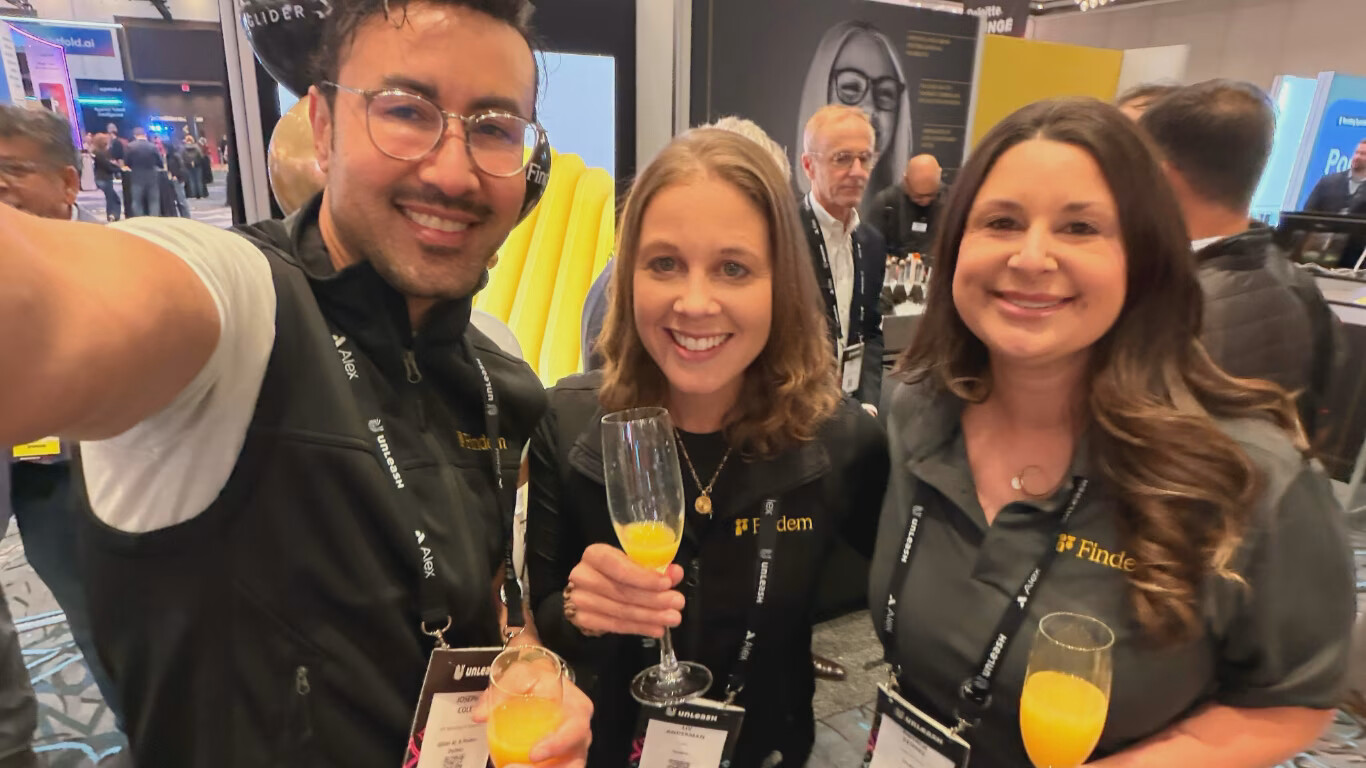
By UNLEASH 2026, the company had more to explain. Findem announced the acquisition of Glider AI, adding candidate assessment and skills verification to its sourcing and intelligence capabilities. In the event photo, Anderman stands between Glider marketing leader Joseph Cole and colleague Natalie Stones, champagne in hand, looking less like a case study in corporate integration than three people who have survived a conference floor together.
The acquisition followed Findem's purchase of Getro, whose talent networks added another relationship layer to the platform. Findem Studio then opened the company's data and intelligence to software agents through MCP tools. Anderman shared the launch as a way for customers to build workflows and bring talent intelligence into existing systems. Again, the pitch returned to context that can move, rather than another application demanding a fresh tab.
A higher-resolution view
CMOs are often cast as manufacturers of attention. Anderman's work suggests a more durable role: translator, host and examiner of evidence. Translate the machinery into a consequence people can recognize. Host the conversation before attempting to own it. Examine the data before celebrating what an algorithm can do with it.
Her career is useful precisely because it resists the polished mythology of a single calling. Literature sharpened her feeling for language. Law supplied structure and scrutiny. International development widened the operating context. Product marketing taught her to connect a feature to a decision. At Findem, those disciplines meet in a category where language and evidence have unusually direct effects on who receives an opportunity.
There is wit in the symmetry. A barrister once argued from a record. The marketer she became now argues that the record is incomplete. The better question is not only whether the machine can find someone. It is whether the machine, and the people using it, have learned to see.