Lisette Sand-Freedman has found a use for artificial intelligence that would have been perfectly intelligible to an old-fashioned newspaper editor. She gives it an email and asks: “Make this less rude.” There is an entire working life inside that request. The message has already been written. The point is clear. The sender knows what she wants. Now someone must remove the sharpest corners before it reaches another human being.
Sand-Freedman is the co-founder and Chief Visionary Officer of SHADOW, a creative marketing and communications agency. Her profession requires her to understand attention, but her own story is better understood through relationships. People meet. They work together. Some stay long enough to become partners. A client asks for something new, and the agency changes shape to make it. Somewhere in that process, a blunt email needs a second draft.
Her company’s name suggests a preference for remaining outside the spotlight. Her personality seems less inclined to whisper. She can be direct, funny and deliberately dramatic. The interesting question is how those qualities have helped her build a business designed to put other people first.
An apartment, a partner, a name that nearly sneezed
Before SHADOW, Sand-Freedman worked at Alison Brod, where she became a partner. Fashion, hospitality and the business of connecting celebrities with brands were part of her territory. This was work that rewarded knowing people, making introductions and understanding why a particular face might bring a particular crowd.
She met Brad Zeifman through work on Fuschia, the fashion line launched by Wyclef Jean’s wife. The two publicists became friends. Their eventual company would grow out of that friendship, although Sand-Freedman did not immediately welcome the proposal to start an agency. There was a six-week trip to Australia before the idea became a business. Even founders are allowed a period of making other plans.
In 2007, they launched from her apartment. The proposed name, ZSF Media, was presented to Armani Exchange. The response was unflattering and useful: it “sounds like a sneeze.” Sand-Freedman went back to thinking about the job they actually wanted to do. SHADOW described staying close to clients while leaving the attention to them. A client had edited the agency before the agency could begin editing the world.
The setting was modest; the relationships were already established. Early clients included Armani Exchange, Intermix, Chanel, Tenjune and the Tribeca Film Festival. That combination matters. An apartment office can make an appealing origin story, but these founders arrived with professional experience and people prepared to give them work. The furniture was temporary. The trust had a history.
The people who stayed
Michelle Sokoloff had been Sand-Freedman’s assistant before SHADOW began. She joined at the start and became a business partner. Liza Bychkov-Suloti, who had worked with Zeifman, joined in 2008 and also became part of the founding leadership. Their experience supplied another kind of continuity: they knew the founders before the founders had a company of their own.
It is easy to make an agency biography read like a guest list. Famous clients appear, then famous talent, then more famous clients. The less photogenic work happens among colleagues who must decide how to spend money, deliver a project and tell one another when an idea needs another round. A lasting partnership gives those conversations a shared past.
Sand-Freedman and Zeifman also became partners in life. Their working arrangements evolved with the relationship. By their tenth-anniversary conversation, they described handling different parts of the business and drawing on each other’s strengths. The company had grown beyond two friends looking across the same desk.
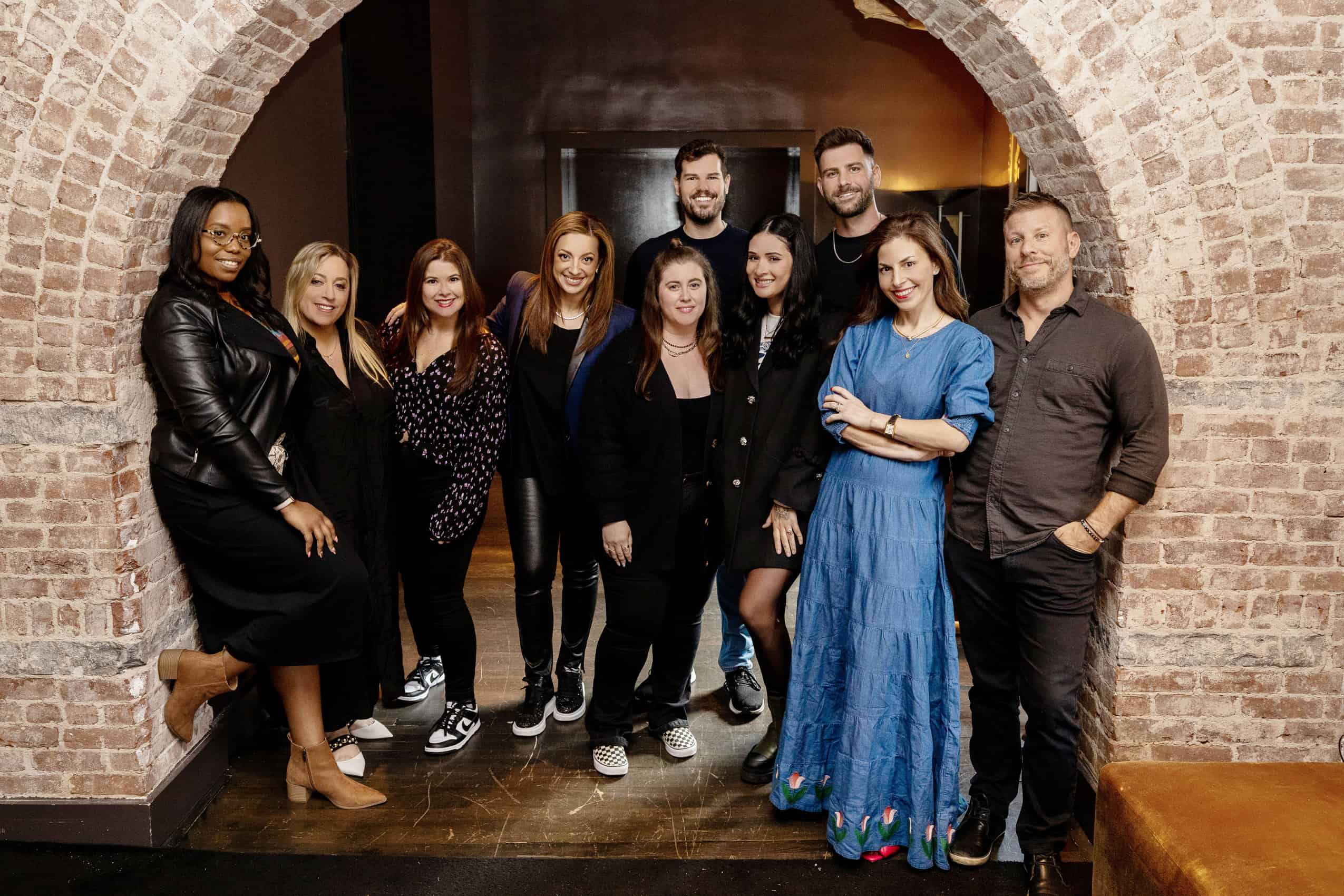
In 2021, Brian Vaughan, Erica Larsen and Jamie D’Attoma became partners after years with the agency. Their advancement gave senior colleagues ownership in the business they had helped develop. It also made the idea of an agency career tangible. Joining a company could lead to helping decide what that company would become.
For a founder, that creates a demanding bargain. New capabilities need leaders with authority to build them. The founder gains a larger business and gives other people more room inside it. Sand-Freedman’s career increasingly involves making that room.
Three weeks to make a dolphin
SHADOW dropped PR from its name in 2016 and formally broadened its work in creative, influencer marketing and events. The change acknowledged that getting a brand into a conversation could involve making the advertisement, organizing the experience or producing the material people would share. A press pitch might be one part of a much larger assignment.
The 2023 e.l.f. Cosmetics commercial made that expansion concrete. SHADOW had three weeks to develop, cast, produce, shoot and edit a spot for Super Bowl Sunday. Jennifer Coolidge starred; Mike White collaborated on the writing. Sand-Freedman is credited alongside agency colleagues and e.l.f. leaders.
The comic premise connected Power Grip Primer’s stickiness to Coolidge’s publicly expressed wish to play a dolphin. It was an unusually useful collision of product detail and personality. The campaign then extended across media outreach and social content. Each piece had to fit the same joke without exhausting it.
From concept to finished commercial for e.l.f.’s 2023 Super Bowl Sunday campaign.
- Product insight
- Comic premise & casting
- Production & editing
- Press & social rollout
A short commercial can conceal a complicated organization. Talent agreements, scripts, footage, approvals and publicity have to arrive in an order that allows the next person to work. The finished thirty seconds looks effortless only if the effort has been coordinated well enough to disappear.
That is a useful way to look at Sand-Freedman’s expanding role. Her work includes bringing people and decisions together early enough that the creative idea can survive the practical business of getting made.
A sandwich shop with a denim problem
American Eagle provides a different test of the same business. A long relationship can produce a great deal of institutional memory. It can also produce habits. Sand-Freedman has publicly encouraged marketers to bring established clients fresh proposals without waiting to be asked.
In Nashville, that approach took the form of the Denim Deli. SHADOW’s activation combined American Eagle denim with sandwiches from Mitchell Deli, live music and interactive experiences. The company reported more than 1,000 attendees over two days and an open mic with more than 50 aspiring singers and songwriters. The numbers describe an event, rather than a measure of anyone’s individual brilliance.
The detail Sand-Freedman found particularly satisfying was that she did not have to be there for it to go well. An agency founder can spend years becoming the person everyone calls. Building a team that can deliver in her absence offers a different kind of accomplishment, and perhaps a quieter phone.
There was another return in her recent work: Nicole Richie, who hosted SHADOW’s first event in 2007, appeared in a later Estée Lauder campaign created by the agency. Eighteen years separated the assignments. The relationship had endured while the format changed from an event to a filmed spot. A familiar collaborator could enter a new chapter.
“Get to the point!”
Lisette Sand-Freedman, on getting an editor to answer an email
The right to leave a message unanswered
For all the talk of attention, public relations is conducted partly through an inbox. In 2019, Sand-Freedman attracted attention for an out-of-office reply during a family trip: “In case of emergency, please call 911.” Her intention was to introduce some levity and encourage people to reconsider what qualified as urgent. Colleagues shared the message themselves. The auto-reply had acquired an audience.
It is a neatly chosen joke for a profession in which everything can arrive marked urgent. The recipient gets the instruction immediately. The sender has established a boundary without composing a solemn essay about boundaries. A vacation has briefly become a communications assignment.
Her taste for humor also appears in familiar correspondence. Dramatic subject lines and ellipses are part of her repertoire. The software-assisted request to soften an email suggests she understands that her directness sometimes needs adjusting. The relationship continues after the message is sent; a satisfying sentence has to survive its reception.
An early job interview offers a less controlled picture. Sand-Freedman arrived at Condé Nast with a broken Steve Madden shoe, and a friend helped prepare her in the Vogue closet. She did not get the job. The anecdote is funny because it leaves in the awkwardness. In a career devoted to arranging how things appear, she is willing to describe a moment when her own entrance required repairs.
These are small stories, but they keep the business biography from becoming a procession of client logos. A person who can negotiate a campaign may still need help with a shoe, a sentence or the decision to put the phone down.
A familiar cast, a different stage
In 2026, Adweek recognized Sand-Freedman in its Agencies Vanguard Awards. Its account highlighted work involving Google Shopping, Dove and Estée Lauder, and identified Erica Larsen as a longtime collaborator central to business decisions. The recognition put a founder and a continuing partnership in the same frame.
Sand-Freedman’s own year-end account of 2025 thanked 117 SHADOW team members. A September 2026 conversation described a team of roughly 120. These are dated snapshots of the organization, but they suggest how far the working day has travelled from an apartment occupied by a few colleagues.
Her advice to aspiring publicists is to learn across marketing disciplines. The job keeps moving, and the people doing it need enough curiosity to follow. She speaks from an agency that has repeatedly added ways to work while retaining relationships from earlier stages.
The name still fits. SHADOW stays beside its clients, although the work behind them has become more elaborate. Sand-Freedman’s part is to help the people, ideas and decisions find one another. Sometimes that requires a bold proposal. Sometimes it requires trusting a colleague to run the event. And sometimes, before she presses send, it requires making an email a little less rude.