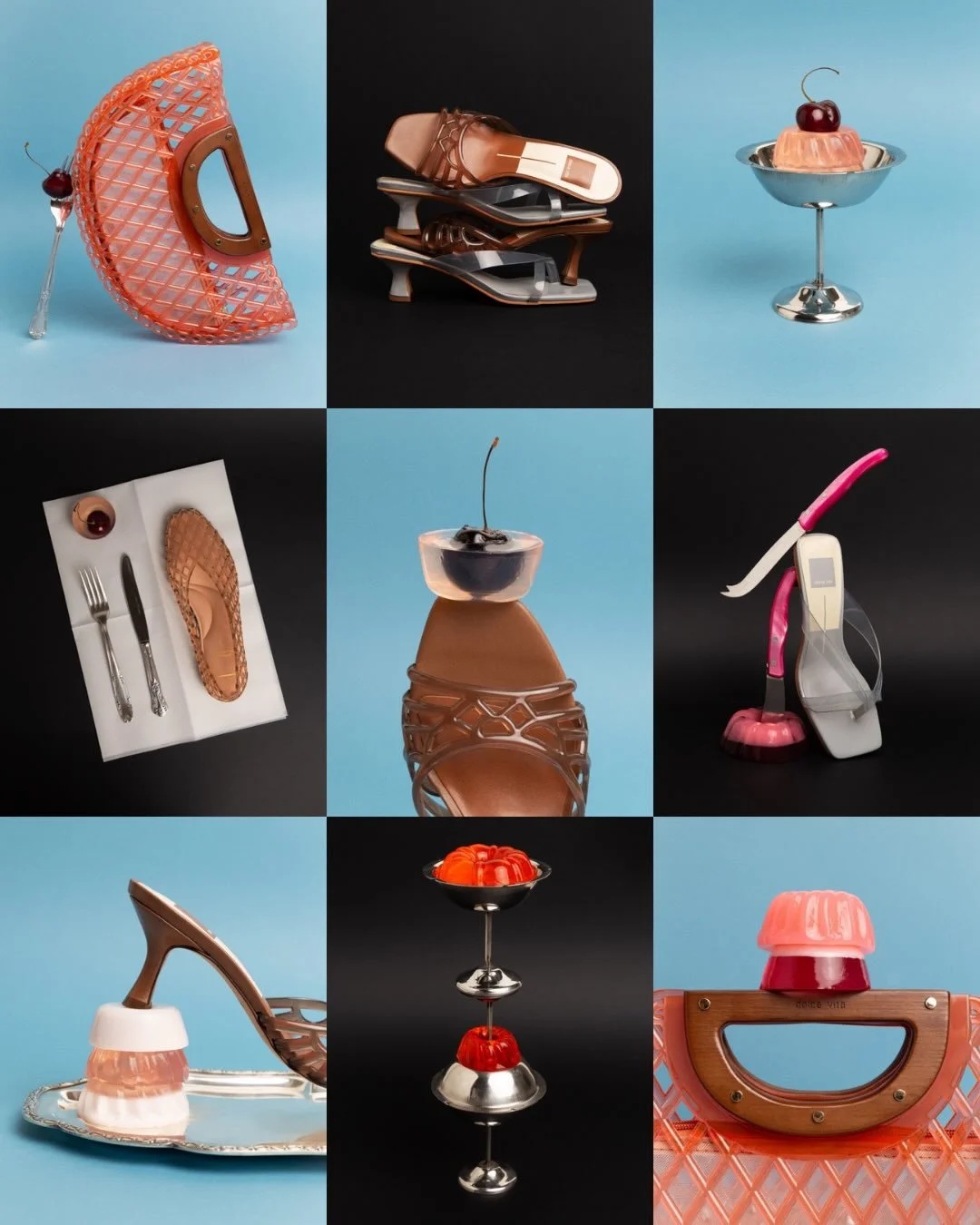
The shoes are served with dessert. On Blue Jeans Public Relations’ client page, a Dolce Vita collage sets sandals beside jelly molds, cherries and silver dishes. A heel balances over a pale pink pudding. The arrangement is funny, meticulous and instantly legible: this is fashion with an appetite for being noticed. Beside it sits a testimonial about something considerably less photogenic: having a useful outside team.
That pairing makes a good introduction to the agency. One side of publicity is the image people remember. The other is the coordination that gets a brand into the right conversation. Blue Jeans works in the space between the two, serving fashion, beauty, wellness and lifestyle businesses whose products need a public life beyond their own accounts.
A following is a starting point
Consider its customers. Dairy Boy has Paige Lorenze. Artless Forever has Maddie Orlando. Tezza has Tezza Barton. These are businesses with recognizable people attached. Their publicists are working with an existing identity, an audience and a set of expectations. The interesting problem is what to do with all that familiarity when the next person has never heard of the founder.
My reading of the agency’s work is that it offers translation: from a founder’s world into an editor’s story, a stylist’s request or an event someone has a reason to attend. A follower might understand a product because they have watched its creator for years. A stranger needs the explanation much faster. Publicity has to supply that explanation without requiring the stranger to catch up on the entire feed.
This is where Blue Jeans fits in the market: a specialist communications service for consumer brands, with close involvement in the people behind them. The buying decision is about access to judgment, relationships and execution. A founder is choosing the people who will help decide what the wider world should hear and how to present it.
The party needs a reason
The agency’s early work was unusually tangible. The PR Net’s 2024 profile names Dairy Boy’s denim launch and New York pop-up, the opening of Norma in West Hollywood, and Love All Tennis Co.’s fall/winter 2023 collection party. Each assignment had a concrete occasion. A collection arrived. A door opened. People could go somewhere and see something.
For a founder planning a launch, that is a useful distinction. “We would like more awareness” is a wish. A product, place and date give a publicist material to organize. They also give the audience a next step. An opening can be visited; a collection can be examined. The campaign has something sturdier to stand on than the company’s enthusiasm for itself.
Granger made a related observation in Forbes’ reporting on the Hamptons in August 2025. She described brands seeking proximity to residents, visiting influencers and VIPs, with events generating both conventional press and social coverage. The location does several jobs at once: gathering people, supplying context and creating something to photograph. Its appeal is understandable. The useful question for a brand is whether those particular people have a reason to care about its product.
After the photograph
Rumored provides a compact example of the next stage. In a 2025 Fashionista interview, Granger described turning Taylor Swift’s appearances in the brand’s Be Mine top into coverage in outlets including People and Page Six. The publicist’s reported contribution was the editorial follow-through. The sighting supplied the occasion.
The lesson worth borrowing is preparation. When attention arrives, a brand needs usable images, accurate product information and someone ready to answer questions. This is an editorial takeaway from the example, rather than a promise that the same sequence can be reproduced. A celebrity appearance is an uncertain input for any business plan.
Production is another part of the agency’s remit. Harper’s Bazaar Vietnam credits Blue Jeans Public Relations and Granger for production on a Tezza Barton feature. That small line matters. Readers see the finished editorial; the credit points toward the work required to bring it together. It places the agency inside the making of the feature as well as the broader business of pursuing attention.
The lists behind the look
Blue Jeans’ published menu spans editorial, brand development, partnerships and events, influencer and celebrity seeding, cover and shoot production, and crisis management. Those services let a client seek help at different moments: finding a story, introducing a product, organizing an appearance or handling a difficult conversation. The business sells professional work to other businesses; the people and their time are central to the offer.
A fall 2026 recruiting notice makes the daily mechanics unusually visible. It describes research, outreach drafts, gifting lists, coverage tracking, clippings and reports. The advertised internships are remote, unpaid and for school credit. Whatever the finished campaign looks like, a considerable portion of the process involves knowing who needs what, keeping information current and checking what actually happened.
The agency’s 2026 PR Net profile also documents a dedicated Celebrity Division handling stylist pulls, red carpet dressing and custom design requests. Those are specific coordination tasks. A request needs an answer; a garment needs to be available. Seen this way, relationship work includes a great deal of practical reliability.
“They’ve become a valuable extension of our team”
Nicole Reisman, Dolce Vita
Agency-published client testimonial
Reisman’s comment captures what the buyer remembers. On the same client page, Cacti Wellness founder Kira Jones describes help across launches, events, wholesale outreach and gifting strategy. These are selected testimonials, but their emphasis is revealing: the service is experienced through ongoing involvement, across tasks that a small brand might otherwise have to coordinate itself.
A name with room to move
When Granger announced Blue Jeans in 2023, she wrote about wondering whether she could fit into Los Angeles, then learning to value the ways she did not. Her launch note connected the agency to her family’s roots and compared its approach to a pair of jeans fitted to the client. The name was a statement about how she wanted to work.
By her August 2025 Fashionista interview, she said she had built the agency without outside investment and acquired clients through word of mouth. That is a description of how this business began, with an obvious implication for a service company: each engagement can influence the next introduction.
For a prospective client, the practical starting point is a brief with an actual decision in it. Identify the launch or problem, name the audience, set a budget, and agree on what the agency will deliver. Separate the work that can be commissioned from the response an editor or audience might choose. This approach is less useful when a business needs guaranteed immediate sales or has no clear product story to communicate.
The dessert-and-sandals photograph gets you to stop. The rest of the work gives that pause a purpose. Blue Jeans’ proposition lives in that interval: helping a brand turn a moment of attention into something people can understand, talk about and act on.