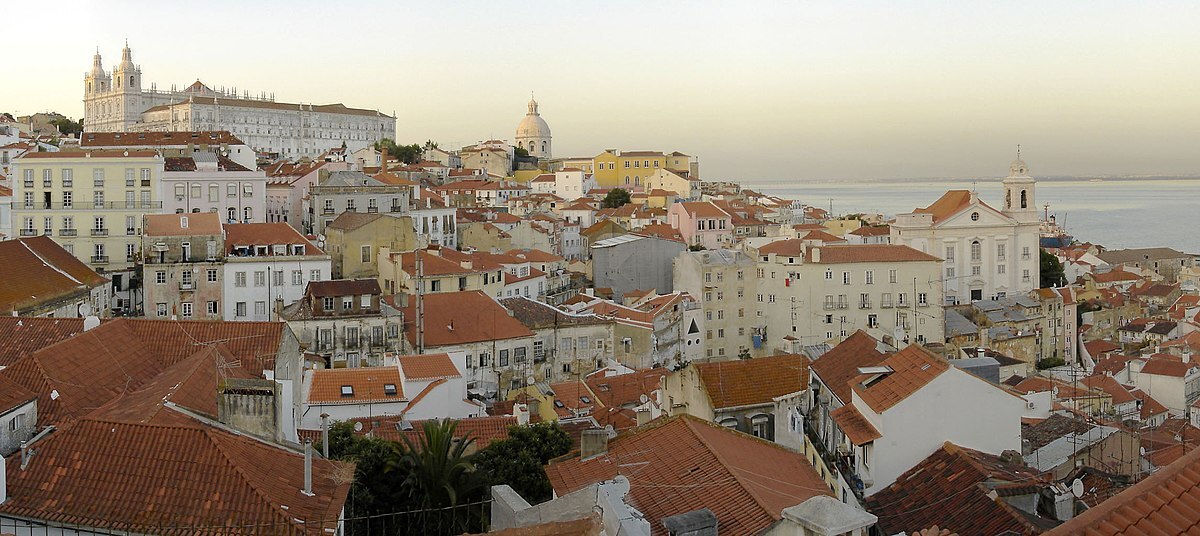
Lisbon does not introduce itself politely. It puts a hill in front of you. The pavement is a black-and-white mosaic, beautiful until rain turns it into a skating test. A yellow tram squeezes past with inches to spare. Somewhere above, laundry is doing more civic branding than most tourism agencies manage in a year. Then the street opens and the Tagus fills the horizon - broad, silver and easily mistaken for the sea.
The usual sales pitch stops there. It should not. Portugal's capital is more interesting as a working system than as a warm-toned photograph. The municipality held 545,923 residents in the 2021 census, but its daily audience is far larger: metropolitan commuters, students, founders, conference crowds and travelers funneling through an airport that received 18.2 million arriving passengers in 2025. Lisbon is a place, a public service, a global brand and a contested piece of real estate at the same time.
That makes the city sound suspiciously like a company with too many customer segments. Residents need housing, shade, schools and reliable rides. Visitors want access, atmosphere and a story they can take home. Businesses want talent and connections. The mistake is assuming one offer can satisfy all three. Lisbon's present tension comes from discovering that popularity is not the same thing as product-market fit.
2021 census
single ticket, 2026
passengers, 2025
01The first product was a grid built after disaster
Lisbon's talent for reinvention was not born in a strategy workshop. On November 1, 1755, an earthquake estimated by the city at magnitude 8.7 struck in three phases. A tsunami followed. Fires burned for days. Much of the downtown between Rossio and the river was wrecked. What failed first was the dense medieval fabric, especially in low-lying Baixa - buildings, escape routes and basic assumptions about permanence.
The response changed the city. Reconstruction produced broad streets, regular blocks and the Pombaline building system instead of simply restoring what had been there. Stand in Praça do Comércio now and the scale feels ceremonial, but the deeper idea is operational: circulation, repetition and a more rational structure. Lisbon's most elegant district is also a disaster-recovery artifact.
Lisbon's signature move is not preservation. It is reuse with the memory still showing.
That pattern returned in the east. The site chosen for Expo 98 was an abandoned industrial zone of old facilities, debris and scrap. The city and national government used a 132-day world exposition - 146 countries, 14 international organizations and 10,128,204 visits - to finance and accelerate a new district. The fair disappeared; Parque das Nações remained, with Oriente station, the Oceanário, housing, offices, promenades and a restored relationship with the river.
It was not cheap theater dressed as planning. The bet worked because permanent infrastructure and a post-event use were baked in. That is the copyable part for other cities: choose land with a real urban problem, build transit before the crowd arrives, and judge every temporary structure by what the district needs after closing day. It would not work where the event site is isolated, the transport is cosmetic or the debt survives longer than the public benefit.
02A transport network disguised as an attraction
The famous tram is where Lisbon's audiences collide most visibly. To a visitor, Tram 28 is a moving yellow prop connecting photogenic neighborhoods. To a resident, it is a small, old vehicle trying to perform public transport while backpacks block the aisle. The charm is real. So is the mismatch between celebrity demand and limited capacity.
The sensible way around Lisbon is less cinematic and more useful. The Metro's four lines run from 6:30 a.m. to 1 a.m. and treat stations as public-art rooms. Contactless bank cards work at Metro gates. In 2026, a CARRIS/Metro ticket costs €1.90, zapping is €1.72 for a Metro journey and a 24-hour CARRIS/Metro pass costs €7.25. For €11.40, a day ticket adds CP urban trains, opening routes toward Sintra and Cascais. Ferries make the river part of the network rather than a backdrop.
The anti-checklist route
Coffee and street life before the center starts performing for the day.
Take the descent slowly. The viewpoint is better when it has not become a queue.
Use the ferry. Lisbon's shape makes more sense from the water.
See the industrial east being rewritten while it is still a neighborhood, not a finished slogan.
What can a reader copy? Buy before boarding when possible, because an on-board tram fare is €3.30. Group a day by geography instead of racing between landmarks. Use the Metro for distance, feet for texture and the ferry for perspective. This falls apart for travelers with limited mobility if they assume every steep lane or station is accessible; route planning matters, and the historic pavement is unforgiving.
03The soundtrack is not décor
Lisbon's defensible advantage is cultural density. Fado is the cleanest example. UNESCO describes it as a Lisbon practice combining music and poetry, shaped by Afro-Brazilian dances, rural migration and early nineteenth-century cosmopolitan song. A singer is traditionally joined by acoustic guitar and the twelve-wire, pear-shaped Portuguese guitarra. It lives in concert halls, small fado houses and neighborhood associations; transmission happens through performers, families and informal teaching.
In other words, fado is not a premium add-on to dinner. It is a social technology for turning longing, bad luck and neighborhood memory into a shared room. Visitors get more from it when they choose a place that expects listening, arrive without demanding a greatest-hits set, and understand that silence during a performance is part of the deal.
The same rule applies to Lisbon's other pleasures. Pastéis de nata are not improved by treating one bakery as a pilgrimage emergency. Azulejos are not merely a blue pattern for tote bags; they manage surfaces, stories and climate. The calçada underfoot is a craft, a maintenance burden and a mobility problem all at once. Lisbon stays amusing because every beautiful object seems to have a practical complication hiding behind it.
04The market found Lisbon. Housing paid the price.
The city's difference from Barcelona, Madrid or Porto is not a single landmark. It is the compression of an Atlantic capital into a relatively small, legible municipality: old quarters, beaches and palaces nearby, an international airport close to the center, a strong English-speaking business scene and a startup ecosystem promoted through Unicorn Factory Lisboa and the Beato Innovation District.
The numbers explain the pitch. Unicorn Factory says it has supported more than 1,100 startups that together raised more than €1 billion. Startup Genome placed Lisbon among its Top 30 emerging global ecosystems in 2025 and reported ecosystem value up 13 percent since 2022. The support model spans incubation, acceleration, workspace, corporate partnerships, investor access and international exposure. Lisbon sells founders a network wrapped in a good place to live.
Popularity ledger · different units, same pressure
Bars are indexed for visual comparison, not drawn to one shared scale.
But a city cannot onboard new users indefinitely without adding capacity. The OECD counted 21,181 Airbnb listings in Lisbon in December 2024, equal to about 7.6 percent of dwellings in the urban area. It also found a high share of vacant and holiday homes in the center. Rent for a relatively small flat can consume most of a household's net income in metropolitan Lisbon. The value proposition for a remote worker and the monthly reality for a local employee are not the same spreadsheet.
What changed the official mind was not one dramatic failure but accumulating evidence: resident loss, housing stress and entire pockets where visitor accommodation competed with permanent homes. Lisbon created containment rules for local accommodation, suspended new registrations in pressured areas and raised its nightly tourist tax to €4 for eligible guests, capped at seven nights. The city now treats tourism as something to manage, not simply maximize.
Put visitor revenue into transport, public space and neighborhoods beyond the overloaded core. Make the easiest tourist choice useful to residents too.
Housing supply stays fixed, wages lag, short stays outbid long ones, or promotion sends everyone to the same six streets at the same hour.
05The next rebuild is less photogenic
Lisbon was European Green Capital in 2020 and now aims for climate neutrality by 2030, including an 80 percent greenhouse-gas reduction from 2002 levels. The practical work includes electric Metro service, reduced-emission zones, cycling links, neighborhood speed controls and green corridors. The Monsanto corridor alone covers 51 hectares and offers roughly 40 kilometers of trails linking the center with the city's largest urban park.
These projects matter because the next Lisbon emergency will not announce itself with nine minutes of shaking. It will arrive as hotter streets, flash flooding, unequal access to shade and a housing market that quietly edits out the people who make the city function. A climate walk, a protected cycle connection or a converted vacant home lacks the instant drama of a new museum. That is precisely why it is harder to sell and more important to do.
Lisbon's history offers a useful standard. The Pombaline grid worked because it changed the underlying system. Parque das Nações worked because an event left a district. The current response will work only if climate targets alter ordinary journeys and tourism income improves ordinary neighborhoods. Awards, rankings and record arrivals are outputs. A city where a nurse, a waiter, a founder and an older resident can all stay is the product.
For a visitor, the respectful version is also the more enjoyable one. Stay longer. Travel off-peak. Spend in streets where breakfast is still breakfast, not a content set. Learn which tram is carrying commuters before squeezing aboard. Cross the river. Listen when the singer begins. Lisbon does not need help becoming desirable. It needs guests, investors and policymakers who understand that the thing they came for is a living city, not unlimited inventory.
Open tabs worth keeping