Pat Gouhin came to angel investing with an engineer’s interest in how things work. The complication was that some of the people around him placed considerable value on a feeling. In a 2025 conversation with Andrew Kazlow, he described the friction between his instinct for standardization and his board’s insistence on the place of gut judgment. A young company, apparently, was going to resist being treated like a neatly specified component.
It is a useful place to begin with the chief executive of the Angel Capital Association. His work concerns people who commit their own money to businesses early in their lives. He wants the knowledge behind those decisions to become more accessible and more organized. Experience has a seat at the table. So does the question of what experience can teach.
Gouhin’s professional route helps explain that interest. Before the angels came aerospace and automation, followed by the daily work of running member organizations. He learned to operate in communities whose expertise belonged to many people. An association executive has to persuade those people that sharing what they know is worth their time. The job description sounds rather tidier than the job.
An engineer meets the angels
He began as ACA’s CEO on May 20, 2019. Marianne Hudson, the organization’s founding executive director, would retire after a transition. The appointment brought in someone with three decades of association management experience, including chief executive, executive director and operating roles. Gouhin was to work from North Carolina’s Research Triangle area while the association retained its Kansas City-area headquarters.
The distinction matters. This was a professional community hiring someone to help run and develop it. His public introduction emphasized membership, services, management and policy experience. Those are less cinematic subjects than the dramatic rescue of a startup. They are also the work that lets a community keep serving people once an exciting meeting has ended.
Asked in 2020 how he had become involved, Gouhin gave an unusually direct answer: “Neither as an entrepreneur nor as an investor.” His background was engineering and association management. He saw an opportunity to bring the practices of established professional societies into a younger community. The outsider’s advantage was a different set of comparisons; the work involved learning from the people already there.
“A steward means a caretaker.”
Pat Gouhin, 2020
The long apprenticeship in associations
Gouhin earned a bachelor’s degree in aeronautical and astronautical engineering at Ohio State and a master’s in engineering management at George Washington University. He later completed executive education at Wharton and Stanford. His credentials cover both a technical discipline and the administration of complicated work. He is also a Certified Association Executive, a qualification that puts a name to his eventual profession.
He spent 15 years with the American Institute of Aeronautics and Astronautics, including service as chief operating officer. Another assignment placed him at the beginning of the National Institute of Aerospace at Langley Research Center. He served as integration lead on the successful proposal behind a $69 million government contract, then became the institute’s first vice president of operations and technology transfer.
That role involved the day-to-day operations of a 50-person startup. The term has a different setting here from the companies ACA members fund, but the operational demands were concrete: a new institution had to function. A proposal can describe an organization beautifully. Someone still has to help turn it into a working place.
AIAA leadership and the launch of the National Institute of Aerospace.
Named executive director of the International Society of Automation.
Begins leading ACA, bringing association experience into early-stage investing.
In 2006, Gouhin became executive director of the International Society of Automation. His tenure there lasted 12 years. The organization’s work included technical standards, professional education and the people responsible for making industrial systems operate. It was another setting in which useful knowledge had to pass between specialists, institutions and employers.
Knowledge that travels
In March 2013, Gouhin wrote about a meeting in Hong Kong with fellow association executives. The group was discussing international growth: which markets to prioritize, how different cultures affected the work, what had succeeded and what had failed. The gathering offered a chance for organizations to borrow experience from one another before repeating an expensive mistake.
His conclusion was plain: “It is clear that there is no cookie cutter approach or single solution that is the key to continued international growth.” The sentence is a useful counterweight to his interest in standards. He was advocating collaboration while acknowledging that context changes the answer. A professional society can carry knowledge across borders; it still has to listen when it arrives.
The less glamorous side of that knowledge work appears in a 2014 preview he wrote of ISA’s new website. He described news, events, publication features, job postings, video and ways to engage with colleagues. It reads like a practical inventory of what members might need. Expertise becomes more useful when people can locate it without having to know the right person first.
That modest design problem runs through his career. An association has accumulated information, relationships and experience. Its members have limited time. The executive’s task includes arranging the first so that it serves the second. The website, the meeting and the course are all ways to make that exchange happen.
Rules around the table
At ACA, public policy is part of the exchange. On January 20, 2023, Gouhin joined other association and regional startup leaders for a two-hour meeting with SEC Commissioner Hester Peirce in Research Triangle Park. Their subjects included the accredited investor definition, qualified small business stock and the conditions that allow a startup community to function.
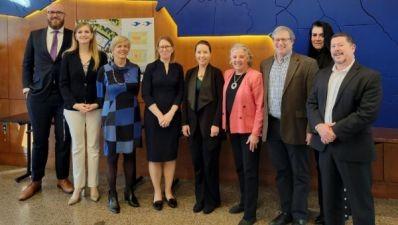
Later that year, he appeared on an SEC Investor Advisory Committee panel about accredited investors. The September 21 discussion examined who should qualify to invest in private markets and how qualifications should balance financial sophistication, resources and investor protection. It put the community’s concerns inside a formal regulatory conversation. The setting required arguments that could be examined by people with different responsibilities.
A smaller-scale example had appeared in Gouhin’s writing in 2021. He described a Louisiana rule change that made certain convertible and subordinate debt investments eligible for the state’s angel investor tax credit. Local investor groups had worked on the issue for three years. The eventual route involved a change to program rules rather than new legislation.
His account gave credit to the local advocates and the economic development officials involved. That makes it revealing as a piece of association work: the organization explains a result achieved by a network of people. A founder may experience the consequence as another financing possibility. Behind it sits an argument about the wording of a program. Bureaucracy occasionally earns its keep.
A classroom with a wider door
Gouhin’s June 2021 account of ACA’s direction organized the work around four areas: community networking, data analytics, education and public policy. Seen together, they describe the job he had taken on. People need a way to meet, information to compare, opportunities to learn and a voice in decisions that affect their activity. None works especially well in isolation.
Four areas Gouhin outlined for ACA in 2021. A framework for services, rather than a formula for returns.
His January 2022 review described education becoming a more developed set of products. Angel University had added courses on risks and exits during 2021. ACA had also launched peer-reviewed Angel Insights Publications. The same review looked ahead to the official launch of the Angel Investor Foundation, the charitable arm that Gouhin’s professional biography credits him with creating.
The emphasis on community extends beyond people already making investments. In 2022, he served on the organizing committee of the Diversity and Equity Accelerator through Learning for Startups, an initiative funded by the United Engineering Foundation. Its sessions addressed the path from engineer to entrepreneur, available resources, business planning and regulatory questions. Here was a connection between his original training and his newer professional territory.
The 2026 Bill Payne Memorial Scholarship makes the educational ambition particularly tangible. One recipient can take the eleven-course Angel University program, with two hours of material per course, leading to the Advanced Angel Investing Certificate. Eligible applicants are full-time community ecosystem builders working in US economic development organizations, innovation hubs or nonprofits supporting local entrepreneurship.
The audience is a deliberate choice. Someone organizing a region’s entrepreneurial activity can use investment knowledge in conversations with founders, institutions and prospective investors. The scholarship treats that person as part of the community worth educating. It offers a recognizable path through material that could otherwise remain scattered across introductions, meetings and hard-earned experience.
The discipline of asking better questions
By July 2026, Gouhin was describing a market with more deliberate portfolio construction and stronger diligence practices. ACA’s Angel Funders Report recorded $491.3 million of investment in 2025, compared with $437 million in 2024, among the member organizations contributing data. The figures describe the reporting pool. They are a view into part of the market, with a defined context.
Investment reported by contributing ACA member organizations. Values are not totals for the entire US angel market.
The report’s language about discipline brings the story back to the engineer and the feeling. Gouhin’s 2025 interview had revisited the relationship between professional knowledge and subjective judgment. He also discussed education as a possible route toward broader investor qualification. That was an ambition for the profession’s future, one requiring more than the creation of a course.
His career offers a practical way to understand the work in front of him. He has helped run institutions where expertise is distributed, where volunteers matter and where a common vocabulary helps people collaborate. At ACA, the subject includes young companies with unsettled futures and investors making consequential decisions about them. The association can give those people more opportunities to prepare.
There is something appealingly untheatrical about that assignment. A class needs to be organized. A colleague needs to be introduced. A policy question needs an explanation. Gouhin’s story gives those tasks their proper place beside the funding announcements. The next person through the door should have someone to learn from, something useful to read and a better question to ask.