The most revealing thing about Lisa Vormittag’s job is the conjunction. She is the chief financial officer of VAI, the Long Island enterprise-software company, and she has also directed its marketing. Finance tends to arrive with a spreadsheet. Marketing brings a story, a booth, a campaign and an alarming number of opinions about typefaces. Vormittag has spent three decades making the two sides speak to each other.
Her remit reaches from budgets and financial planning to content, conferences and marketing programs. That range suits a company whose software tries to connect the moving pieces of another business: accounting, inventory, warehouses, sales, e-commerce and analytics. At VAI, the executive reading the numbers also has reason to ask how the customer experiences the message behind them.
The arrangement is unusual enough to be instructive. A CFO can tell whether a campaign paid for itself. A marketing director can tell whether anyone cared. Put those perspectives in the same head and the conversation gets shorter. Cost, attention and customer value meet before the meeting has time to multiply.
A surname gets you noticed. The work decides what happens next.
VAI began in 1978, when Bob Vormittag stayed on Long Island and built software for businesses that needed their accounting and operations to behave. His daughter Lisa joined in 1995. Her brother, Bob Jr., started that year too, beginning on the help desk. The family connection is plain. So is the duration of the work that followed.
By 2008, Lisa was publicly identified as VAI’s CFO. Her education traces a route toward the two-sided role she would occupy: multidisciplinary study in business, psychology and political science at SUNY Stony Brook, an MBA from Dowling College, then a master’s in accounting from Long Island University’s C.W. Post campus. The sequence moves from how organizations and people behave to how their choices are measured.
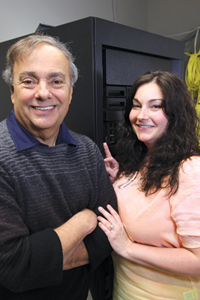
Joining a founder’s company creates a peculiar test. History is always in the room, but history cannot close the books, run the conference or explain the next software release. VAI’s customers operate in distribution, manufacturing, food and pharmaceuticals. Their daily questions are stubbornly concrete: What is in stock? Where is the shipment? Which lot expires first? What did that order cost? A family narrative may supply continuity. It does not scan a pallet.
Vormittag’s public comments stay close to those practical edges. In 2013, she explained that VAI’s mobile application let sales representatives see where a customer sat in the sales cycle. The sentence is less about a phone than about timing. Information becomes valuable when the employee who needs it can see it at the moment a decision is due.
The marketing weapon hidden inside a partnership
The same year, Vormittag offered a glimpse of the financial brain at work inside marketing. VAI’s long IBM relationship included co-funded promotion. If the materials followed IBM’s rules and carried IBM content, the larger partner would help pay for trade-show materials and magazine advertising. Vormittag called the arrangement “a real marketing weapon.”
It was a lively phrase for an unglamorous mechanism. That is precisely why it sticks. Independent software companies rarely win a spending contest against larger rivals. They can, however, find leverage: a partner’s reach, a narrow industry specialty, a customer relationship held long enough to reveal what generic software misses. The CFO sees the saved dollar. The marketer sees the borrowed megaphone.
VAI’s independence adds weight to that habit. The company moved through consolidation in the ERP market without selling. Its software crossed from IBM-centered installations to browser access, mobile tools, cloud delivery, analytics and, more recently, AI-assisted functions. Each transition demanded investment. Each also risked confusing motion with progress.
One tenure, four operating eras
Her 2015 remarks on analytics sound current because they begin with business questions. What challenges lie ahead? What services will customers want? She highlighted three capabilities for CFOs: access to real-time data, visualization and the capacity to analyze data at scale. The point was not to admire the dashboard. It was to improve forecasting, distinguish the company in its market and locate possible revenue.
That view collapses another organizational wall. Data is not the private garden of the technical department. Finance needs it to model risk. Marketing needs it to understand demand. Operations needs it before the truck leaves. The useful company is the one in which the answer travels faster than the question changes.
Preparation is creativity with a calendar
In 2020, VAI moved its Prevail customer conference online. Vormittag wrote a short guide to the conversion. The advice contains little theatre and plenty of stage management: choose a platform around requirements; assign clear roles; develop the theme and timeline; rehearse the equipment with every participant; create surveys, games, questions and networking opportunities.
The list reads like an operator’s pocket card. It also reveals the benefit of her dual role. Finance identifies dependencies. Marketing designs attention. A virtual event fails if either side goes missing. Perfectly controlled software with a bored audience is a lonely server. A sparkling agenda on an untested platform is a scheduled apology.
Choose for the job
Start with registration, breakout, support and audience needs before selecting the platform.
Assign the team
Make responsibilities visible and keep a regular rhythm of status checks.
Test the whole system
Include internal and external participants in the run-through, not just the technical crew.
Design participation
Use questions, polls, games and useful networking so the audience has a role.
Her closing line was warmer: “It’s your conference, your customers, and your brand.” Build an experience that people will discuss afterward, she urged. The sentence puts ownership and hospitality together. A customer event is a temporary piece of software. It needs architecture, testing, an interface and a reason to return.
The long view still has to ship on Tuesday
By 2024, 2025 and 2026, Vormittag was representing VAI in announcements of its placement on CRN’s Solution Provider 500. The annual comments form a small time series of their own. She spoke about technological acceleration and customer transformation, then adapting to a fast-moving landscape, then investment in cloud innovation and cybersecurity with measurable return.
The vocabulary changes because the operating environment changes. The underlying concern remains stable: technology should help customers compete, expand and keep working. In 2025, she also described VAI’s redesigned website as a place where customers, partners and prospects could connect more easily with the company’s products and ideas. A website refresh sounds modest beside artificial intelligence. For the person trying to understand an ERP system on a lunch break, navigation is strategy.
Three decades at one company can be told as loyalty. A more interesting reading is accumulated context. Vormittag has seen which promises survive implementation, which customer questions return in new clothes and which technological shifts alter the work beneath the label. That memory is useful only when it remains curious. Her public record suggests curiosity disciplined by checklists.
There is an appealing symmetry to her position. ERP software promises one view of the enterprise. Vormittag’s career has required two views of VAI at once. The ledger asks whether the plan is sound. Marketing asks whether the plan can be understood. Customers, with admirable efficiency, ask both.
The lesson available for stealing is small enough to keep: put the people who measure value closer to the people who explain it. Let customer signals reach the budget. Let operational limits sharpen the creative brief. Then rehearse before everyone arrives. It is not glamorous advice. It has the useful shine of something handled often.
It also changes how ambition sounds. In a public statement about VAI’s 2026 industry recognition, Vormittag linked the company’s next investments to cloud innovation, cybersecurity, customer-focused service and return on investment. Those terms form a tidy chain. New infrastructure needs protection. Protected infrastructure needs to solve a customer problem. The result needs to justify the expense. The future enters the building through a purchase order and eventually has to show its work.
Her path offers no grand reinvention scene, no ceremonial leap from one industry to another. It offers something rarer in profiles: the texture of staying useful. Learn the new delivery model. Rework the conference. Redesign the site. Ask the analytics system a better question. Keep the customers close enough to hear when their needs change. Continuity, in that telling, is a series of renewals disguised as an ordinary workweek. Vormittag has been having that workweek since 1995.