When Kogta Financial announced a ₹1,230 crore investment in June 2024, Varun Kogta chose to talk about what the money would do to the balance sheet. The number was large enough to carry the headline by itself. His response concerned the confidence of credit rating agencies and lenders. It was a CFO’s answer: the applause would end; the borrowing relationships would still need tending.
There is a useful way into his story here. A company that lends money must also persuade other people to finance it. Between a used commercial vehicle and an institutional investor lies a substantial amount of accounting, reporting and judgement. Varun works in that space. Based in Jaipur, he is Kogta Financial’s Whole Time Director and Chief Financial Officer, with responsibilities that reach into the company’s wider administration.
The business bears his surname, but its history began before his professional career. Kogta Financial was incorporated in 1996 by Banwari Lal Kogta, Bal Mukund Kogta and Radha Krishan Kogta. Today its leadership includes Varun, his brother Arun, the Managing Director and CEO, and Nayan Kogta, the Chief Operating Officer. A family name has travelled into an organisation with institutional investors, outside directors and an expanding lending book.
A banking education, from both sides of the desk
Varun studied commerce at Sydenham College of Commerce & Economics and qualified as a chartered accountant. Before Kogta, he worked at Ernst & Young and ICICI Bank. His audit experience involved ICICI Bank and Axis Bank; his work inside ICICI included treasury. That combination put him near both the production of financial information and the scrutiny applied to it.
For an auditor, a bank is a collection of claims that must stand up to examination. For someone working inside it, the same institution is an operating business with funding needs and obligations. The significance of Varun’s background is the opportunity to see both perspectives before carrying those habits into a smaller lender. It is a practical preparation for a career in which confidence needs evidence.
He first joined Kogta Financial’s board on 25 April 2014. The date marks a formal responsibility, rather than the beginning of the company or a claim that he invented its business. By then, the family enterprise already had a lending history. His subsequent public record shows a finance executive explaining how outside capital could support the next stage of that enterprise.
A surname is a convenient introduction. It is less useful when a lender asks for a cash-flow statement. Varun’s working life sits at that junction: inherited business context on one side, professional financial accountability on the other. The interest lies in what happens when the two have to share a desk.
The vehicles have already lived a little
Kogta’s products include financing for new and used commercial vehicles, cars and tractors, alongside loans against property and secured business lending for smaller enterprises. Its customers include farmers, taxi operators, small transporters and traders. This is an economy in which a vehicle can be both something owned and something used to earn.
A used vehicle brings a previous life into a new loan. For the buyer, it may be a practical way to acquire an earning asset. For the lender, it places attention on the borrower, the asset and the ability to collect repayments. The product’s everyday familiarity can make its financial complexity easy to overlook. A truck is straightforward to picture. A sound lending operation is harder to draw.
The company’s commercial vehicle finance operations began in 1998. Its expansion therefore grew from an established business rather than a newly discovered product category. Varun’s part in the story belongs to the financial organisation supporting that expansion. The vehicles give the lending book its physical subject; the funding arrangements determine how much of that book the company can support.
A simplified view of the relationships a lending business must sustain.
Four announcements, one recurring concern
In November 2018, Kogta raised ₹154 crore from a Morgan Stanley Private Equity Asia-managed fund and IIFL Seed Ventures. Varun discussed expansion into further geographies and the effect on the company’s financial capacity. At the time, the business had 80 branches across six states and served more than 20,000 customers. The funding announcement attached a national financial name to a regional operating network.
Less than a year later, in October 2019, a ₹300 crore Series C round brought in Creador alongside Morgan Stanley. Kogta reported 105 branches in eight states and a loan book of roughly ₹825 crore at the end of September. Varun’s explanation again stayed close to the plumbing: stronger owned funds, liquidity and the timing of assets and liabilities.
“This investment has substantially increased the net owned funds”Varun Kogta, on the 2019 investment
That vocabulary matters. A lender receives repayments over time while meeting its own obligations on their agreed dates. Growth cannot be assessed solely by how many new loans it makes. The financing behind those loans has its own schedule. Varun’s comments suggest a consistent professional concern with the capacity to carry expansion, including the money available when commitments fall due.
In 2022, the company announced an ₹846 crore Series D round led by Multiples, with participation from CPP Investments and existing investors. The transaction also provided an exit for IIFL, the first institutional investor. Ownership was changing while the business continued. Varun shared the announcement on LinkedIn, where much of his visible activity concerns the company’s milestones.
The 2024 investment brought Ontario Teachers’ Pension Plan into the shareholder group. The ₹1,230 crore transaction combined capital for the company with partial exits for Morgan Stanley and Creador. A subsequent rating assessment put the fresh equity component at ₹610 crore. The distinction is worth keeping: money changing hands between investors has a different destination from money entering the business.
Varun linked the investment to stronger financial capacity and confidence among the institutions financing Kogta. Ontario Teachers’ investment announcement, in turn, credited Arun and Varun with developing a business attentive to asset quality, technology and talent. That is an investor’s assessment of their joint work. It also places the CFO inside the operating story, alongside the colleague whose title more readily attracts the spotlight.
The signature below the expansion
There is another kind of public appearance in Varun’s record: the CEO and CFO certification accompanying the 2018-19 accounts. He and Arun accepted responsibility for internal controls over financial reporting and certified their review of the financial statements and cash-flow statement. Such pages rarely become anyone’s favourite reading. They are nevertheless where an executive’s name meets an explicit obligation.
The certification also covered changes in accounting policies and internal controls, and disclosure of any significant fraud of which the executives had become aware. This is the detailed side of accountability: the responsibility to bring problems into view, rather than leave a clean set of totals to speak for itself.
The ceremony of a financing announcement lasts a day. Reporting recurs. Budgets recur. Questions from banks recur. Varun’s responsibilities include those repetitions, alongside financial, operational, legal and administrative work. The 2026 AGM notice also describes an IT remit. This is a broader job than counting the proceeds of investment rounds, even if the proceeds provide the easiest numbers to remember.
The scale of the work has changed. In September 2024, Kogta had ₹5,241.11 crore in assets under management and 252 branches. For the year ending March 2025, its operating income was ₹1,001.56 crore and profit after tax ₹166.19 crore. Those are company results produced by an organisation, rather than an individual scorecard. They set the size of the institution within which Varun’s responsibilities now sit.
The same March 2025 figures put net non-performing assets at 1.77%, compared with 1.30% a year earlier. Expansion brings more accounts to manage and more obligations to monitor. It does not remove the question of repayment. Reading the growth figures beside the credit figures gives the finance role a clearer setting: capacity must be maintained as the business becomes larger.
A trophy, then back to the numbers
One photograph offers a smaller, warmer scale. In a public post, Sumit M. shared his receipt of “The Inspirer 2021” recognition from Varun. The two stand together holding a trophy, Varun smiling on the right. A finance career usually leaves a trail of tables; this moment has the decency to include an actual human expression.
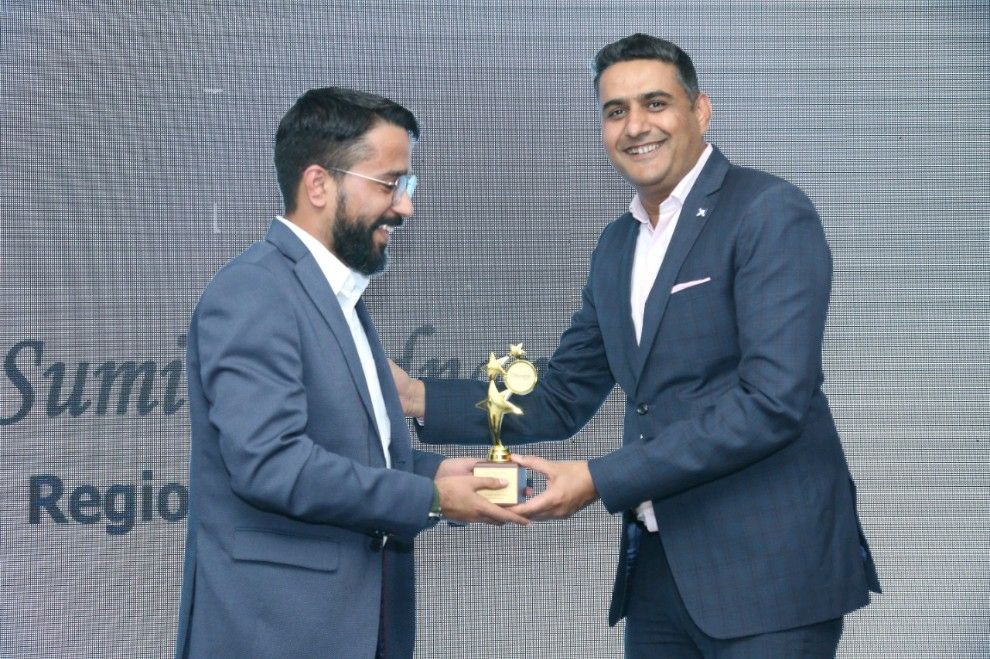
The photograph records a particular recognition, rather than proving an entire management philosophy. Set beside the formal record, it is a useful glimpse of the person occupying the role. People within a company encounter executives through meetings, acknowledgements and decisions, while the wider world often encounters them through a title below a quotation.
In a 2025 video published by Multiples, Varun discussed the investor partnership. The accompanying account highlighted openness to ideas, speed of decision-making and access to experienced professionals. These themes extend the capital story beyond money. A new shareholder can bring people into the conversation as well as funds into the business.
The direction visible in Varun’s public comments is continued growth supported by financial strength and sustained investor relationships. It is an aspiration expressed in the language of his job. Back in Jaipur, the underlying task remains easy to state and demanding to perform: helping a lender retain the capacity to lend. Every new vehicle loan gives that balance sheet another working life.
Continue reading & watching
- Kogta Financial
- Varun on LinkedIn
- Leadership biographies
- 2024 investment announcement
- 2019 capital announcement
- 2018 funding coverage
- 2022 investment coverage
- 2024 financial assessment
- 2025 financial figures
- 2026 AGM notice
- Watch: Varun on the Multiples partnership
- Employee recognition photograph
- Company YouTube channel
- Company Instagram
- Company Facebook
- Company X
- Company LinkedIn