Asked to explain an expensive collection of computer chips, Liang Wenfeng reached for a domestic object: a piano. You buy one because you can afford it, he reasoned, and because there are people eager to play. This was his explanation for a computing investment that would eventually help support DeepSeek. Accountants might have preferred a spreadsheet. Liang offered a music room.
The comparison appeared in a 2023 interview, before his name became familiar far beyond Chinese finance. It is a useful place to begin with him. The instrument mattered. So did the players. A machine sitting idle would have been an extravagance; a group of curious researchers without machines would have been a conversation. He had spent years putting the two together.
By January 2025, that arrangement had produced an AI company whose releases were being examined around the world. Liang appeared at a meeting with Premier Li Qiang on January 20, the same day DeepSeek released its R1 reasoning model. The founder with thick glasses was suddenly part of a much larger public story about China, American technology and the cost of building intelligence.
But his route there had a less ceremonial beginning. It ran through engineering classes, experiments in automated trading, a successful quantitative investment business and a willingness to spend its resources on questions that had no tidy commercial timetable. The revealing question about Liang is how he arranged to keep asking them.
A researcher’s questions.
From machine vision to markets to general AI.
The student behind the trader
Born in 1985, Liang grew up in Wuchuan, Guangdong, in southern China. He went to Zhejiang University in Hangzhou at seventeen, studying engineering and later completing a master’s degree in 2010. The geographical move became a durable connection: Hangzhou would also become the base for DeepSeek. His education supplied a more specific inheritance than the familiar entrepreneurial origin story suggests.
His master’s work concerned tracking objects with a low-cost pan-tilt-zoom camera. In his thesis acknowledgements, he credited his supervisor, Xiang Zhiyu, with introducing him to machine vision and helping him work through code. The detail is modest and telling. Long before language models became a public fascination, Liang was working on the practical problem of getting machines to interpret what they encountered.
After university, he experimented with AI applications from a rented apartment in Chengdu. Finance eventually provided a workable direction. He co-founded High-Flyer in 2015, building a quantitative trading business around mathematical methods and machine learning. The business required the tools he cared about: data, algorithms and computing hardware. It also offered a way to pay for more of them.
Trading is an unforgiving place to develop an enthusiasm. An elegant model still has to survive contact with a market. Liang’s later move into general AI therefore came with a useful complication: the advocate for curiosity had already spent years in a business that measured outcomes in money. He knew what a commercial scoreboard looked like. He wanted room for experiments that would take longer to score.
Buying time, buying machines
High-Flyer’s computing capacity grew over years, rather than arriving in one inspired shopping trip. By 2021, its Fire-Flyer 2 infrastructure contained roughly 10,000 Nvidia A100 GPUs. The purchases preceded the American export restrictions that would make access to advanced chips a persistent constraint for Chinese AI companies. The equipment gave Liang’s research ambitions somewhere to run.
He announced the move toward general AI in 2023. DeepSeek was the independent research effort that emerged, backed by High-Flyer. The ambition extended beyond improving a trading strategy or supplying software for financial institutions. Liang wanted to investigate artificial general intelligence: the still-unresolved prospect of machines able to handle a broad range of intellectual tasks.
That distinction affected the timetable. A finance product could be judged by a customer, a portfolio or a contract. Foundational AI research could consume resources while producing an answer that led mainly to another question. Having an established business behind the laboratory bought some freedom from the requirement to turn every experiment into a product immediately.
There is a temptation to treat this as a romance in which money politely leaves the room. The hardware makes that reading difficult. Curiosity needed capital, electricity and engineers. What made Liang’s arrangement interesting was the use he made of financial success: he could support an uncertain research programme without first persuading every prospective investor to enjoy uncertainty.
- 2010Completes his engineering master’s at Zhejiang University.
- 2015Co-founds High-Flyer, applying computation to trading.
- 2023Establishes DeepSeek to pursue general AI research.
Let the work travel
DeepSeek-V2 brought his approach into clearer view in 2024. The model combined technical changes with low API prices, helping set off a round of price cuts among Chinese AI providers. Customers saw a cheaper service. Competitors saw a pricing problem. Liang described the change as following from lower costs and the wish to make AI affordable, rather than a carefully staged campaign to collect users.
His defence of sharing the work followed a similar logic. Published research and released model weights gave other people something to examine and build on. A rival might copy a technique, but the team that developed it would retain experience and the ability to attempt the next problem. In Liang’s account, the organisation’s accumulated judgement was a more durable asset than a temporarily private trick.
“More investment does not necessarily produce more innovation.”
Liang Wenfeng · 2024 · translated from Chinese
It is a pointed observation from someone who had bought so many chips. Scale supplied opportunities; it did not guarantee that anyone would use them well. His bet depended on researchers noticing a useful possibility, testing it and finding colleagues able to help. The management question was how much room to leave between an idea and an instruction.
There is also an unusual bargain in the open release itself. A laboratory gives away material that others might charge to keep private. In return, its work can circulate, attract scrutiny and become useful beyond its own products. For Liang, the scientific ambition and the appeal to potential colleagues belonged together. A researcher could help create something that other researchers would actually use.
The number that needed a footnote
The December 2024 release of DeepSeek-V3 supplied a memorable number. Its technical report put the compute cost of the official training runs at about $5.576 million, using an assumed rental price of $2 per H800 GPU-hour. The figure was specific. Public discussion often made it sound much more comprehensive.
It did not describe everything spent to create the company, buy its hardware, pay its people or explore unsuccessful approaches. The report excluded prior research and ablation experiments. Treating that training estimate as the full price of DeepSeek would be rather like pricing a restaurant by the gas used during dinner. The cooking matters; so does everything that made dinner possible.
The architecture nevertheless offered a concrete example of economical computation. V3 had 671 billion parameters in total, with about 37 billion activated for each token. Its mixture-of-experts design routed work through selected parts of the model. That made the difference between total capacity and the amount used for a particular step central to understanding the system.
R1 followed in January 2025, bringing attention to reasoning and reinforcement learning. DeepSeek released model weights and smaller distilled models, giving developers ways to work with the results outside a single hosted chatbot. The release helped turn Liang’s preference for research that travels into something tangible: files, code and technical explanations that other people could put to work.
Reported V3 architecture. This ratio describes parameter activation, not a percentage saving in total training cost.
Explore the technical report ↗A seat at a different table
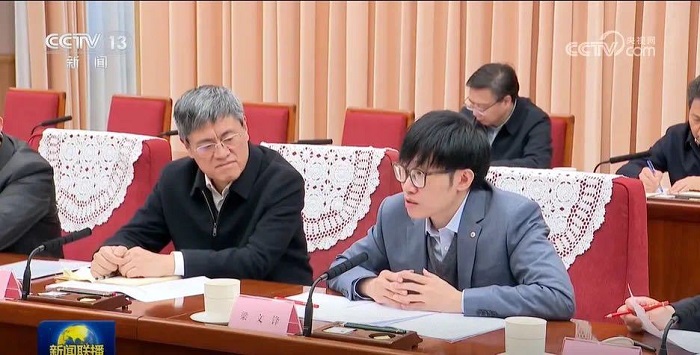
The meeting photograph from January 20 catches Liang in a grey jacket, speaking into a microphone across a formal conference table. The red chairs have white lace covers. It is an excellent setting for a conversation about the future: even the furniture appears determined to preserve the past. The occasion concerned input on China’s draft Government Work Report.
Liang also attended the February 2025 symposium with private-sector business leaders chaired by Xi Jinping. These appearances placed the founder of a young laboratory among established names in Chinese business. They showed how quickly a research release could acquire national significance. A company built around technical questions had become part of a public discussion about technological capability.
The recognition spread beyond those rooms. He appeared on the 2025 TIME100 list, and Nature included him in its annual selection of ten people who shaped science. Those honours described the reach of DeepSeek’s work. They did not settle its scientific ambition. AGI remained a goal, and a successful model release remained one stage in a continuing research programme.
The price of the next question
By 2026, the funding arrangement was changing. DeepSeek raised $7.4 billion in its first external financing round in June, according to subsequent reporting. On October 22, a further round of roughly 100 billion yuan, about $15 billion, was reported to be nearing completion. The reported participants included existing shareholders Tencent and CATL. Final terms could still change.
That is a substantial development for a founder who said in 2024 that there were no near-term fundraising plans. The dates matter. A statement about one stage of a company’s life need not govern every later stage. The harder question is what happens to research independence as the laboratory’s ambitions, costs and circle of financial stakeholders expand.
The releases continued alongside that change. DeepSeek introduced its V4 preview in April 2026, including open weights and a million-token context window. Its October 17 update added public search API access and refreshed V4.1-Flash. These are company developments, but they place Liang’s early ambitions against the practical work now occupying the organisation: models, tools and services that must function for other people.
His story is compelling because the practical and the speculative have remained so close. A camera-tracking thesis led into algorithms for markets. A trading firm helped pay for computing infrastructure. That infrastructure supported a laboratory whose results could be shared. Each stage supplied something the next stage required, without making the eventual destination inevitable.
The piano comparison survives the larger numbers. Buying an instrument is only the beginning; keeping a room in which people can practise is a continuing expense. Liang has shown that he can assemble the room, recruit the players and let their work be heard elsewhere. With outside investors now taking seats, the next question is how much freedom the players will keep.
Follow the questions
- DeepSeek · official website
- DeepSeek · company X account
- DeepSeek · research on GitHub
- 2023 conversation · the research ambition
- 2024 conversation · costs, people and open models
- Zhejiang University · his machine-vision training
- DeepSeek-V3 · technical report
- DeepSeek-R1 · models and code
- Watch · January 2025 meeting footage
- Nature · 2025 profile
- TIME · 2025 recognition
- October 22, 2026 · financing report
- DeepSeek · latest release notes