The room was 90 square feet, which is enough space for a desk, three opinions and almost no graceful way to disagree. In 2007, Leon Leong and his fellow National University of Singapore graduates were building Techsailor from just such a room inside the NUS Enterprise incubator. The web was still young enough to reward a good guess. Their guess was that online life would become social, local and mobile long before those words hardened into a conference panel.
Leong arrived with a computing education and an appetite for the customer-facing end of technology. During the NUS Overseas Colleges programme in the United States, he connected with the people who would become his Techsailor collaborators. He had already co-founded WhoLivesNearYou.com, an early location-based network built around a plain but potent premise: neighbors might want a digital place to find one another. Y Combinator would later summarize his pre-MindFi record in four brisk words: two startups, two exits.
The brisk version hides the useful mess. Companies do not travel from student projects to acquisitions in a straight line. Techsailor began in web development, moved into online communities, then followed the social media wave into location-based and mobile work. The founders changed the offer as the internet changed its habits. What stayed fixed was an interest in the space between a platform and the people it hoped to gather.
The engineer at the edge of the room
There is a tidy version of a computing graduate's future: stay near the code, get steadily more technical, and acquire increasingly expensive coffee apparatus. Leong wandered toward the edge of the room instead. At Techsailor he worked on projects, client acquisition, business relations and development across markets. His job became translation - between what software could do, what clients thought they wanted and what users would actually tolerate.
Former colleagues described him publicly as patient with clients, keen to learn and generous with what he knew. Those qualities sound ornamental until one tries to sell an unfamiliar service. Then patience becomes distribution. Curiosity becomes product discovery. Generosity becomes the shortest route to trust.
The company moved quickly. Techsailor opened an office in Guangzhou in 2008, established a presence in Malaysia in 2010 and grew to about 40 people by 2012. Its client list included NTUC, LG Electronics and Singapore Airlines. A Facebook page it managed for NTUC Membership was ranked Singapore's most engaged by Campaign Asia in 2012. In the era when brands were learning that customers could talk back, Techsailor had learned to make a business from the reply.
An acquisition is a beginning wearing a party hat
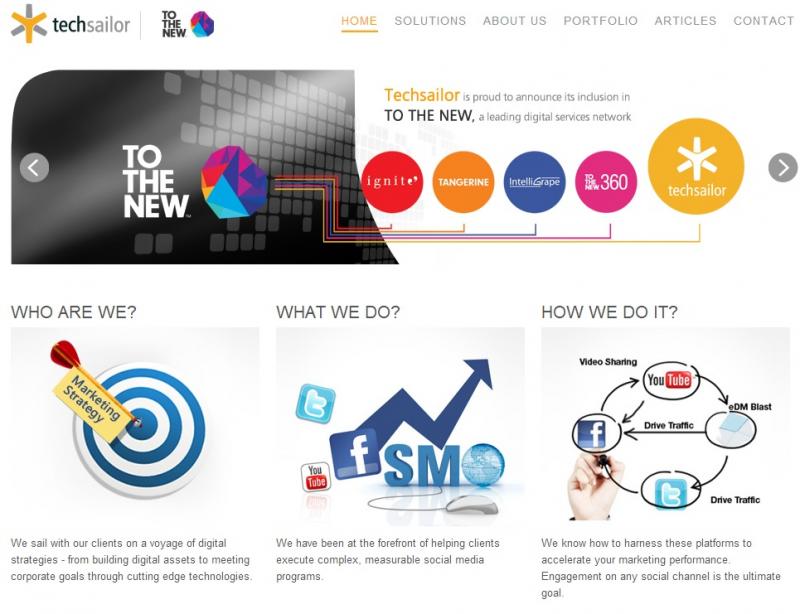
In 2013, Indian digital services group TO THE NEW acquired Techsailor for an undisclosed sum. The neat founder mythology says this is where the credits roll. Leong stayed. So did the other founders and staff. The little regional company entered a network of nearly 400 employees, and the question changed from whether it could get big to whether it could remain itself while becoming part of something bigger.
“We're expanding our team, market reach and product offerings at a much faster pace.”
A year after the deal, Leong said revenue had risen 50 percent year on year and that the company was entering new Asian markets. It had also moved into a larger, open-concept office. Space, at last. Yet the more consequential expansion was in Leong's operating range. He held vice president roles in business development, worked across Singapore and Malaysia, and later helped with expansion into the United States. Selling the company had not removed the work. It had changed the scale of the work.
The operator's route - four rooms, twenty years
This stretch is the hinge in his career. Founding teaches urgency. Acquisition teaches interfaces: between teams, incentives, brands and reporting lines. International expansion adds a second lesson. Software may cross a border with a click; credibility clears customs at its own leisurely pace.
The category changes. The problem rhymes.
Leong joined MindFi's founding team in 2020, taking a senior commercial brief. Public listings over the following years placed him across growth, revenue and operations before MindFi's own leadership page named him chief executive officer and co-founder. The sequence matters. He reached the CEO chair by trying most of the chairs that sit between a product and its customer.
MindFi sells a workplace wellbeing and employee-assistance platform to organizations. It brings a provider network, self-guided resources, multilingual delivery and employer analytics into one system. The company joined Y Combinator's Summer 2021 batch and announced a US$2 million seed round in February 2022, with backing from Y Combinator, Global Founders Capital, M Venture Partners, iGlobe Partners and individual investors.
If Techsailor's challenge was helping brands participate in a suddenly social internet, MindFi's is helping employers provide a sensitive service across countries and cultures. The common material is confidence. A user must believe the system respects context. A buyer must believe the service will travel. A provider must believe the platform will strengthen, rather than flatten, the human work.
MindFi's widening operating surface
MindFi now says it serves more than 1.5 million employees across more than 60 countries, with over 1,500 providers on its platform. The figures describe reach, but they also describe operational drag: different languages, expectations, schedules and institutional buyers. Leong's old business-development education is visible in the architecture. This is software with a delivery system attached, or perhaps a delivery system smart enough to wear software.
A company built in the translation layer
Founders often speak as though scale removes conversation. Leong's career suggests the reverse. At greater scale, the conversation becomes a system. Client success turns into repeatable onboarding. Local knowledge turns into culturally relevant delivery. A provider relationship becomes a network. Management asks not merely whether something happened, but whether it worked.
That is where his apparently wandering résumé becomes coherent. Wireless network engineer. Community founder. Project manager. Business relations director. Vice president of business development. Growth leader. Revenue operator. CEO. Each role moves one step farther from the machine and one step deeper into the conditions that let a machine become useful.
The durable product in Leon Leong's career is not a category. It is the ability to make technology travel through trust.
In 2026, that work collected two industry acknowledgments. MindFi won first place in the APEAR Excellence in Employee Assistance Innovation Award in Seoul. Months later, the European Employee Assistance Forum named MindFi its Innovation Award winner in Ljubljana, explicitly congratulating Leong. Awards can be polished mirrors, but these came from groups that understand the unfashionable mechanics of the field: delivery, professional networks, outcomes and adoption.
Leong's public writing offers a small clue to the person behind the titles. His Medium biography calls him a digital marketer, entrepreneur and craft beer nerd. The joke does useful work. It punctures the corporate varnish and fits a founder whose best material lives in ordinary behavior. People want to meet neighbors. Brands want replies. Teams want services that make sense in their own context. Craft beer nerds, one presumes, want another opinion about hops.
What survives the pivots
The tempting lesson is that Leong knows how to pivot. A better one is that he knows what not to pivot away from. WhoLivesNearYou.com, Techsailor and MindFi occupy different shelves in a software taxonomy. Beneath the labels, each asks how a digital system can mediate a relationship without making it feel mechanical.
For builders, there are three practical pieces to steal. First, keep the observation stable and let the product change. Techsailor moved with the web because its real asset was not a particular service; it was an understanding of how organizations wanted to meet people online. Second, treat distribution as design. A product that cannot be explained, trusted or delivered has unfinished features. Third, stay curious after the apparent ending. The years after Techsailor's acquisition broadened Leong's map of scale, markets and integration.
The 90-square-foot office makes a charming origin story because it allows distance to do the writing: tiny room, large footprint. But the room's more interesting feature was compression. With no space to hide, engineering, sales, client service and strategy had to sit almost on top of one another. Leong has spent the years since keeping them in conversation.
Today the room is metaphorical and considerably more crowded. It contains employers, providers, employees, algorithms, client teams and regulators across dozens of countries. The chief executive's task is still to make the introductions, translate the expectations and keep the machinery human-sized. The office got bigger. The work between people did too.