Money is easy when it arrives as one number. The trouble begins when the number has to explain itself. A food-delivery order might become restaurant revenue, courier pay, a tax provision, and a platform commission. Add a discount, a refund, two payment providers, several currencies, and a delayed settlement. The cheerful button marked “Pay” has done its job. Behind it, finance and engineering have inherited a detective novel written by committee.
Anne-Sybille Pradelles chose to build in that back room. As co-founder and CEO of Formance, she leads the commercial and operational side of a company that makes ledgers and the services around them: connections to financial providers, programmable flows, and reconciliation. Formance neither accepts nor holds the money. It gives every movement an internal account, a rule, and a memory.
It is gloriously unshowy infrastructure. Nobody invites a ledger to cut a ribbon. Yet when the books disagree with the bank, the ledger suddenly becomes interesting. Pradelles knows the value of systems that earn attention by preventing calamity. Before fintech, she spent four years building the operating machinery of a cybersecurity company.
The education of an operator
At HEC Paris, Pradelles specialized in entrepreneurship and innovation, earned a certificate in mergers and acquisitions, and wrote her thesis on the characteristics and success factors of European technology startup acquisitions. For a student project, she worked on Neodista, a secure-by-design cloud computing concept based on homomorphic encryption. The subjects turned out to be less academic than they first appeared.
In 2017 she joined Alsid, a young French cybersecurity company focused on Active Directory security. She has recalled arriving when the team numbered four. As COO, she helped develop operations across the United States, Europe, the Middle East, Africa, and Asia-Pacific. By the time Tenable acquired Alsid in April 2021, the company had grown beyond 120 employees. The announced price was approximately $98 million.
There is a pleasing symmetry here. She studied acquisitions, helped scale a cybersecurity product whose customers cared about invisible technical risk, then worked through an acquisition herself. After the deal and its integration work, she knew what she wanted next: to return to the beginning, still in technical B2B software.
Her earlier stops had supplied other angles on the same question. She worked in finance at Credit Suisse, examined young companies as a venture capital analyst, and spent time in business development at CybelAngel. Capital, company selection, technical sales, and operations rarely sit in one job description. In her career they became successive views of how an enterprise product earns permission to matter. Formance would need all four: a credible financial model, investor backing, patient category education, and an organization capable of serving customers whose tolerance for error approaches zero.
A business angel introduced her to Clément Salaün. Salaün had encountered a different invisible risk while leading payments at the marketplace Selency. Accepting money through a provider was straightforward. Allocating and tracking it after acceptance was not. Marketplaces had to write custom code for commissions, promotions, returns, seller payouts, and every peculiar exception their business model invented.
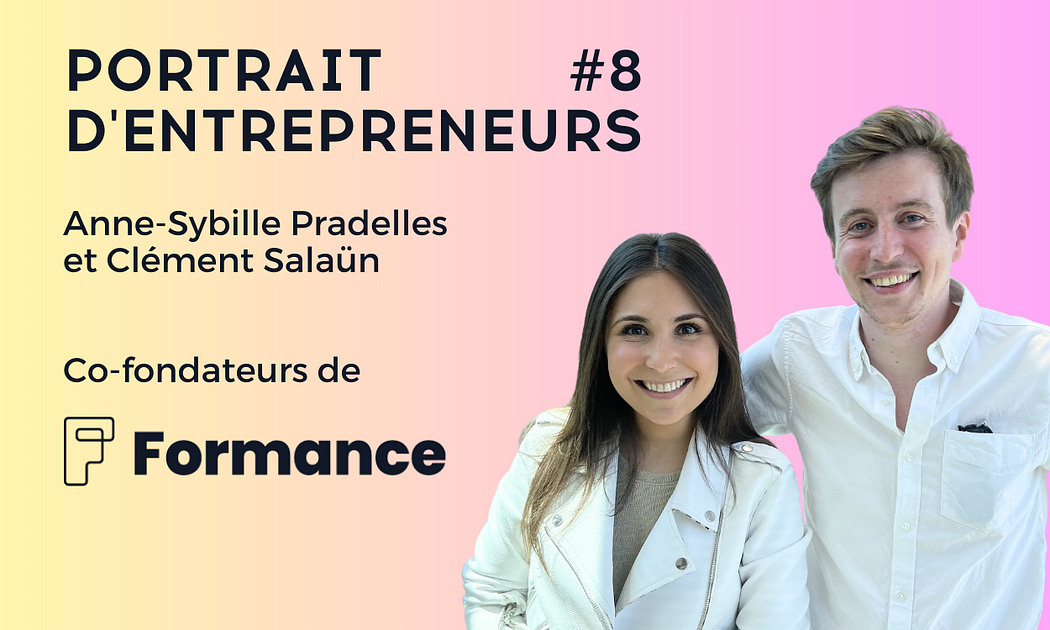
Salaün supplied the product premise and technical depth. Pradelles brought the experience of recruiting, operating across borders, fundraising, and making an enterprise company cohere while it grew. Formance emerged from Y Combinator’s Summer 2021 batch, initially under the name Numary. Their division of labor remains crisp: he runs product and engineering; she runs operations, go-to-market, and fundraising.
“We have a clear separation of concerns, and full trust; I trust my co-founder 200% and vice versa.”Anne-Sybille Pradelles, on building with Clément Salaün
The cent with a passport
Pradelles explains Formance with pipes. The company sits between pay-in and payout, where money must be divided, recorded, and eventually reconciled with the outside world. Consider a $30 food order: perhaps $20 belongs to the restaurant, $5 to a courier, $3 to taxes, and $2 to the platform. Those allocations are business policy expressed as financial state. A conventional database row can record the amount. A proper ledger must preserve what happened, atomically, without permitting a later edit to improve the past.
$30
ledger
The distinction sounds fussy until a refund races a payout, or a provider reports settlement differently from the internal books. Then precision is not pedantry. It is the difference between knowing and hoping. Formance’s open-source ledger uses double-entry principles and a domain-specific language called Numscript to define transactions. The broader platform adds connectivity, orchestration, and reconciliation so the internal account of events can be compared with banks and payment providers.
Open source is central because buyers are handing the software a sensitive position in their control environment. Pradelles has said early users made their condition plain: if the system was not open source, they would not consider it. Source code does not eliminate risk. It makes the logic available for inspection, testing, and self-hosted deployment. In this category, transparency behaves less like a marketing virtue and more like an internal control.
One of her favorite company memories is small enough to be useful. A fintech in Puerto Rico discovered Formance, followed the online documentation and GitHub materials, used the community Slack, and deployed the product in two weeks without the usual conversation beforehand. To an infrastructure founder, autonomous onboarding is applause with better unit economics. The product had traveled on its own.
A company that leaves evidence
Formance announced $3.1 million in early funding in 2022. Three years later, it raised a $21 million Series A co-led by PayPal Ventures and Portage Ventures, with Y Combinator, Hoxton Ventures, and Axeleo Capital participating. The announcement followed a reported tenfold increase in revenue over twelve months and named enterprise customers including Doctolib, Liberis, Booksy, and Btech.
Pradelles says the Series A process took two months. Her account is refreshingly mechanical. The company had traction. Recognizable customers demonstrated that it could address the enterprise segment. Investors began reaching out. She read the signals and opened the process while attention and evidence overlapped. “Momentum is key,” is how she puts it.
There is a lesson in her use of customers, too. Early contracts included room for case studies and public endorsements. The customer gets a system for its financial core; Formance gets proof that the next buyer can examine. “Every new deal helps close the next one,” she has said. A logo is not a trophy in this model. It is a productive asset.
That commercial pragmatism sits beside a pronounced preference for lean teams. Pradelles argues that a durable company begins with the value of the product and the quality of the founding team. “It’s better to build a painkiller than a vitamin,” she says. Complementary founders matter because cracks in the foundation become painfully expensive after a company adds products, countries, and layers of management.
Formance has expanded from Paris into New York and London. In discussing the United States, Pradelles has emphasized the cost of local credibility: compliance work, local presence, and a go-to-market team close to the customer. The company supplemented inbound interest from developers with more systematic, industry-specific outbound work. Open source may let a product cross an ocean unattended. Enterprise trust still wants someone in the room.
The financial internet, reconciled
The current ambition is larger than the original ledger. Formance has built modules for payment connectivity, workflows, and automated reconciliation around that core. Recent integrations with open-banking providers Powens and Tink connect external bank activity directly to internal ledger records. In July 2026, the company introduced Formance Studio, which turns a plain-language product description into a proposed and validated ledger model.
The direction follows a consistent thesis: financial products should be easier to compose without surrendering control of their records to a black box. It is a technical proposition with an operator’s sense of where companies actually ache. Engineering wants programmable primitives. Finance wants accounts it can read. Risk and compliance want a history that survives scrutiny. Pradelles’s job is to make those constituencies recognize the same problem and buy the same foundation.
Useful infrastructure does not make money move faster at any cost. It makes the movement legible enough to trust.
Her own career has the structure of a tidy double entry. On one side, the HEC student studying startup acquisitions and secure computing. On the other, the operator who lived an acquisition, returned to zero, and started selling trust in a new technical category. The entries balance without looking preordained.
There is wit in choosing the ledger as a life’s work. It is the software equivalent of the sober friend who remembers where everyone went, what they spent, and who still owes the taxi fare. Glamour is optional. Accuracy is not. Pradelles has built her second act around that asymmetry. The payment button may get the applause. She is making sure the money can survive the questions afterward.