Concrete has no patience for vague instructions. The wrong ratio stays wrong after it hardens. A mold either holds its geometry or turns an elegant sketch into an expensive lump. Lenny Vainberg, the Southern California founder behind ModaConcrete, has built a career around this stern little truth: the object is only as good as the system that repeatedly makes it.
His public résumé wanders across categories with cheerful disregard for the usual career narrative. There is modular garage storage, architectural pavers and breeze blocks, clean-burning tabletop fire features and, more recently, concentrated laundry capsules. He has co-invented patented components, adapted a factory in Baja California, guided a consumer brand into a public company, raced a desert course and returned to the decidedly indoor problem of washing clothes.
The materials change. The method is remarkably stable. Take an ordinary ritual. Make the physical experience cleaner, more useful or better looking. Then get painfully specific about molds, mix designs, inventory, packaging, retailers and the data moving among them. Vainberg’s taste shows up in the product. His leverage appears in everything the customer never sees.
A garage wall with an operating system
Long before ModaConcrete, Vainberg was a co-founder of Flow Wall, a modular storage system built around panels, brackets, hooks, shelves and cabinets. A patent application filed in 2007 names him among the inventors of a storage and organization system. The idea was practical but quietly ambitious: turn a blank wall into an adaptable platform.
By 2008, he was already talking about the web as more than a digital shelf. Flow Wall’s redesigned site offered planning tools and preconfigured sets to help buyers understand, configure and purchase a system. It was ecommerce with a small dose of architecture. Customers were not choosing one fixed object; they were assembling a useful environment from interoperable parts.
That early language matters because it reappears in his later ventures. Modularity is not merely a feature. It is a way to make complexity legible. A wall becomes panels plus attachments. A concrete collection becomes shapes, colors, finishes and load ratings. A fire feature becomes vessel plus fuel. A wash becomes one measured capsule. The founder’s job is to make the choices feel generous while keeping the machinery underneath disciplined.
First, replace the napkins
When Vainberg and his partners acquired the brand that became their TerraFlame operation, the products had retail traction and the business had cracks. His later description was magnificently unvarnished: “There were no systems. It was napkins and spreadsheets and nobody knew what was going on operationally.” Costs were murky. Inventory was barely controlled. More sales threatened to create more clerical labor rather than more leverage.
The response was physical and digital at once. The group adapted a factory in Tecate, Mexico, that had produced architectural precast. They tooled it to manufacture popular TerraFlame products, then revived precast production as ModaConcrete, selling architectural products to trade and design-build customers. One factory now served two adjacent but distinct markets: consumer flame products and architectural hardscape.
In a 2022 account of the rebuild, about 60 percent of the combined business was manufactured in-house. Vainberg described a sequence that sounds like industrial choreography: design the product, test it, build a 3D model, develop the mold set, fill, cast and finish. Roughly a dozen concrete mix designs were stored as bills of materials. When raw ingredients became finished objects, the inventory system recorded both sides of the transformation.
The visible object and its invisible journey
This was not software theater. Before integration, an order could require at least four manual touches across a retail portal, QuickBooks, warehouse requests, labels and tracking. After connecting inventory, shipping, barcode scanning and electronic data interchange, Vainberg said the same small team that had struggled with 300 orders a week could comfortably handle as many as 2,000.
The delicious irony is that concrete, among the oldest building materials, became the beneficiary of an unusually modern operating stack. The company could accept a made-to-order configuration, tell the factory what to produce, convert prepared blanks into finished goods and notify the buyer when the shipment moved. The romance remained in shadow, texture and saturated color. The repeatability lived in the database.
What the acquisition photo leaves outside the frame
By 2022, Vainberg said the operation had moved from a practical starting point of $500,000 in 2019 toward crossing $10 million in annual revenue. TerraFlame products had reached large retailers. In May 2023, Solo Brands acquired TerraFlame, adding indoor fire to a portfolio that included Solo Stove, Chubbies, Oru Kayak and ISLE. Vainberg moved from TerraFlame CEO to general manager inside the buyer.
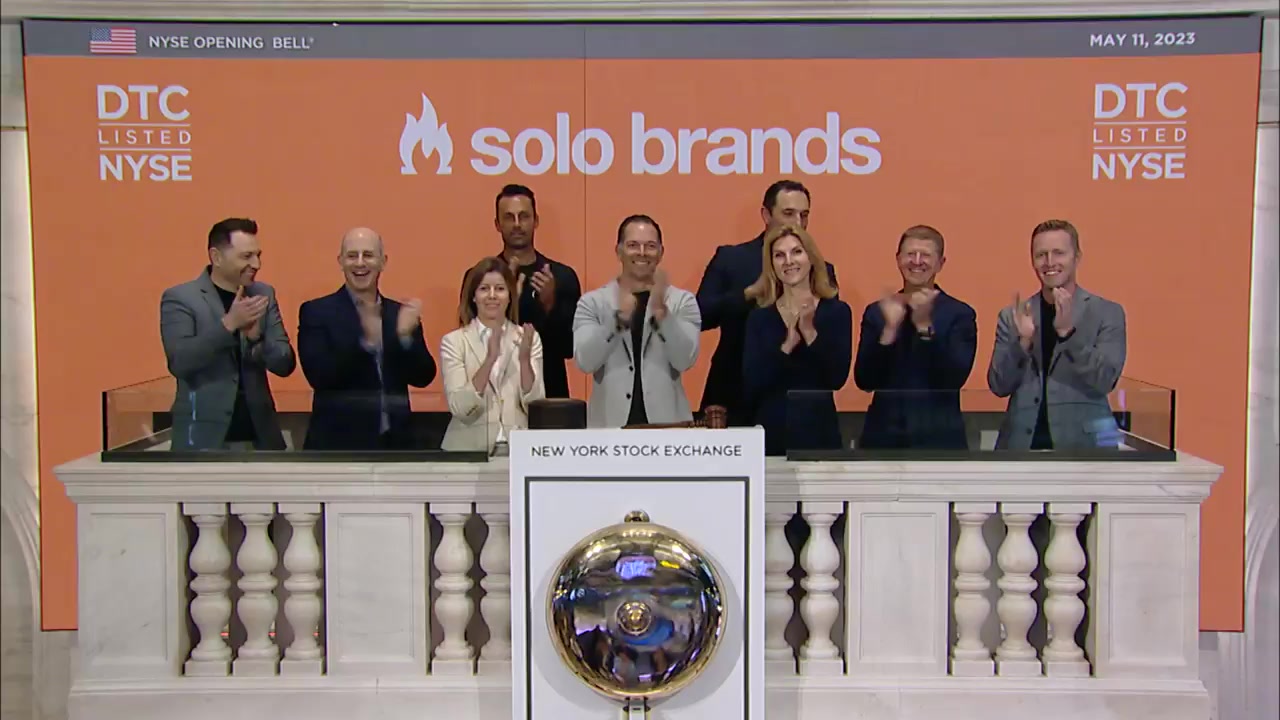
An opening-bell image compresses years into seconds: applause, orange backdrop, everyone facing the camera. Outside the crop are the mold sets, retailer connections and correctly counted cans of fuel. Deals are announced as moments, but physical-product acquisitions are accumulated from thousands of ordinary decisions that another organization believes it can inherit.
The corporate chapter took another turn in June 2025, when Solo Brands sold TerraFlame back to its original sellers for $2.5 million. The round trip is not a tidy victory-lap fable, and it is more instructive for that reason. Brands move between owners. Strategies change. The hard-won knowledge of how to make, package and distribute a thing travels with the operators who learned it.
Flow Wall’s patent and ecommerce system turn storage into a modular platform.
The rebuilt ModaConcrete and TerraFlame operation establishes its practical starting point.
Solo Brands acquires TerraFlame; Vainberg becomes general manager.
TerraFlame returns to its sellers while ModaConcrete and Laundry Labs move forward.
Concrete outside, capsules in the wash
Today, Vainberg is publicly identified as ModaConcrete’s CEO and founder. His current posts speak the language of architects: breeze-wall systems, large-format slabs, anti-slip finishes, pressure casting, pedestrian and vehicular loads. In early 2026 he promoted ModaBlok’s next launch and a redesigned ModaConcrete site intended for architects, designers, contractors and dealers. A January trademark application carries his signature and the title CEO.
At the same time, he has emerged as a founder of Laundry Labs. In late 2025, articles under his name introduced concentrated, pre-measured PowerPax capsules and argued for independent biodegradability testing. An industry open house listed him as the presenter of PowerPax. In June 2026, he filed a trademark application for Power Pax Pets covering detergent and cleaning-supply organizers.
Laundry is not concrete, obviously, although both can punish careless mixing. The useful connection is tighter: each venture takes a variable physical process and packages it into repeatable units. The capsule controls a dose. The breeze block controls geometry. The wall panel controls attachment. Vainberg’s categories keep changing because his actual specialty is upstream of category.
The operator’s field notes
- Count every manual touch before spending to create more demand.
- Turn recipes, configurations and exceptions into visible system data.
- Design product options and operational constraints at the same table.
- Give a small team the infrastructure to look larger without pretending it is larger.
There is also a streak of literal motion in the biography. In 2019, at age 45, he joined a four-driver Chevrolet entry in the Best in the Desert Parker 425. The official result records a DNF after two laps. It is a wonderfully concrete detail in every sense: machinery, terrain, teammates, attrition. The desert does not grade on a founder’s narrative either.
What does Vainberg seem to want next? His public attention is on architectural construction elements and relationships with designers. ModaConcrete is pressing deeper into wall systems and pavers, while Laundry Labs explores another corner of physical-product control. Neither project is an app disguised as a company. These are weighty goods with freight bills, tolerances and consequences.
That makes his career useful to study now. The internet trained a generation to think distribution could rescue nearly anything. Vainberg’s work offers the stubborn physical-world correction. Distribution helps. A striking photograph helps. But someone still has to know what the product costs, which mold made it, where it sits and whether the next thousand orders will produce delight or administrative smoke.
A handsome breeze block throws patterned light across a patio. It looks effortless, which is the compliment. Somewhere behind it, a precise system has done its unromantic work.