There is a particular species of Southern California house that wants its concrete to look effortless. The screen wall should filter the afternoon sun. The pavers should lead calmly to the pool. The planter should be enormous but not appear to have arrived by forklift, even though it almost certainly did. ModaConcrete makes the pieces that pull off this trick. The company sells architectural breeze blocks, dimensional wall tiles, large-format pavers, sinks, tables, fire pits, fountains and sculptural planters from a showroom in Laguna Niguel and a 60,000-square-foot factory in Tecate, Baja California.
The catalog photographs beautifully. The more instructive story is hiding behind the product page. ModaConcrete is a small manufacturer trying to make concrete behave like a coordinated design platform and its factory behave like modern software. That means proprietary mixes become bills of materials. Customer choices flow from Shopify into production. Barcodes follow inventory. EDI talks to large trading partners. A piece that still has to be mixed, molded, cured, finished and freighted can nevertheless begin with a clean click.
First, the business hit a wall made of spreadsheets
Founder and CEO Lenny Vainberg did not begin with a blank slab. In a 2022 case study, he described acquiring a product brand, building out a Baja supply chain and adapting a factory that could produce both TerraFlame consumer fire products and ModaConcrete architectural precast. The brands served different buyers from the same production base: TerraFlame reached mass retail; ModaConcrete sold factory-direct to trade, design-build and homeowners.
What failed first was not demand or design. It was visibility. The inherited operation had little inventory control, no dependable bill-of-materials management, no raw-material tracking and no clear view of true product cost. Orders moved through QuickBooks, partner portals and warehouse requests by hand. Vainberg's description is unusually vivid for an ERP testimonial: “It was napkins and spreadsheets and nobody knew what was going on operationally.” Each order could require four manual touches. More volume meant more typing.
“Now you can see what your true cost is, and based on that, you can make intelligent decisions.”Lenny Vainberg, founder and CEO
The team had seen heavyweight systems such as NetSuite, but the time, staff and capital required did not fit a young operation running lean. What changed Vainberg's mind was finding Cin7 broad enough to handle inventory, manufacturing, forecasting and native EDI without demanding an internal development department. ModaConcrete connected it with Shopify, QuickBooks and ShipStation, then added barcode scanning and labeling at the factory. Power BI gave management a clearer view of pricing and demand.
order
BOM + EDI
casting
finish
delivery
The product is coordination
ModaConcrete's four collections are less interesting as departments than as a single sentence. ModaBLOK makes breeze-block screens. ModaWALL creates textured interior and exterior surfaces. ModaPAVE covers the ground in wet-cast or high-pressure concrete. ModaCAST supplies the objects: GFRC planters, basins, sinks, tables, fire pits and fountains. Ten harmonized colors run through much of the cast collection, with matte and gloss choices. The company is selling the possibility that the planter, screen wall and tile will look related when the project leaves the rendering.
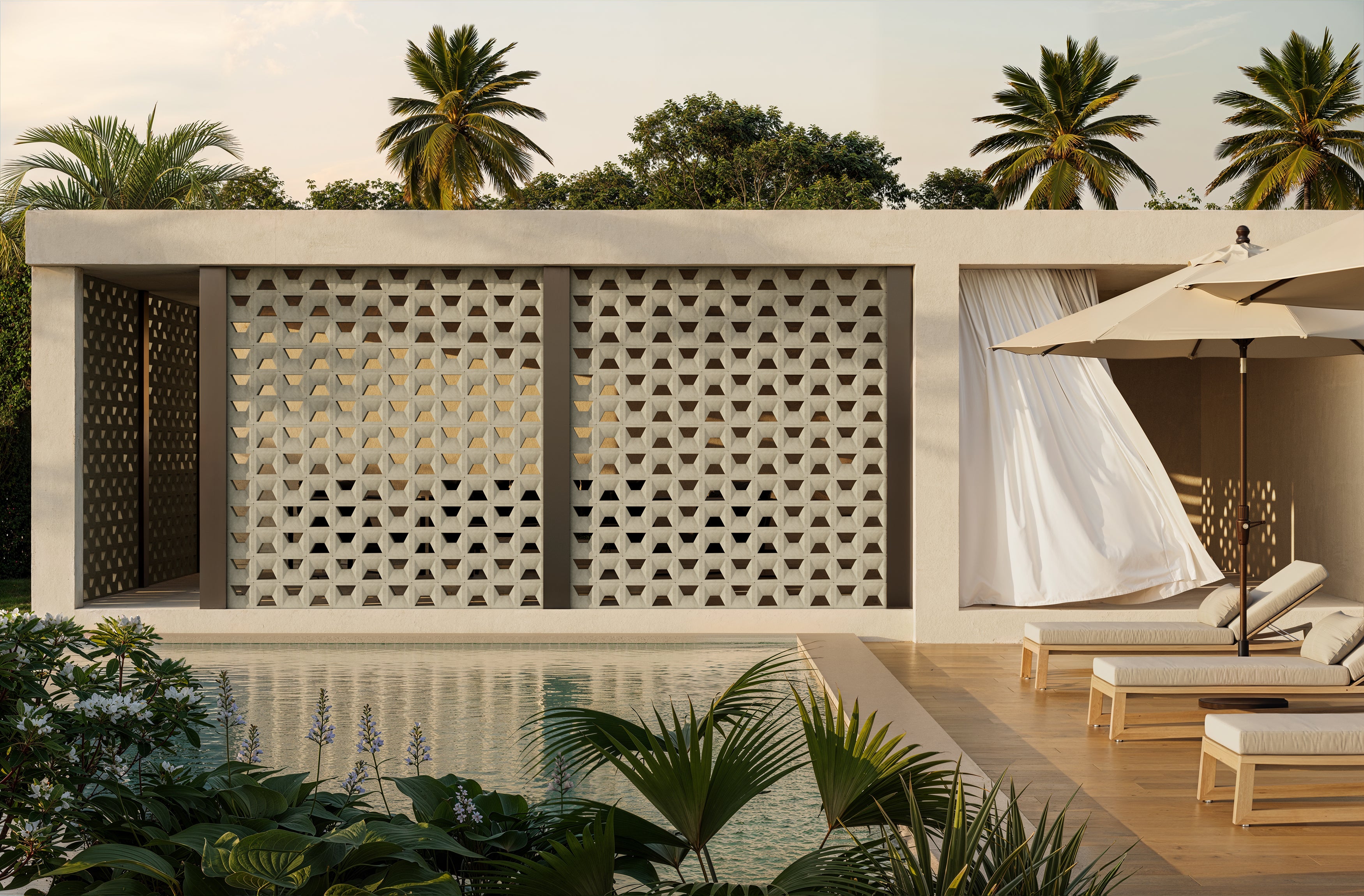
That solves a fussy, expensive problem for architects and contractors. Concrete color is not paint color. Aggregate, cement chemistry, water, curing and sealers all affect the result. Split a job among several suppliers and the “same gray” can arrive as three distant cousins. ModaConcrete's differentiation is factory control: shared mix knowledge, precision thermoformed molds, coordinated finishes and several production methods matched to use.
KUBE, its original ModaBLOK pattern, is made with a semi-dry blend of locally sourced limestone and marble fines compressed into steel molds under high pressure, then naturally cured in humidified greenhouses. The stated payoff is density, sharp edges and low water absorption. ModaWALL's GFRC cuts weight for vertical installation. ModaPAVE includes grade-set and pedestal formats, while the homepage claims more than 8,000 PSI compressive strength for the paving family. This is not one magic concrete recipe. The expertise is choosing the mix and method for the job.
What does the shortcut cost?
KUBE currently starts at $9 a block, or $30.67 per square foot before freight and installation. Wall tiles span roughly $7 to $36 each; planters run from about $150 to more than $800. Prices move with size, finish and delivery.
Concrete ecommerce, with the inconvenient bits left in
The business model crosses D2C and B2B without confusing the two. A homeowner can buy a planter online. An architect can order samples and coordinate a finish schedule. Dealers and wholesale customers get onboarding and trade pricing. Contractors can send plans, site photographs and specifications. Custom projects sit beside stocked and made-to-order products. Most pieces quote three to four weeks of production, followed by three to seven days in transit. Large items usually arrive curbside by liftgate-equipped LTL freight; white-glove service is available by request.
This matters because concrete refuses the fantasy of frictionless commerce. It is heavy. It can chip. A freight driver needs a phone number and a safe place to lower a pallet. Installation may require an experienced crew. ModaConcrete does not erase those constraints; it organizes them. Its made-to-order workflow even uses preliminary blanks that can be converted into finished variants faster than beginning every configuration from zero.
The documented result in 2022 covered the combined ModaConcrete and TerraFlame operation, so it should not be mistaken for ModaConcrete's current standalone volume. Still, the operating lesson is clean. The same small office team that struggled with around 300 orders a week could comfortably support as many as 2,000. Sixteen EDI connections linked retailers and internet channels. Inventory sat across four locations. The throughput multiplier was roughly seven, created mainly by removing clerical drag.
A sibling-brand detour, then a sharper identity
TerraFlame became a revealing side plot. Solo Brands acquired the fire-feature business in May 2023 for total consideration of $13.2 million, including $5.5 million in cash at closing and contingent payments. The deal was about TerraFlame, not a disclosed funding round for ModaConcrete. Solo later sold TerraFlame back to its original sellers for $2.5 million. ModaConcrete continued developing the architectural manufacturing capability that had once shared the factory.
By 2026, the company was speaking more clearly to specifiers. It refreshed its website around complete collections, samples, technical pathways and project photography. Newer products include Hyperion pavers, large-format slabs and additional wall and block patterns. Its LinkedIn description now emphasizes designers, architects, builders and dealers. The shift is from a broad catalog of concrete things to a legible material system.
Copy this when
You own repeatable recipes, serve configurable demand, can standardize product data and have customers who value consistent outcomes more than same-day delivery.
Skip it when
Every job is a one-off sculpture, freight overwhelms order value, local commodity supply wins on urgency, or your partners will not exchange clean digital order data.
What another operator can steal
First, turn the recipe into data. ModaConcrete represents different mix designs as bills of materials, so raw ingredients leave inventory when finished goods enter it. Second, delay final configuration. Semi-finished blanks can absorb color and finish choices later, reducing the time between order and shipment. Third, make channel complexity someone else's problem only after your own records are clean. EDI becomes leverage when SKU, inventory and shipping data agree.
Fourth, measure manual touches. “Work harder” is not a process, and four re-entries per order are four invitations to make a mistake. Fifth, treat design consistency as an operational feature. A harmonized palette is marketing, chemistry, quality control and customer service folded together. Finally, set expectations where the product refuses to be digital: lead time, curbside freight, samples and installation support.
The model will not travel everywhere. A local precaster may beat ModaConcrete on freight, schedule or customization. Commodity block can be sensible when no one cares about crisp edges or coordinated shades. A customer who needs material tomorrow should not order a made-to-order planter from another country. And the technology stack only pays off when volume and repeatability are high enough to justify its setup and discipline.
In market terms, ModaConcrete sits between the anonymous masonry yard and the small custom studio. The yard wins on availability and basic unit economics. The studio wins when a designer wants a singular commission. ModaConcrete aims at the repeatable middle: products distinctive enough to specify, standardized enough to price online and flexible enough to combine across a whole property. That is useful in modern residential work, hospitality, offices and landscaped commercial spaces where material continuity matters but a bespoke artisan for every surface would become expensive and slow.
Its best customers therefore arrive with a plan, not merely a Pinterest tab. They can use samples to lock the palette, calculate block or paver coverage, schedule around the production window and prepare the site for freight. In return they get fewer vendors to coordinate and a direct line back to the maker. The bargain is not instant gratification. It is fewer aesthetic surprises at the end of a long build.
But for design-led physical goods, ModaConcrete offers a sturdy proposition. Own enough of production to protect the result. Build a catalog around a system rather than isolated hits. Put the messy middle of manufacturing into software without pretending the actual making has become software. The concrete remains gloriously concrete: heavy, slow-curing and sensitive to its ingredients. Everything around it can move faster.