A national chain does not really commission a store. It commissions the same argument hundreds of times: this prototype, on that odd parcel, under those local codes, before a deadline that was optimistic when it was printed. The glamorous drawing happens once. Then come utility conflicts, permit comments, revised equipment, landlord rules, procurement delays and a thousand tiny translations between people who do not share a payroll.
Core States Group built its business in those translations. The privately held West Chester, Pennsylvania, firm combines architecture, civil and building engineering, surveying, land planning, permitting, program management, signage, construction and energy work. Its customers are the operators for whom a building is less a monument than a unit of expansion: retailers, restaurant and grocery chains, banks, convenience brands, industrial developers, fleets and charging networks.
Founded in 1999 by John M. Scheffey, Core States began with engineering and project management for retail petroleum. That origin explains a lot. Gas stations are compact bundles of civil work, environmental constraints, fueling systems, branded retail and safety rules. They are also repeated. A firm that can keep those pieces aligned has a natural path into convenience stores, remodel programs and, eventually, the electrified cousin of the fuel island.
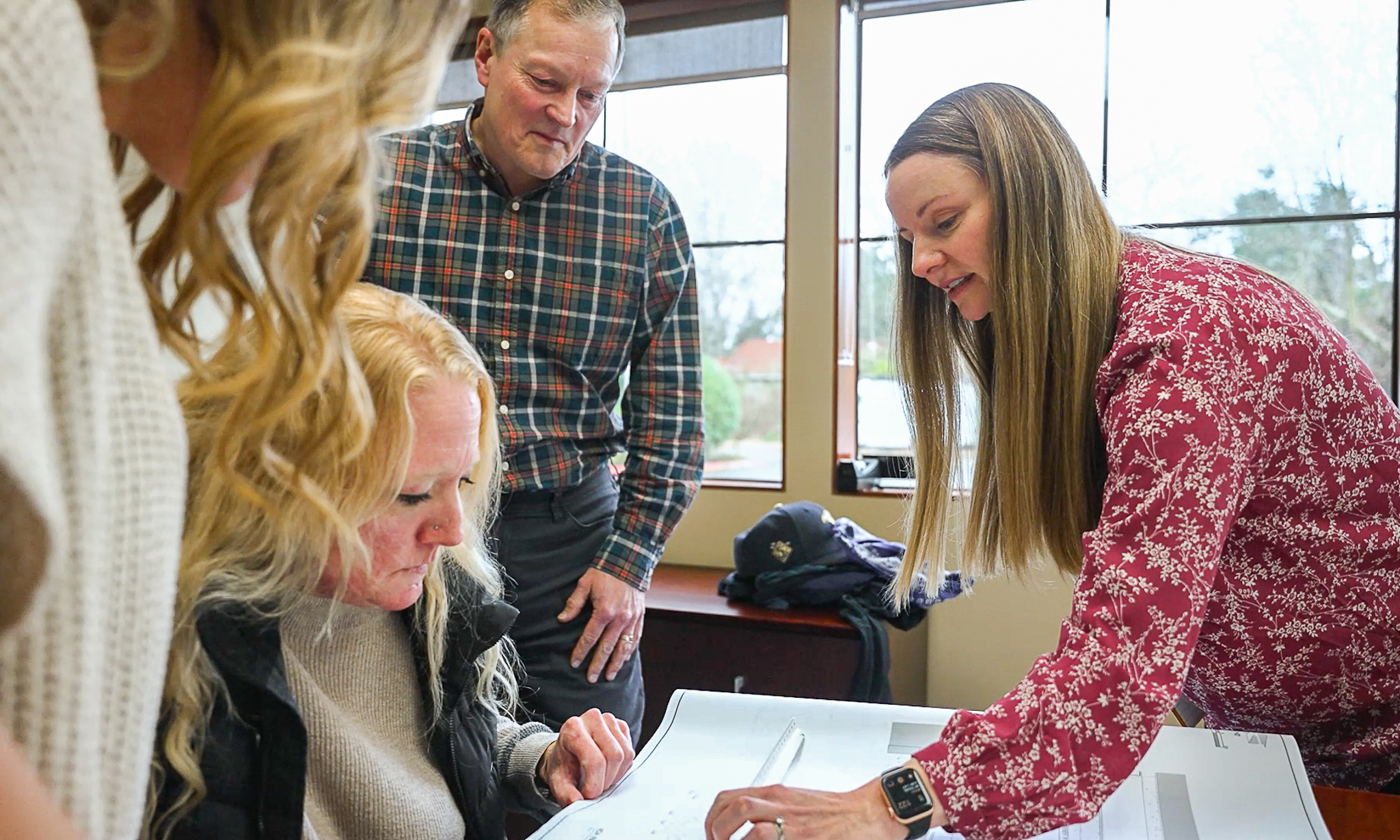
The product is the handoff
Core States describes its offer as integrated A/E/C - architecture, engineering and construction. In ordinary language, it tries to keep the baton inside one organization. A client's prototype can move through site study, design, engineering, permits and construction with fewer firms relearning the brief. For a one-off building, that may sound like administrative housekeeping. For 100 sites, every saved meeting becomes inventory.
The firm said it was involved in well over 1,000 projects annually as far back as 2016, when it adopted Projectmates to standardize construction program workflows. That detail is more revealing than a portfolio glamour shot. A thousand projects create a knowledge flywheel only if the permit comment from site 38 reaches the team on site 39. Otherwise scale merely produces a larger pile of surprises.
This is the company's difference from both ends of the market. A collection of local specialists may know each jurisdiction beautifully but force the customer to manage every seam. A giant generalist may have continental reach but treat a rollout as a stack of unrelated jobs. Core States is trying to occupy the middle: national program discipline, regional offices and enough in-house specialties to remember why the prototype changed last Tuesday.
“The hidden moat is not the first building. It is every mistake the client does not have to buy twice.”YesPress analysis
From pump islands to electrons
Energy is where the old expertise becomes newly legible. Core States now works on solar, battery storage, fuel cells, generators, combined heat and power, microgrids, EV charging and hydrogen fueling. Its Energy division had completed more than 100 design-build projects for Electrify America by 2024. In San Francisco, it later supported an EVgo site with 60 fast-charging stalls across two phases. In Ontario, California, its work for TravelCenters of America combined heavy-duty truck charging with solar, storage and distributed generation.
The problem is no longer just where to put a charger. It is whether the utility can serve it, whether the pavement and drainage cooperate, whether equipment arrives, whether drivers can use the site safely, and whether today's hardware can be replaced without another excavation. The coordination surface gets wider as the technology gets cleaner.
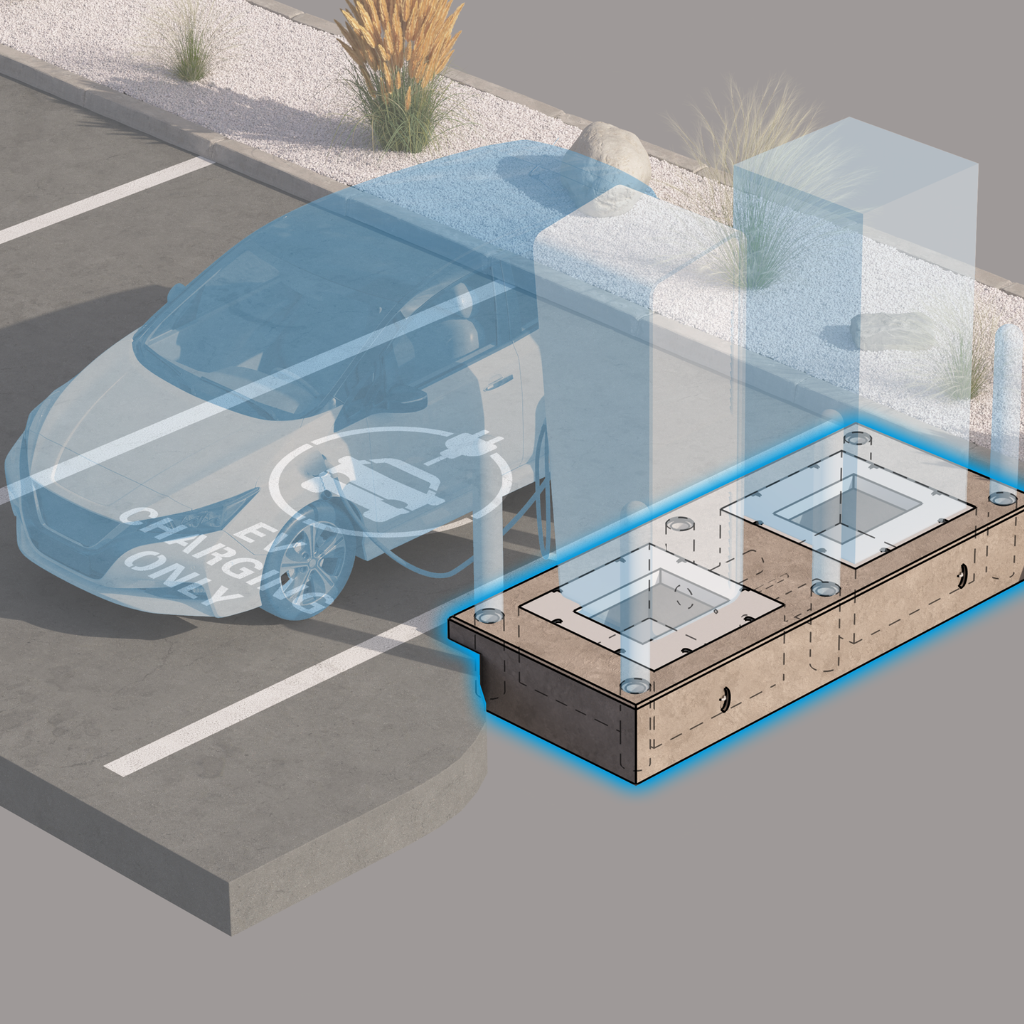
CoreCast, introduced in 2026, is the neatest physical expression of the Core States thesis. It is a precast concrete skid for charging equipment. The unit arrives formed, can be placed and connected to conduit in the same day, and uses replaceable steel lids so hardware can change without replacing the entire base. Core States says the approach can reduce foundation installation from days to hours and cost less than steel or cast-in-place alternatives. The useful claim is about the mechanism, not a magic percentage.
The first thing to fail is usually the seam
The company's offer points directly to the failure it is designed around: fragmented delivery. A survey arrives late. The electrical design assumes different equipment. A permit revision does not reach construction. A national prototype collides with a local stormwater rule. The first failure is often not a beam or a circuit; it is information crossing an organizational boundary badly.
Integrated delivery does not abolish those risks. It changes who owns them. The client pays for a larger bench and a longer relationship instead of assembling the lowest bidder at every stage. The visible cost is organizational: maintaining architects, engineers, surveyors, permit specialists and builders across 24 offices before the next assignment arrives. That fixed bench is the service advantage in a rush and the financial exposure in a slowdown.
Repetition compounds learning
The client has many sites, a deadline, recurring equipment, and enough local variation to make coordination expensive.
The project refuses to repeat
A one-off cultural landmark, a tiny scope, or procurement based only on the lowest fee may not reward the integrated premium.
A succession plan becomes a platform
The company's financing history reveals what changed its owners' minds. When Scheffey considered succession, adviser Griffin Financial Group says he wanted liquidity for most of his equity, continuity for customers and staff, more employee ownership, and resources for growth. A full sale to a strategic buyer could maximize finality but weaken the other goals. The chosen answer was a 2022 recapitalization by Harren Equity Partners, with Scheffey and management retaining meaningful stakes.
Then the firm started buying reach. The 2024 acquisition of Barghausen added a Washington-based practice founded in 1982, with deep civil engineering, surveying, entitlement and land-development experience. This was not simply a dot on a map. It purchased decades of local memory and client relationships - precisely the material a national rollout firm cannot manufacture overnight.
In July 2026, Wacona Capital closed a single-asset continuation vehicle for Core States with approximately $210 million in commitments, led by Painswick Capital. The structure let the sponsor keep backing the company while giving existing investors liquidity. It was not a disclosed $210 million valuation, and public materials describe commitments to the vehicle rather than a simple debt round. The money supports organic expansion and acquisitions. In plain English: investors chose more runway over an exit.
“The investment from our new capital partners establishes a strong foundation from which we will continue to grow the business with new and existing clients, as well as through acquisition.”D. David Dugan, president and CEO, July 2026
What an operator can copy
Make the next job cheaper to understand
- Start with a recurring pain. Core States began in a narrow, repetitive market where coordination mattered more than novelty.
- Own adjacent handoffs. Add capabilities where information is most likely to get lost, not simply where revenue looks available.
- Standardize the memory. A workflow tool matters because lessons need to travel faster than people.
- Productize one stubborn bottleneck. CoreCast turns a messy site-built foundation into a configurable unit.
- Buy local knowledge carefully. An acquisition works when relationships and judgment survive the integration spreadsheet.
The model will not work everywhere. It weakens when clients change the prototype constantly, hoard decisions, refuse early access to site data, or split procurement so aggressively that no party can manage the whole sequence. It also depends on a healthy backlog. The in-house bench that makes Core States responsive is expensive when utilization falls. And acquisitions can destroy the local trust they were meant to capture if every regional practice is forced into sameness.
Still, the market fit is unusually clear. Core States sits between design consultancy, engineering platform, program manager and builder. Its competition includes global firms such as AECOM, Stantec, WSP, Arcadis, Gensler, Kimley-Horn and Burns & McDonnell, plus hundreds of regional specialists and clients' own vendor networks. Its argument is not that it draws the only good plans. It is that one accountable system can move from plan to permit to pavement with less amnesia.
That is a modest-sounding promise with large consequences. A delayed opening repeats rent, payroll and lost sales. A charger waiting on utility coordination is stranded capital. A prototype mistake multiplied across 100 locations becomes strategy by accident. Core States sells against those multipliers. Its best work may be nearly invisible: the opening that happens on time, the revision that reaches the field, the foundation that accepts the next machine, and the fiftieth site that is calmer than the first.