The last payment on a vehicle loan ought to be a full stop. Yet the loan may have carried other products: guaranteed asset protection, known as GAP, or a vehicle service contract. An early payoff, repossession or total loss can leave a cancellation to process and a refund to pursue. The customer’s story has moved on. The institution’s paperwork has acquired a sequel.
Lender Compliance Technologies has made that sequel its business. Its Refund Control platform gives banks, credit unions and finance companies a place to manage cancellations, obtain provider quotes and track recoveries. The appealing detail is who holds the controls: the lender, even when the process involves a dealership and a separate product administrator.
- The job: cancelled protection-product refunds.
- The buyer: lender servicing and compliance teams.
- The proposition: direct quotes, tracking and audit records.
The handoff is the problem
Consider the mechanics. Someone must identify the product, initiate cancellation, establish the refund amount and follow the money. A notice can be sent without the refund being received. A calculation can look plausible without matching the provider’s records. LCT’s own early explanations describe phone calls, emails and follow-ups that consume staff time. The administrative nuisance is distributed; responsibility is harder to distribute so conveniently.
Refund Control organizes those tasks into a workflow. Lenders can notify the selling dealer and product provider simultaneously, track dealer performance and maintain an auditable record. That changes the conversation from “we asked” to “here is the status.” Software cannot make every counterparty prompt. It can make the waiting visible, which is a useful place to begin. A manager can then distinguish an unanswered request from a disputed quote or an outstanding payment. Each requires a different response. Putting them on one screen matters only if the underlying stages remain distinct.
- 01TriggerLoan event prompts review
- 02CancelNotify dealer and provider
- 03QuoteObtain provider amount
- 04TrackFollow recovery and record
A small problem worth $4.15 million
LCT introduced Refund Control in April 2021. That June, it announced a $4.15 million Series A backed by a syndicate of software entrepreneurs, Automotive Ventures and Driven Capital Partners. The funding announcement described a product in pre-sales, with its US rollout approaching. This was capital behind a specific operational proposition, rather than evidence that customers had already adopted it at scale.
The founders listed in company databases are Glenn Munro, Ed Kisinger and Robin Bever. Today, LCT identifies Munro as chief executive and Kisinger as chief technology officer and director of client success. Bever was listed as director of product management. The company’s stated expertise spans lending, recoveries, compliance and SaaS development. Its customers need those disciplines to meet in the same workflow. The product also serves RV, marine and powersports lending, where the financed vehicle changes but the coordination problem remains familiar. The company sells to institutions managing portfolios; consumers are beneficiaries of the process, rather than the buyers of the software.


Make the quote come from the provider
LCT’s distinction is narrower, and more interesting, than the familiar promise to automate everything. It emphasizes direct provider refund quotes instead of relying on form-based calculations. Its homepage advertises connections to more than 600 providers. The point is the origin of the number: a lender wants a refund amount that can be traced to the organization administering the product.
The company also says Refund Control is built on Salesforce. In its announcement about industry refund-quote standards, LCT describes requirements covering direct data sourcing, retention, reporting, access validation and audit trails. It claims alignment with standards approved by three trade associations. Those associations do not endorse or qualify individual platforms. Alignment is a product claim, and buyers should examine the actual recordkeeping behind it. For an operations team, the useful demonstration is a case moving through the system: where the quote came from, who can see it, what changed and how that history is retained. An impressive screen is the easy part.
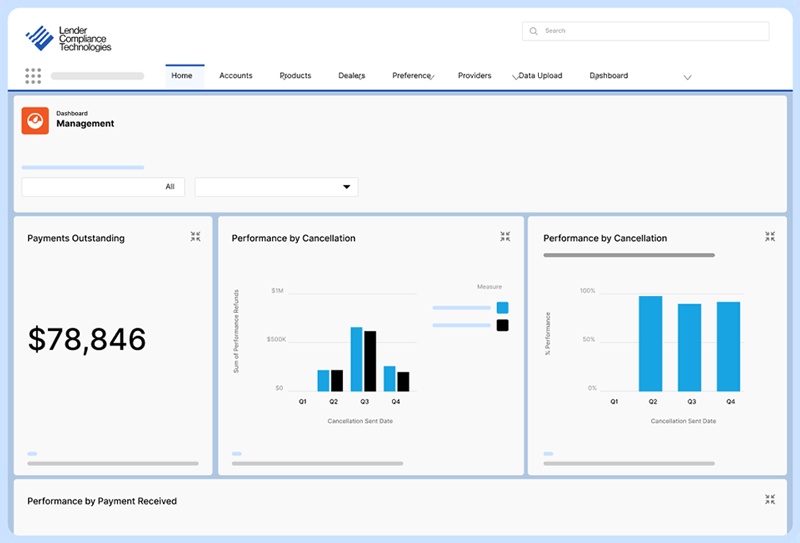
Teach the software to read the paperwork
By October 2023, LCT was addressing another piece of the process: finding product information inside a deal package. It partnered with Informed.IQ to power LCT IDP, its intelligent document processing functionality. The announced job was to extract, analyze and summarize information from protection-product forms and lending documents. Here, artificial intelligence gets a practical assignment. Read the documents so staff need less manual review before submitting a cancellation.
In April 2024, LCT announced a partnership with AKUVO, whose platform handles collections and credit risk. The integration brings cancellation and refund requests into the collections process. A Proteris partnership followed in April 2025, connecting form approval services with cancellation compliance technology. Together, these moves suggest an approach to adoption: put refund work closer to the systems and documents lenders already use.
The credit union route
In September 2026, LCT announced LCT CUSO, a credit union service organization formed with One Washington Financial, SWBC and Jay Mossman. One Washington Financial is wholly owned by Washington State Employees Credit Union. Mossman, AKUVO’s chief executive, invested personally through NRT Holdings LLC. That distinction matters: an integration partner and a personal investor are two different relationships.
LCT reported nearly 30 credit union clients serving more than five million members. Those are the institutions’ members, rather than five million people operating Refund Control. Separately, the company announced more than one million processed cancellations. Volume makes the workflow commercially interesting; it does not, by itself, tell a buyer how many refunds were completed or how quickly consumers received them.
VPP cancellations processed through Refund Control
Cumulative cancellations, not a count of completed refund payments.“From day one, we built Refund Control© to scale.”Glenn Munro / CEO, LCT
Buy the workflow, measure the outcome
The business model is software sold to financial institutions, with demonstrations, onboarding and support. For a buyer, the useful cost comparison includes staff time spent reviewing documents, chasing counterparties and reconstructing records. A procurement conversation should establish the commercial terms, integration work and responsibilities for unresolved cases. The 2021 investment explains financing; it is no substitute for an operating budget.
Lenders have alternatives. Allied Solutions’ RefundPlus offers cancellation support, dealer and provider follow-up, reporting and a payment lockbox. An institution can also maintain an internal process. LCT’s position is lender-controlled visibility. That suits an operation prepared to own the workflow; a team seeking extensive delegated execution should compare service responsibilities carefully.
The idea readers can copy is pleasantly unfashionable: make handoffs explicit, use information from the responsible provider and preserve evidence through completion. Accurate contract data, cooperative counterparties and staff who act on exceptions remain necessary. A dashboard with neglected cases is still a queue. The real test comes when the loan is over and someone can explain, without an afternoon of searching, what happened to the refund.