Consider the moment after a customer agrees to a loan extension. The conversation has gone well. Then the representative sends a form, asks for a signature and waits. A printer enters the story. So does an inbox. The customer, who was available a moment ago, becomes someone to chase. Lightico has built a business around keeping that person present.
- The product: one guided flow for forms, signatures, documents, identity checks and payments.
- The buyer: regulated businesses with complicated customer transactions.
- The wager: fewer handoffs mean more people finish.
At Westlake Financial, the practical change was almost embarrassingly small: send the customer a text while the service representative is still on the phone. The link opens a mobile session where forms can be completed and signed. The lender’s published case study reports 94% eSignature conversion on loan extensions and 91% conversion for ACH forms. Paperwork became part of the conversation.
on loan extensions
conversion
Westlake’s reported results for these servicing uses. Different workflows can produce different outcomes.
01 / The trouble between the tools
Lightico calls its offering digital completion, and now describes it as AI customer journey orchestration. Strip away the vocabulary and the proposition is understandable. A bank may have a customer database, a lending system and a signature tool, yet still make the borrower carry information between them. Lightico connects those customer-facing steps above existing systems.
Its market is enterprise software for businesses serving consumers, particularly lenders, insurers and telecom operators. The customer list includes Capital One, GM Financial, HSBC and MetLife. Its expertise lies in arranging regulated interactions: which document to request, which consent to capture, what to verify and where the completed record should go. A tidy interface is only the visible part.
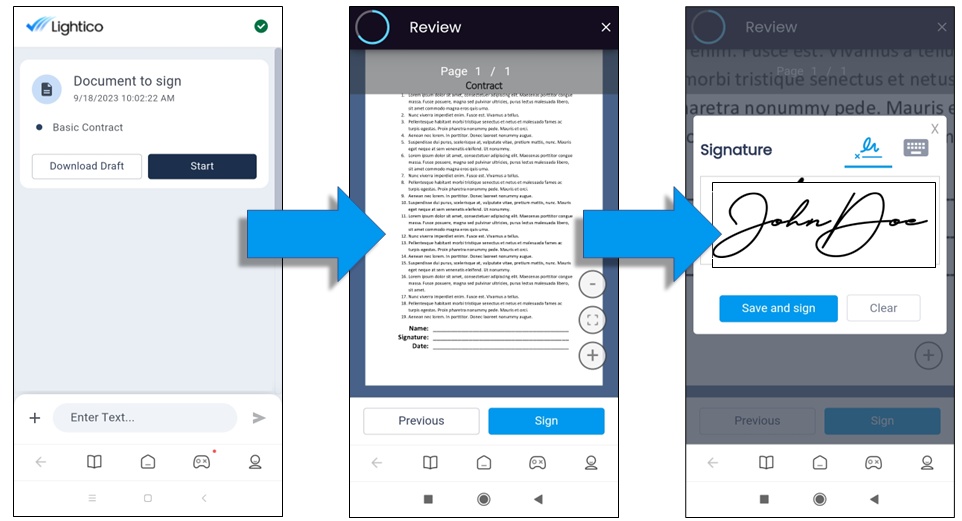
The product family includes eSignatures, ID verification, eForms, secure payments and case management. CompleteDoc AI adds document classification, data extraction and rule evaluation. A customer can photograph supporting paperwork; the business can check the resulting information. No-code workflows arrange the sequence, while integrations connect it to business records. The point is to finish a transaction containing several requirements.
02 / A shop floor makes the case
EE supplies a useful test because the customer was already in the shop. Even physical presence did not settle the problem. Its retail financing process involved seven separate tasks, paper applications, wet signatures and disconnected systems. The company had digitised other channels; stores remained a gap. The published account describes customers walking away and revenue opportunities being lost.
- 01Invite
- 02Verify
- 03Collect
- 04Sign
- 05Record
Illustrative sequence. Businesses configure the steps and rules for their own processes.
EE, Lightico and Amdocs joined product selection, financing, acceptance and provisioning in a digital flow on a customer’s phone or store tablet. Amdocs handled integration and implementation; EE aligned its internal teams. Across more than 500 shops, the case study reports transactions seven minutes faster and £120 million in incremental revenue attributed to the programme. Those are joint project results, not a software-only experiment.
03 / The bill behind the promise
Lightico sells enterprise SaaS through sales-led agreements. A useful historical glimpse comes from its commissioned August 2021 Forrester study of one North American bank. The model used $2.20 per transmission and 1,500 transmissions monthly, plus a $5,000 implementation fee and $10,000 in initial internal training expenses. Staff implementation time and continuing administration added further costs. Buying software still requires people to change the work.
Risk-adjusted present values in the commissioned Forrester model. Historical assumptions, not current pricing or a forecast for every buyer.
Forrester projected a 360% return over three years and payback within six months. The study gives a buyer something useful to interrogate: volumes, time saved and costs beyond the subscription. It remains a commissioned model based on one customer interview. Its numbers deserve a spreadsheet, rather than a standing ovation.
04 / A customer bought the argument
For CEO Zviki Ben-Ishay, the problem came into focus while working with enterprise interaction systems at NICE. In a June 2026 interview he recalled paper, email and tools that needed stitching together: “There was a lot of friction.” The company’s founding group also includes Omri Braun, Justin Josh and Vladimir Levin. The idea emerged from watching established businesses struggle to complete ordinary interactions.

Capital One supplied a more consequential endorsement than a testimonial. Its venture arm participated in Lightico’s November 2020 financing and led a $15 million follow-on in July 2021, after wider deployment inside Capital One. In 2023, Lightico acquired Vizolution, adding assisted and self-service capabilities and European customer relationships. The strategy broadened the ways a customer could complete the journey.
05 / Design the next step, then check it
The recent VodafoneThree arrears programme shows what buyers can copy. Faced with complex guidance and inconsistent execution, the operator combined Lightico with advisor training and operational changes. Guided conversations adapted to customer circumstances and preserved an audit record. Its July 2026 announcement reported a 30% compliance uplift and a 13-point NPS gain. The lesson is to design required steps into the interaction and keep reviewing outcomes.
“We’re building compliance into the conversation itself.”
Tina Montgomery / VodafoneThree
There are practical boundaries. Lightico’s Document Analyzer documentation explicitly retains human validation of AI results. Its September 2026 release added selective retakes for failed identity images and accessibility improvements. Digital journeys still depend on usable documents, accessible interfaces and sensible rules. Automating a poorly chosen requirement merely makes that requirement arrive faster.
Alternatives include signature platforms such as DocuSign, broader workflow software and building the connections internally. Lightico’s appeal grows when several obligations must be completed together; a single straightforward signature asks less of the machinery. For an operations team, the first move is simple: follow one unfinished case through every handoff. Count the exits. Each is a place where a willing customer can disappear.