Consider the office worker who asks you for information the office already possesses. Your name sits in one system, your address in another, your signature in a PDF someone has filed with the confidence of a person who will never need to find it again. Yet here comes a blank form. Please begin at the beginning.
This is the territory Intellistack has chosen. The company once called Formstack made it easier to collect answers. Its newer platform, Streamline, tries to make those answers travel: into a document, through an approval, onto a signature request and back to the system that needs the result. The distinction sounds small until you count the people employed, informally, as human connecting cables.
- The old business: forms, generated documents and electronic signatures.
- The new bet: connect enterprise data to an entire process.
- The strategic purchase: Open Raven brought data-security expertise in 2024.
- The practical test: can the next person act without typing everything again?
A successful form can still leave a mess
Ade Olonoh founded Formstack in 2006. An online form builder gave people without programming skills a way to collect information. The portfolio later extended to document generation and electronic signatures. There is a pleasing logic to that progression: once you have the answers, somebody usually wants them arranged on official-looking paper and signed.
The commercial ambition widened too. PSG invested in 2018. In November 2021, Formstack announced a $425 million growth investment led by Silversmith Capital Partners and returning investor PSG. That was investment in the company, rather than a disclosed price tag for Streamline. The announcement described an expanding ability to serve midmarket and enterprise customers.
Then came two acquisitions with different personalities. Formsite, acquired in December 2023, extended the familiar form-building business. Open Raven, acquired in June 2024, brought data discovery, classification and security. Buying another form company is easy to understand. Buying a security company tells you where management thinks the harder problem lives.
“The best way to secure data is by integrating data security into the workflow.”Dave Cole, Open Raven founder and Intellistack CTO, June 2024
Open Raven founder Dave Cole became chief technology officer. In June 2025, Formstack adopted the corporate name Intellistack and launched Streamline. The old product brands remained on sale. Read those moves together and the strategic shift becomes visible: the company wanted to handle the information behind the form, as well as the form itself.
The university with nearly 2,500 forms
The scale becomes easier to picture at St. John’s University. A September 2026 company-published customer account describes nearly 2,500 existing forms and campus systems that did not connect well. Admissions, advisement and purchasing each had work to do; getting information between them created more work.
St. John’s chose Streamline as a connecting workflow layer. The account describes a common student-facing entry point, event-triggered processes, document information reused in forms, and completed workflow data exported to a warehouse for analysis. It also describes a path to modernize those existing forms. That is a more careful claim than announcing that all 2,500 have already been transformed.
A measure of the coordination problem, not a speed benchmark.
The lesson reaches beyond education. A student sees one request. Inside the institution, that request may need several departments. The useful unit of design is the student’s journey through them. A form can be perfectly usable while the journey around it remains thoroughly exhausting.
Follow the information, not the app
Streamline’s advertised mechanism begins with connections to existing business systems. It classifies sensitive information, uses connected data to prefill forms and documents, and supports writing changes back. Role-based policies govern who can access data. The point is to work with systems an organization already runs without requiring a wholesale migration.
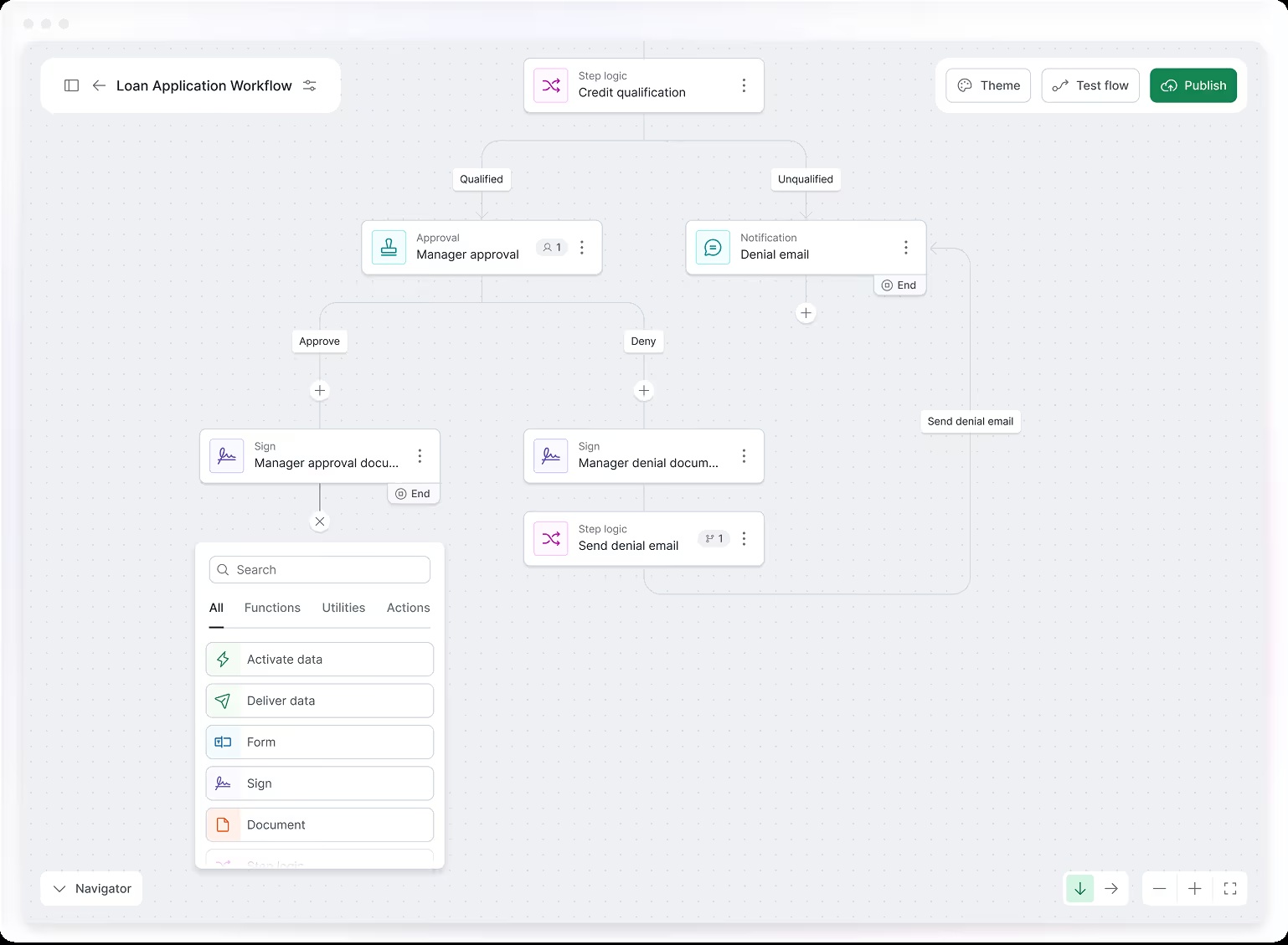
Imagine a loan application, as an illustrative use case. A customer provides missing details; an existing record supplies what is already known; conditional logic selects a review path; a document is generated; an authorized person approves it; the applicant signs. An organization still has to decide its rules. Software can carry those rules through the process.
- 01 Existing record
- 02 Prefilled form
- 03 Approval
- 04 Document + signature
- 05 Write back
This helps explain the focus on healthcare, higher education, finance and legal work. These sectors have plenty of information, plenty of approvals and excellent reasons to control both. The company reported more than 32,000 organizations served worldwide at its 2025 launch, naming Kaiser Permanente, Shell, Shopify and Netflix. That portfolio-wide figure should not be mistaken for a count of Streamline customers.
Security got the first vote
An older Formstack customer story supplies a particularly useful answer to what changed a buyer’s mind. AdventHealth came to the product after a data breach. Security was the immediate reason to replace its form infrastructure. The account describes more than 400 HIPAA-compliant forms launched in one day and a broader deployment into pre-birth registration.
The interesting benefit was what followed. The customer reported that a form and integration previously required 40 hours from a developer. Staff could now build and deploy forms themselves. That is a specific before-and-after account, not a promise that every customer saves 40 hours on every form. It shows how a purchase prompted by risk can also change who is permitted to get work done.
For Streamline, security also requires precise reading. The company markets zero data retention for connected data used in workflows. Its CLM product has a document repository, and August 2026 updates added configurable retention periods and automatic purging. A connected record passing through a process and a contract deliberately stored for later use have different lifecycles. A buyer needs to understand both.
The contract has enough people in it already
Streamline CLM launched in September 2025. It brings contract generation, redlining, approvals, signatures and post-signature tracking into the platform. The help documentation calls it an add-on module. Its distinctive commercial promise is access without per-user or per-envelope charges.
There is a behavioral argument buried in that pricing. Contracts involve sales, legal, procurement and finance, sometimes with an outside party joining the discussion. Charging for each additional participant can make collaboration a budget decision. Removing that particular toll gives teams less reason to conduct the real negotiation somewhere outside the official tool.
The broader business remains subscription software. At the time of this profile, Formstack lists Forms from $83 a month and Suite from $250 a month when paid annually. These are the established Formstack plans; they are not a Streamline price quotation. Enterprise buying also involves setup, integrations and the staff time needed to define the process.

The unglamorous work is the revealing work
Look at the 2026 product updates and the story becomes less theatrical, which is useful. March brought Salesforce file write-back and controls over when workflow changes go live. August brought saved version checkpoints, shared-task ownership and document retention settings. These features concern the ordinary questions that decide whether a workflow survives contact with a busy organization: who has it, what changed, and when should this file disappear?
The partner network tackles another practical problem: customers may need help assembling the process. A March 2025 TaskRay partnership connected Formstack’s Salesforce-native forms to project management. Native data capture could feed project tasks and onboarding work inside Salesforce. It is a narrower proposition than Streamline, but it pursues the same habit of joining collection to execution.
Internally, Intellistack describes a workforce combining remote and hybrid work and an employee-supported RAISE committee. That is the employer’s account of its culture. For a customer, the more consequential expertise is the accumulated combination of form design, documents, signatures, integrations and data security. Each piece covers a different place where information can become stranded.
Count the retyping before you buy
Intellistack sits between several shopping lists. A team seeking a form builder may compare Jotform or FormAssembly. A team joining applications may consider Microsoft Power Automate. A contract team may examine Conga or Docusign. These tools overlap in different ways; purchasing one category does not automatically solve the whole journey.
The useful thing to copy is a method. Choose one recurring request. Trace its information through every handoff. Count repeated entry, waiting, missing approvals and the applications involved. Then test a complete journey with the people who actually handle it. Measure elapsed time and corrections, rather than congratulating yourself on replacing a PDF.
This approach depends on usable source data, accessible systems and someone authorized to define the rules. Poor records will produce poor prefills. An integration cannot resolve a disagreement over who approves a request. For a simple contact form, a wider orchestration platform may add unnecessary complexity. No-code lowers the programming barrier; the organization still owns the decisions.
That is what makes Intellistack’s evolution interesting. The form was a visible nuisance. Following it led the company to a less visible one: work that stalls between otherwise functioning systems. The next blank form you receive is an invitation to investigate. Somewhere, somebody may already have your answers.