In the summer of 2023, Lee Shavel returned to Pride and Prejudice. What caught his attention was Jane Austen’s understanding of self-deception: the ease with which people mistake an impression for a judgment. For the president and chief executive of Verisk, whose business helps insurers assess risk, it was an unusually appropriate holiday companion. A drawing room can conceal a great deal. So can a spreadsheet.
His other reading included William Faulkner’s A Fable. His listening ran to Watchhouse and Lake Street Dive. The resulting picture is rather more interesting than the standard executive biography: a finance veteran with an English degree, a taste for bluegrass, and a working interest in the things people fail to notice.
There is a useful connection here, though it would be extravagant to credit Austen with a corporate strategy. Shavel runs a company whose usefulness depends on improving decisions. His public life repeatedly returns to the preparation behind those decisions: understanding a client, questioning an assumption, deciding where to invest. The numbers arrive in the foreground. Someone still has to ask what they mean.
Two degrees, one persistent question
Shavel graduated with honors from the University of Pennsylvania, earning a BA in English and a BS in economics from Wharton. The combination gives his biography an appealing double entry: language on one side, financial reasoning on the other. Neither qualification explains a person completely. Together, they make his continued interest in literature feel less like an executive’s decorative bookshelf.
From 1993 to 2011, he worked at Bank of America Merrill Lynch and its predecessor, taking roles that included Americas head of financial institutions investment banking. These were jobs concerned with how financial businesses funded themselves, bought other businesses, and competed. In May 2011, he became Nasdaq’s chief financial officer and executive vice president for corporate strategy, positions he held until March 2016.
That history matters because Shavel came to Verisk through finance, rather than through an insurer’s underwriting department. He had spent years considering the relationship between financial institutions and technology. Insurance became a new setting for an established question: how can a business use information and investment to make itself more useful?
- 1993-2011Financial institutions banking
Bank of America Merrill Lynch - 2011-2016CFO and corporate strategy
Nasdaq - 2017Joins Verisk as CFO
- 2022Becomes Verisk CEO
- 2023Adds the president title
Selected appointments; intervals are not drawn to scale.
The familiar office, the unfamiliar responsibility
Verisk hired Shavel as CFO in November 2017. He worked on its treasury, investor relations and procurement operations, and introduced a more disciplined process for allocating capital. In February 2021, his responsibilities expanded to group president, including oversight of energy and financial services businesses. By the time the board selected him to succeed Scott Stephenson as CEO, he had already spent several years inside the machinery.
His first day in the top job was May 25, 2022. In a note to colleagues, he described arriving at the office with the nervous energy of someone starting somewhere new. The address was familiar; the weight attached to it had changed. Before the handover, he had visited teams in London, Boston, Lehi and Jersey City with Stephenson and Mark Anquillare.
He asked employees for candor. He also argued that returns for shareholders depended on creating value for customers and colleagues. That is an easy proposition to print and a demanding one to administer. It requires decisions about whose problems deserve attention, which ideas receive funding, and how employees can disagree with the person who signs off on both.
In his welcome to investors ahead of the transition, Shavel thanked Stephenson for his counsel and described the importance of Verisk’s expanding data and customers’ growing ability to use it. The continuity was explicit. His appointment was a succession, with an existing business to understand and relationships to preserve.
“I ask that you be equally so with me.”
Lee Shavel, asking colleagues for honesty on his first day as CEO
The decision to do less
Some of the consequential decisions around that transition involved selling businesses. Verisk’s portfolio review led to the disposal of its financial services business in 2022, followed by the completion of the Wood Mackenzie sale on February 2, 2023. The energy analytics business went to an affiliate of Veritas Capital. Verisk was concentrating its attention on insurance.
For Shavel, this had a personal professional wrinkle. He had recently overseen energy and financial services as group president. Now those activities were leaving the group. A business can be valuable and still belong elsewhere; an executive can be responsible for an operation without being obliged to keep it forever. Capital discipline becomes rather more concrete when it changes the organizational chart.
When the Wood Mackenzie deal was announced, he called the moment bittersweet. He praised co-presidents Mark Brinin and Joe Levesque and expressed confidence in the company’s future. It was a small but useful acknowledgment of the people inside a portfolio decision. Transactions have strategic rationales. They also have colleagues.
Shavel assumed the president title in January 2023. Later that year, he described the danger of pursuing too many opportunities and losing the scale needed to solve industry problems efficiently. Focus brought a practical obligation: choose the problems Verisk could address well enough that clients would want to keep paying for the answer.
A banker’s habit: listen before proposing
Shavel’s explanation of his banking background is revealing. “For much of my career, I worked in a client-facing role,” he said. He emphasized listening to what companies needed and understanding where their industries were going. The same habit, he argued, belonged in his new job. A useful proposal begins with someone else’s problem.
At Verisk, that meant talking with client CEOs and technology leaders about their priorities. Older systems, operating costs and underwriting decisions were among the concerns he discussed publicly in 2023. His ambition was to make Verisk a partner in those decisions, with its businesses communicating more actively about what customers needed.
There is a recognizable temperament in this account: financially methodical, interested in feedback, attentive to clients. Those are features of the approach he describes, rather than a claim to know his private personality. The distinction matters in a profile of someone whose public language is mostly the language of work.
His wider responsibilities include a FactSet board seat, which he has held since 2020. Earlier, he served on the board of Investment Technology Group and chaired its audit committee. Another entry in his biography is service on the board of NJ SEEDS, an educational nonprofit. The career extends beyond a single corner office, into oversight and education.
The next shot, and the next risk
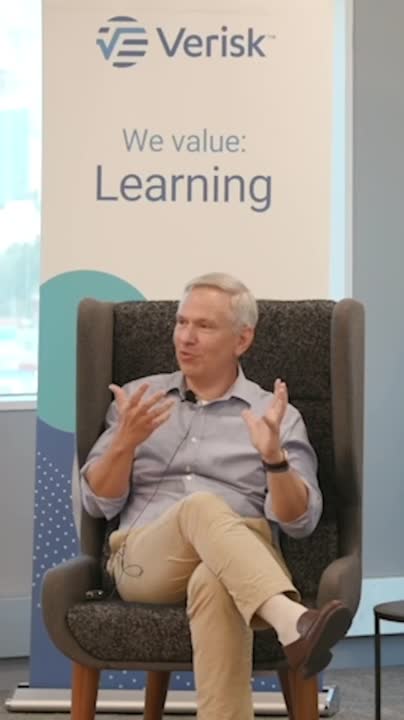
Golf supplies one of his less formal explanations of leadership. In a Verisk interview shared in 2024, he discussed the importance of moving on from a poor shot. The workplace connection was straightforward: acknowledge a setback and put attention into the next opportunity. Golf has the useful property of making retrospective brilliance entirely useless to the ball.
His writing also looks ahead. As an Insurance Journal contributor, he has examined emerging risks, including severe convective storms, battery storage and drones, and later agentic AI, electric motorcycles and hydrogen fuel cells. The range suggests the editorial problem insurers face: deciding which new development deserves a closer look before it produces an established pattern of losses.
In October 2024, Verisk announced his appointment to the Federal Advisory Committee on Insurance. The committee advises the Treasury Department’s Federal Insurance Office and brings together industry figures, regulators, academics and consumer advocates. It placed his experience with insurance data in a forum concerned with the wider market.
By September 2026, he was discussing a risk landscape shaped by climate change, technology and the growing volume of information. Satellite imagery and sensors can reveal more, but they also increase the work of separating a useful signal from background noise. Having more to look at does not automatically tell an insurer where to look.
Conceptual illustration of the problem Shavel describes, not a product diagram.
A conversational future, with someone accountable
In May 2026, Verisk announced a collaboration with Anthropic that put two connectors inside Claude. One provides access to underwriting intelligence; the other supports restoration work through XactRestore. The practical idea is to let professionals ask questions in ordinary language while working with Verisk’s governed information.
For Shavel, the attraction sits alongside a condition: people remain responsible for decisions. A fluent interface does not remove the need for reliable data or an explanation of how a conclusion was reached. The collaboration gives that position a specific application, rather than leaving it as a general declaration about the future of AI.
His longer ambition is to help insurance support resilience for individuals, businesses and communities. The route he describes runs through fairly exacting work: better information, usable systems and investments that solve shared problems. At Elevate 2026, his conversations included people from insurance, catastrophe services and restoration. Those connections put the abstract ambition close to the people handling damaged property and rebuilding it.
Shavel’s career has moved from advising financial institutions to taking responsibility for a company that serves them. Along the way, he has retained interests that make room for uncertainty, interpretation and the occasional bad golf shot. It is tempting to end with Austen. Perhaps the more fitting ending is the next question, asked before an expensive first impression becomes a decision.