The dog required dinner. Leah Solivan required a way to get on with her evening. In February 2008, she and her then-husband were waiting for a cab in Boston when they discovered the dog food had run out. Kobe, their 100-pound yellow Labrador, had supplied an exceptionally ordinary business problem. Somewhere nearby, surely, a person was already going to the shop. The missing ingredient was a way to ask.
Solivan, then known as Leah Busque, was a software engineer at IBM. She could see how a phone, a location and a network of people might turn that household inconvenience into a transaction. Four months later she left her job. The resulting company, first called RunMyErrand, became Taskrabbit. In 2017, IKEA acquired it. Kobe’s place in the origin story was secure; his résumé needed no further embellishment.
That beginning has the pleasing neatness of a business-school anecdote. The years that followed were considerably less tidy. Software had to be built, customers persuaded, a product replaced and leadership shared. Today, as an investor and the host of Breaking Precedent, Solivan spends much of her time examining what happens between the appealing idea and the respectable ending.
The girl who took the shortest route
Long before Taskrabbit, there was Pollution Solutions, a childhood environmental venture. Solivan had asked her father which job sat at the top of a company, learned the title of chief executive, and found an opportunity to put it into practice. Her sister and cousins supplied a convenient workforce. The instinct to organize arrived rather earlier than the venture capital.
She grew up in Shirley, Massachusetts. Her high-school job was behind the counter at the Shirley Cooperative Bank, where passbooks recorded transactions and tellers balanced their drawers before going home. A familiar face once presented a forged check that passed through the process. The experience stayed with her: recognizing someone and verifying a transaction were different operations. Years later, a marketplace inviting strangers into homes would give that distinction considerable practical importance.
At Sweet Briar College in Virginia, she studied mathematics and computer science, graduating in 2001, while also pursuing dance. One favorite class was Algorithm Analysis, taught by a mathematics professor. The pleasure lay in making things work efficiently. Even walking between classes became an optimization exercise: she took routes through buildings and classrooms because the shortest distance seemed too useful to waste on convention.
“I’ve always been obsessed with efficiency.”
Leah Solivan, on her college years
Her engineering career at IBM involved Lotus Notes and Domino. Yet her later enthusiasm for web development had an almost holiday air. She learned Ruby on Rails with an online tutorial and started assembling features. There is something revealing about a programmer who remembers the summer spent building her own prototype as fun. Independence meant more work, certainly, but it also meant choosing the problem.
A neighbor, a phone, a first customer
Solivan’s original question was local. Could someone nearby earn money by doing a job another person lacked time to finish? That sounds familiar now. In 2008, turning it into dependable consumer behavior required more than explaining the concept. People had to use it, return to it and trust the person who appeared.
She cashed out her IBM pension to help finance the start. The household reckoned it could cover about six months. During roughly ten weeks of development, she built the first version at home. Leaving a large employer for a company with one employee made the arithmetic intimate: every expense belonged to the same small experiment.
She also talked. Scott Griffith, then chief executive of Zipcar, became an early mentor after an introduction through a friend. His encouragement to see how far she could take the idea gave her a manageable next step. A founder can spend a long time trying to forecast a decade. Building the next version is a more serviceable occupation.
An early beta involved 600 mothers in her hometown. It was a useful place to observe real demand rather than collect polite enthusiasm. The everyday jobs were already there; the experiment concerned whether people would arrange them through a website. Her later advice keeps returning to that distinction. Compliments are pleasant. Repeat use is a rather more convincing form of applause.
In 2009, participation in Facebook’s fbFund incubator helped open another set of doors. The business moved to San Francisco in 2010. The original Boston errand service was becoming something larger, with investors, employees and customers whose expectations could no longer be settled by the founder doing everything herself.
The rabbit changes direction
Growth introduced a more awkward question: what if the product people knew was getting in the way of the service they wanted? Taskrabbit’s original model let people post tasks and receive bids. By 2014, the company was moving toward matching customers with workers, with clearer hourly pricing and a simpler booking process.
The change was substantial. People who had learned one way of finding work now had to navigate another. Some users objected. A marketplace has two sets of customers, and an improvement to the booking experience can still unsettle the people earning their living through it. The work of changing the system included dealing with that disagreement.
London had supplied a place to test a different product before bringing the changes back to the United States. Solivan describes the decision as a willingness to reconsider assumptions and rebuild around what the experiment showed. The successful outcome does not make the original decision comfortable in retrospect. At the time, there was an existing business attached to the old software.
Her recent writing returns to this episode because it complicates the familiar romance of persistence. Continuing takes resolve; so does stopping a process that has acquired employees, customers and a history. In her telling, commitment to the underlying purpose made changing the implementation possible. A founder’s first plan is entitled to a fair hearing. Eternal tenure is another matter.
- 2001Graduates from Sweet Briar; begins her engineering career.
- 2008Starts RunMyErrand in Boston.
- 2014Taskrabbit changes its booking model.
- 2016Moves to executive chair; Stacy Brown-Philpot becomes CEO.
- 2017IKEA acquires Taskrabbit.
The Allen wrench in the plot
Furniture assembly had been a popular request from Taskrabbit’s early days. Solivan did some of that work herself, confronting the flat packs and the small Allen wrench that accompany so many domestic ambitions. IKEA was therefore a logical company to approach about a partnership. The customer buying the furniture was also a prospective customer for help putting it together.
A London pilot connected the services at checkout. For IKEA, assembly could make a purchase easier to contemplate. For Taskrabbit, it created access to customers at the moment they needed help. Solivan remembers pursuing a partnership; the acquisition conversation followed.
In 2016, Stacy Brown-Philpot became chief executive and Solivan moved to executive chair. The distinction matters to the story. Founding a company and running its next stage need not remain the same job. The acquisition announcement in September 2017 came under Brown-Philpot’s leadership, with Taskrabbit set to continue as an independent platform and retain its contractor model.
By the time of the sale, the business had reached 44 cities and raised more than $50 million in venture funding. Those figures describe an organization assembled over years. They leave out the daily work of making a service predictable, but they establish the distance traveled from the first Boston prototype.
Opening the door for somebody else
One small scene from the company’s growth is particularly useful. In August 2015, Amelia Currin, an incoming Sweet Briar student, spent a day shadowing Solivan at Taskrabbit’s San Francisco office. The student had reached out; the founder made time. Currin’s account describes a conversation about collaboration, confidence and the culture Solivan had carried from college into work.
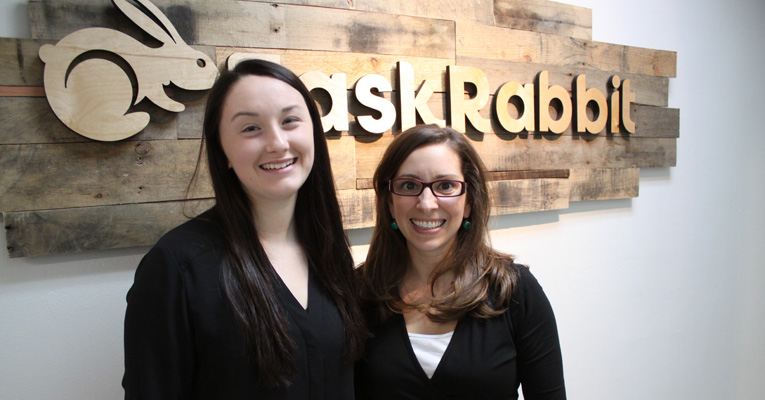
The photograph is a useful counterweight to the acquisition narrative. Careers also advance through a meeting someone agrees to take. Solivan had benefited from Griffith’s encouragement. Here she was making the next conversation possible for somebody nearer the beginning.
Her Puerto Rican heritage also informs how she thinks about belonging. Her father was born in Cayey, and she has written about family visits to Puerto Rico and wanting her children to grow up speaking English and Spanish. The details matter because professional biographies can make people look as though they emerged fully formed from their last employer. Her account has a family, a language and a place behind it.
A pair of slippers beside the investment thesis
Dance has remained part of that account. She keeps old ballet slippers in her closet and sometimes puts them on again. In her writing about raising capital, she connects ballet’s rehearsal and precision with the ability to present an idea under pressure. The connection is practical: confidence can be practiced, rather than awaited as a fortunate change in personality.
She now brings her operating experience to investing. Her current roles include managing director of Precedent.vc and general partner at Fuel Capital. Her investments span businesses including Our Place, Pacaso, Bird Buddy and Boardy.ai. The fund’s stated interest in diverse teams extends a question she has pursued for years: who gets the opportunity to build, and who gets to decide?
In an August 2026 conversation, she emphasized clarity, trust and accountability as leadership responsibilities. She also stressed watching what customers actually do. There is a consistent preference here for behavior over presentation: a service used twice, an experiment that changes a decision, a team able to keep working when the plan changes.
“Build trust before you need it.”
Leah Solivan, August 2026
Her podcast, Breaking Precedent, widens those conversations beyond startups. October 2026 episodes include investor Erin Harkless Moore, entrepreneur Stephanie Cartin and former NBA player Festus Ezeli. A book, also called Breaking Precedent, is planned for 2027 with Bloomsbury. Investing, interviewing and writing now give her several ways to examine how people change established arrangements.
The original arrangement she questioned was modest enough: if the dog needed dinner, someone in the household must interrupt the evening. She imagined a neighbor instead, then built a way to find one. The subsequent years added complications, colleagues and a Swedish furniture retailer. The habit survives: notice the inconvenience, ask another question, and see whether anybody comes back to use the answer.
Keep the conversation going
READ · WATCH · FOLLOW