The phrase was “a pipeline issue.” Investors and competition organisers told Leanne Robers that too few women were building technology companies. It sounded like an explanation. But to Robers and her colleagues at She Loves Tech, it looked suspiciously like a description of where everyone had been looking.
In a 2019 interview, Robers recalled finding more women founders than existing startup competitions seemed to suggest. Virginia Tan’s work with Lean In China had revealed entrepreneurs who needed somewhere to show their products and meet mentors. She Loves Tech, launched in 2015, built that somewhere. The interesting question became: what happens after you find them?
- A competition gets founders seen; mentoring helps them prepare for the meeting.
- Eligibility includes technology benefiting women, even when the founder is a man.
- The business behind the platform learned a painful lesson about depending on sponsors.
A better place to look
The first competition took place in Beijing. Four countries followed in 2016; eight in 2017. By 2020, with physical gatherings disrupted, the competition went entirely virtual and reached more than 30 countries. Its 2022 report records expansion to over 70. This was a way of moving the search closer to entrepreneurs, rather than expecting entrepreneurs to arrive at an established financial centre.
The mechanism depends on local organisations. The 2024 partner list includes CIRCLE in Pakistan, QBO Innovation Hub in the Philippines and Turtle Ventures in Bangladesh. These partners help select businesses before regional rounds and a global final. A founder gets a route into an international network through people working nearer home. An investor gets a filtered introduction to companies outside the usual orbit.
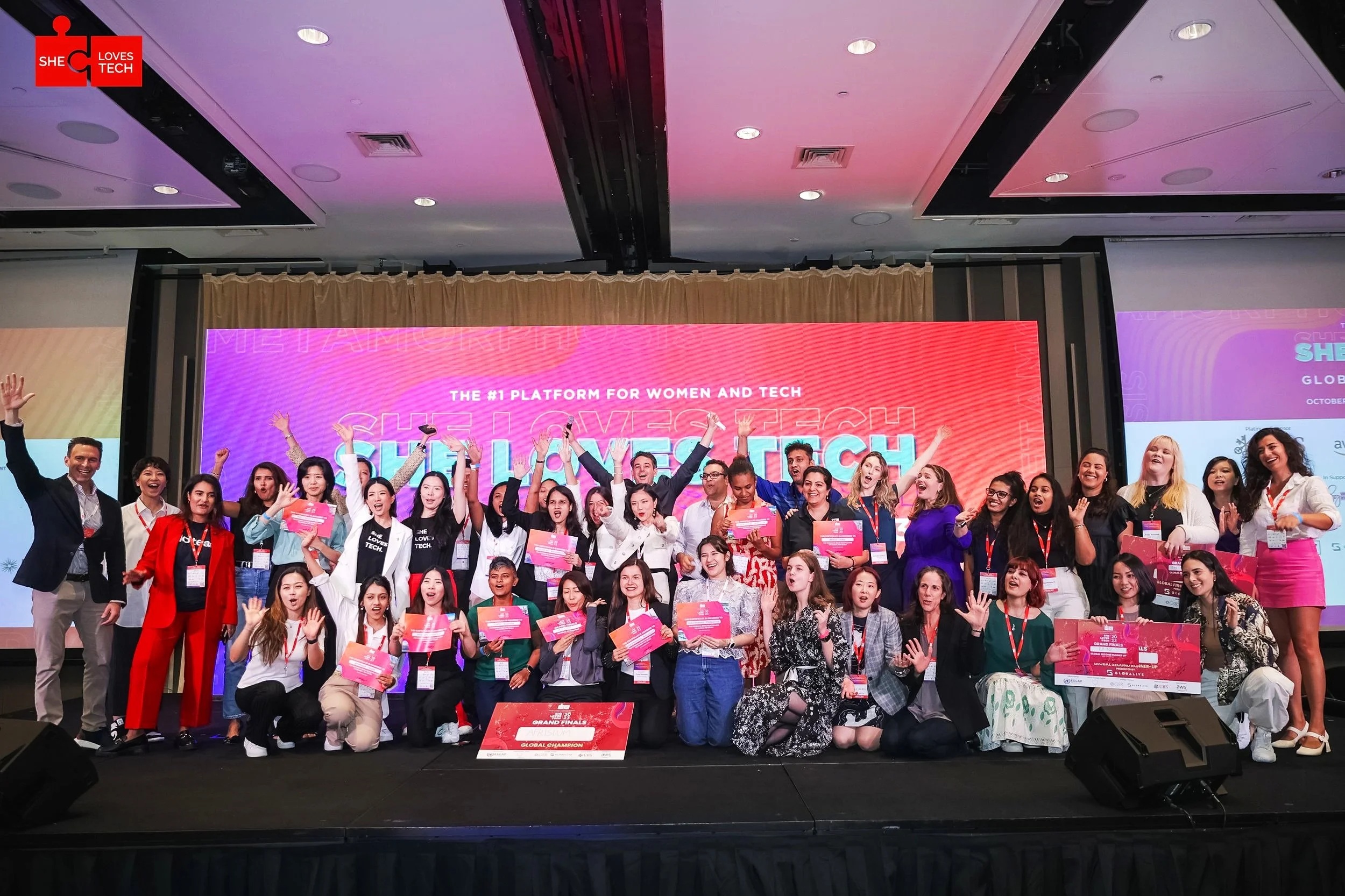
There is a useful distinction here. She Loves Tech serves founders seeking preparation and access, investors looking for opportunities, and corporate partners seeking connections to innovation. Its expertise sits in finding businesses, assembling mentors and making introductions. The pitch contest gives those activities a deadline and an audience.
The meeting before the money
In its 2022 applicant research, 43.7% identified access to investor networks as a fundraising challenge, up from 35.9% a year earlier. Investor matching was the assistance 43.1% wanted. Those numbers suggest a practical problem: a good product can still struggle to reach the right desk. They describe this applicant pool, rather than every woman entrepreneur.
Applicants reporting difficulty accessing investor networks. Scale: 0-50%.
The 2024 programme followed a sequence: screening, local selection, regional mentoring and semifinals, then a week-long bootcamp and global final in Singapore. Preparation comes before the investor audience. Mentors can help sharpen the business case while there is still time to change the presentation.
The competitive field is broad. In November 2024, Feminai took first place and US$20,000 for its work on breast cancer diagnostics. Commerce platform Profit Peak received US$15,000; conversational intelligence company intella received US$10,000. These are different products with different buyers. The shared organising principle is women’s participation and impact, rather than a single technology or industry.
“She Loves Tech gives the stage for female entrepreneurs to shine as they are.”Mint Wongviriyawong, CEO of EATLAB
The platform needed a business, too
Then came the problem familiar to anyone running a mission-driven organisation: who pays for the room? In a 2022 interview, Robers described corporate sponsorship revenue drying up during the pandemic. She paid staff from her own pocket. Burnout followed. The team’s response was to diversify revenue.
At that point, Robers said the conference supplied most revenue, the competition remained a nonprofit activity without joining fees, education pricing was still being worked out, and a proposed fund was targeting US$10 million. That target was an ambition, rather than a completed fundraising round. The account makes the trade-off plain: removing a founder’s entry fee leaves the organiser needing another source of income.
For an organisation copying this approach, sponsor concentration deserves as much attention as the event programme. A crowded stage does not pay salaries by itself.
More than one doorway
She Loves Tech’s founders community extends the relationship with peer mentoring, expert office hours, resources and investor matches. Its published page describes an invitation-only beta. Separately, its UN Women Climate Tech Accelerator offered ASEAN startups a nine-month programme beginning in 2024, combining training with longer mentoring. Girls Love Tech offered free 2024 events for younger participants, with partners including IMDA and Micron Foundation.
These programmes place the company between a founder community, an accelerator and an investment network. A conventional accelerator or direct approach to a venture fund remains an alternative. She Loves Tech’s particular proposition is the combination of local selection, international exposure and a gender lens. Its current team page names Tan as founder and chair, Rhea See as co-founder and CEO, and Robers as co-founder.
Bring a prototype. Bring a plan.
For a founder, the practical starting point is eligibility. Published rules require a working prototype or minimum viable product and less than US$5 million in external funding. A qualifying business can have a female founder, predominantly female users or consumers, or technology positively affecting women. Applicants agree to present publicly and share registration materials with potential investors, mentors or partners.
This route asks for time and disclosure. An idea without a prototype falls outside the criteria; a rejected applicant should not expect individual feedback. Selection offers access, with no promise of a cheque. The published 2024 registration is closed, so founders should check the competition page for a subsequent call.
The homepage reports 13,000-plus startups and more than US$500 million in funding across its ecosystem. Those are the organisation’s figures, not proof that participation caused each investment. The lesson worth copying is smaller and more testable: find overlooked builders, prepare them for a specific audience, and make the introduction useful enough that both sides want another meeting.