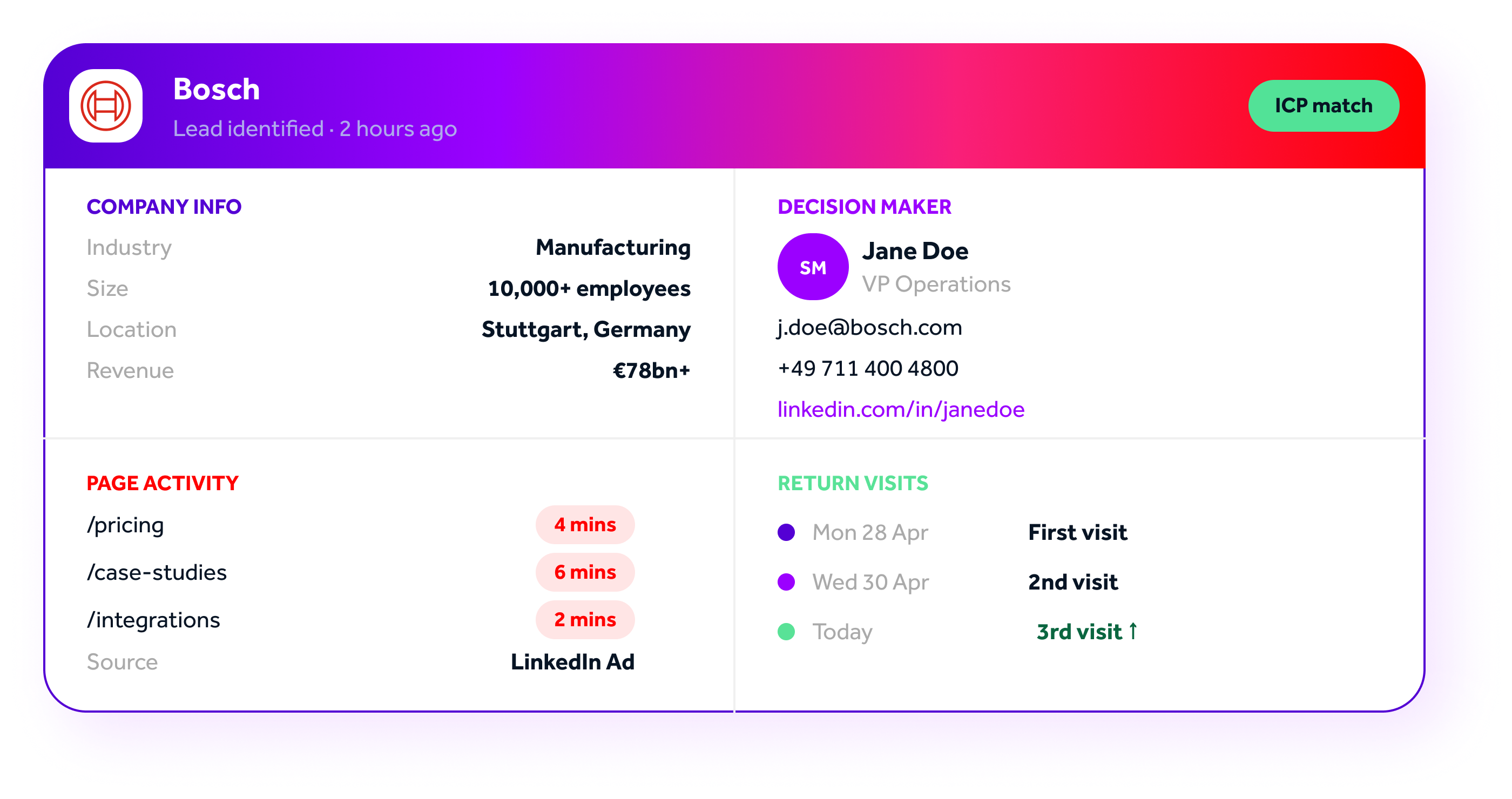
Someone from a manufacturer visits your pricing page at 10:14, returns to a case study after lunch and appears again two days later. Nobody completes a form. To ordinary analytics, this is a tidy stack of page views. To Lead Forensics, it is a company with a location, an industry, a rough size and a conspicuously interesting browsing trail. The Portsmouth-born software business exists to move that trail from the marketing dashboard to a salesperson's to-do list before the interest cools.
The proposition is wonderfully concrete. Add a lightweight JavaScript tag to a B2B website. It captures the IP address attached to a visit and checks it against Lead Forensics' privately maintained database of business IP addresses. A match produces an account profile, firmographic detail, pages viewed, visit history and, where purchased, contact details for likely decision-makers. Rules can score the account, send an alert and push the record into Salesforce, HubSpot, Microsoft Dynamics, Pipedrive or Zoho.
A name for the account, not the human
This distinction is the whole story. Lead Forensics identifies a business, not the individual employee holding the mouse. Its compliance documentation says the system collects non-personally identifiable attributes and an IP address, excludes consumers and sole traders, and returns a company when it can establish a match. The contact attached to that account is a plausible commercial counterpart, not proof of who browsed.
Used intelligently, that is still a meaningful upgrade. A seller no longer begins with an undifferentiated list of companies that fit a demographic filter. The seller begins with companies that have shown some behavior on the seller's own site. A repeat visitor to implementation, comparison and pricing pages is a more interesting account than a stranger pulled from a database. The signal does not close the epistemic gap. It narrows the hunting ground.
The crown jewels are a database
Lead Forensics and its rivals all confront the same unglamorous problem: corporate networks are messy. Offices share addresses, remote staff use home connections, virtual private networks obscure location, and internet providers can masquerade as businesses. The company's answer is ownership. It calls its matched-IP database the “crown jewels,” arguing that direct control lets its team cleanse, verify and update records instead of stitching together third-party feeds.
That claim places Lead Forensics in a busy market beside Dealfront's Leadfeeder, Leadinfo, Albacross, Snitcher, Warmly, RB2B, Visitor Queue and Visual Visitor. Some rivals advertise cheaper self-serve tiers. Some pursue person-level identity in the United States. Lead Forensics leans the other way: company-level identification, a built-in lead manager, unlimited users, contact enrichment, native CRM plumbing and people who help customers configure the machinery.
A website visit obviously doesn't mean someone is ready to buy.Henry Braithwaite, co-founder and Group COO
Braithwaite's caveat is more useful than a page of conversion promises. The alert is evidence of interest, not permission to announce that you watched somebody read three pages. A tactful rep might use the signal to prioritize an account, research the right person and lead with a relevant business problem. A clumsy one might call a random executive and say, “We saw you on the site.” Same data, entirely different customer experience.
What it costs - and what the contract is buying
There is no public rate card on the Lead Forensics website. Customers first book a demo, run a free one-week trial and receive a quote based on site traffic and how many businesses the platform can identify. The two published packages are Essentials and Automate. Essentials covers identification, firmographic and behavioral data, real-time alerts, contacts, lead management, training and a dedicated customer success manager. Automate adds CRM workflows, lead creation and routing, and account-based marketing matching.
Custom software cost + a named owner + fast follow-up
Marketplace estimates vary widely and are not a substitute for a quote. The operational bill is easier to calculate: somebody must tune filters, review alerts, research contacts and act while the visit is fresh.
The company favors annual contracts and says results usually need sustained configuration, training and measurement. Its current playbook includes portal setup, live training, a sector specialist and reviews every 30 days. That is a revealing business model. Lead Forensics is not merely licensing a lookup table; it is selling the organizational habit required to use one. Public UK accounts show £30.8 million in 2024 turnover and a modest £251,898 pre-tax profit after four reported loss-making years. This is an established, sales-heavy SaaS operation, not a lightweight browser extension.
What failed first: the traffic, or the website?
The clearest copyable lesson comes from SF Media, a digital agency running paid search for a B2B client in a market where keywords attracted both businesses and consumers. The obvious fear was wasted ad spend. After two months, account-level visitor data helped the agency separate irrelevant B2C clicks from valuable businesses that reached the site but did not inquire. That changed the diagnosis. Some keywords were wrong, but the landing experience also needed work.
SF Media trimmed the keyword set, preserved traffic from the right kinds of companies and changed the website to convert them. By month four, online enquiries were up by more than 200 percent and the client extended the campaign beyond its initial trial. The useful move was not “install tracking.” It was using identified company traffic as a debugging layer between ad click and form completion.
Other company case studies show the same pattern with different motions. Shortlist Marketing loaded known target accounts, watched for visits to campaign pages and reported 89 extra leads and £49,000 in pipeline over three months. Bay MarketForce said appointment-setting effectiveness rose from 7 percent on its normal activity to 39 percent using Lead Forensics lists. Site-Seeker paired the data with a four-email nurture sequence and attributed a $100,000 deal to the program. These are vendor-published customer accounts, useful as examples of method rather than universal forecasts.

The operating manual hiding in plain sight
A reader can copy the workflow without copying every product choice. First, define a narrow ideal-customer profile before looking at the visitor list. Second, assign more weight to meaningful behavior: repeat visits, product detail, implementation, case studies and pricing should outrank a single blog bounce. Third, route accounts to an owner automatically. Fourth, give that owner a service-level expectation measured in hours or days, not “whenever the dashboard gets checked.” Finally, measure appointments, pipeline and revenue, not the thrilling but economically empty count of identified logos.
The platform also stretches beyond net-new prospecting. Account managers can see an existing customer exploring another product, a dormant account returning after months away or a named target researching a category. Marketers can compare campaigns by the quality of companies attracted instead of lead totals alone. With StackAdapt, Lead Forensics data can now feed account-based advertising across native, display, audio and connected television. With Panintelligence, it gained embedded dashboards and reporting. The direction is clear: from “who visited?” toward “what should the revenue system do about it?”
Conditions that favor it
- Meaningful B2B website traffic
- A precise target-account definition
- Sales capacity for prompt research and outreach
- Enough contract value to justify a quote-led tool
- A CRM and clear routing ownership
Conditions that weaken it
- Primarily consumer traffic
- Only a few hundred B2B visits a month
- A need to identify the exact human visitor
- No rep available to work the signal
- Long delays between alert and action
Where the clue earns its keep
Lead Forensics was launched in 2009 by Paul Thomas and Henry Braithwaite, two founders with roots in outsourced sales. That lineage explains the product. It does not admire data from across the room; it wants the data worked. The company says more than 60,000 people now use the platform, while its website describes 10,000 business customers and displays names including Kärcher, Travelers and Xerox. Current marketplace profiles put the team above 400 people across offices in the United Kingdom and United States.
Its recent trophy cabinet is crowded: a 2026 TrustRadius Buyer's Choice award, a number 42 place on the UK's 2026 Best Workplaces list and 52 G2 badges in the Fall 2026 reports, 33 of them number-one rankings. Awards do not settle questions about match accuracy, contact freshness or value for money. They do show that Lead Forensics has become a durable name in a category it helped establish.
The sharper verdict is conditional. Lead Forensics is useful when a high-value B2B purchase leaves faint digital footprints and a capable team is waiting to interpret them. It is less useful when traffic is thin, buyers are consumers or sales expects the software to produce a person's identity and a ready-made reason to call. The product turns anonymity into an account-level clue. Its customers still have to supply judgment, timing and manners.