Here is a fact about startups that is both obvious and constantly ignored: the thing you build first is usually not the thing you end up selling. Revenoid, a San Francisco company with a second home in Carrollton, Texas, is a fairly pure demonstration of this. It began life in 2016 as EvaBot, and EvaBot was, of all things, a corporate-gifting robot. You would send someone a link, they would answer a few chatty questions about what they liked, and three or four minutes later an emotionally intelligent piece of software would pick out a present and mail it to them. This worked. The company shipped, by its own count, more than 125,000 personalized gifts, with something like 90 percent of recipients reporting they were pleased about it, which is a higher approval rating than most gifts from actual humans achieve.
You can see the logic. Relationships drive business, thoughtful gestures build relationships, and software that automates thoughtful gestures at scale is a real product. Investors saw it too. In the summer of 2022 the company raised a $10.83 million Series A - $8.33 million of equity plus $2.5 million of venture debt - led by Comcast Ventures, with Alumni Ventures, Bloomberg Beta, Precursor Ventures, Forefront Venture Partners and Silicon Valley Bank filling out the round. The headline at the time was about amplifying thoughtfulness in business and creating high-value touchpoints, which is the kind of phrase you write when your product is gifts.
And then the ground moved. Large language models went from research curiosity to boardroom mandate, and the interesting question stopped being "how do I send a thoughtful gift" and became "how does a sales team know which account to call, and what to say, before a competitor figures it out." The founders - Rabi Gupta, who is CEO, along with Satwick Saxena, Ashish Kumar and Akshay Gupta, all of whom immigrated to the United States to build the company - did the thing that is easy to describe and hard to do. They kept the thesis (relationships win deals) and threw out the product (gifts). EvaBot became Revenoid.
What Revenoid Actually Does
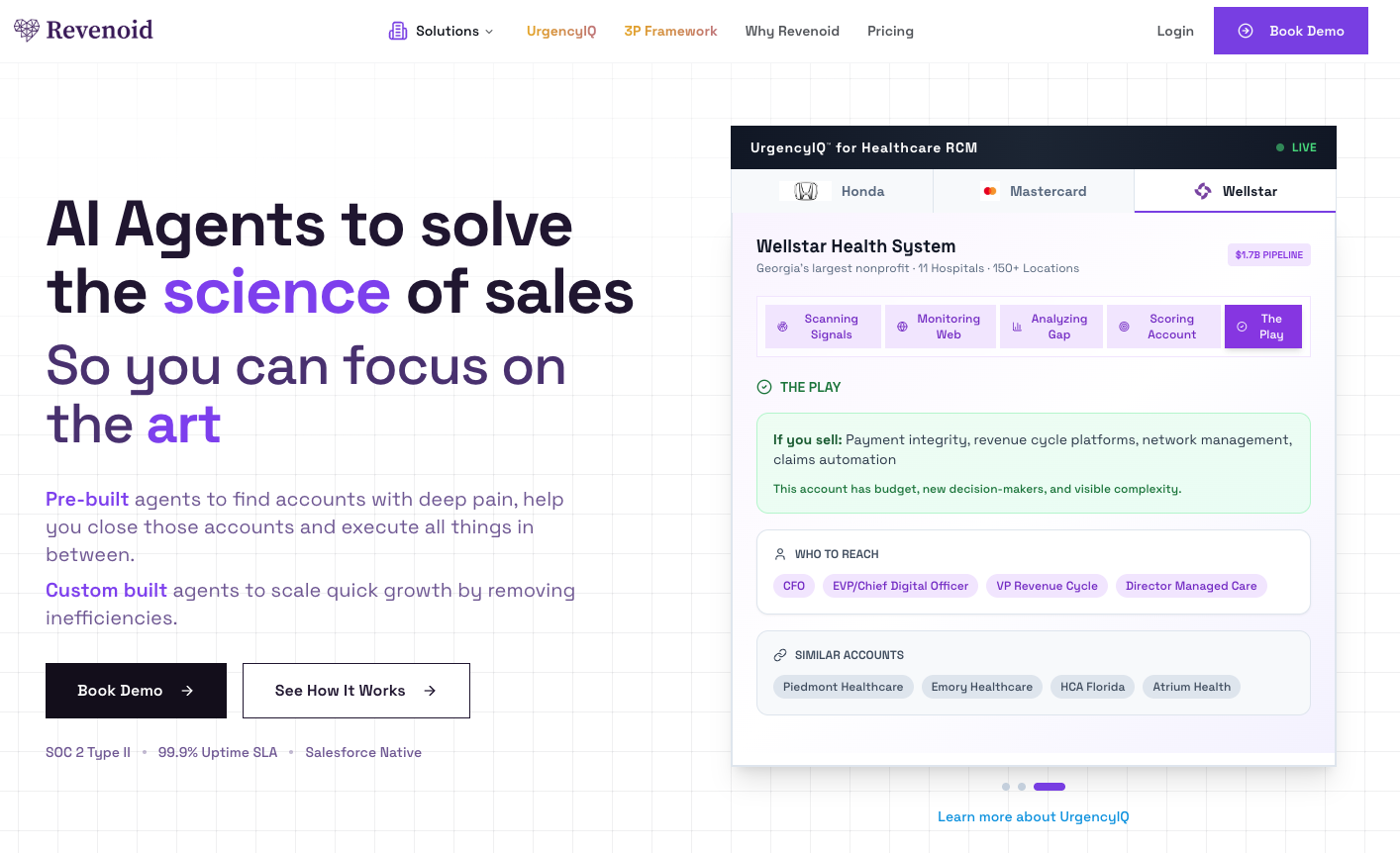
Strip away the category language and Revenoid is answering a boring, expensive problem: a salesperson spends roughly two hours researching a single account before they can say anything intelligent to it. Multiply that across a book of business and most of a rep's week evaporates into reading. Revenoid's claim is that it compresses those two hours into about fifteen minutes by having AI agents do the reading.
The reading, importantly, is of public and semi-public signals: 10-K filings, earnings-call transcripts, news articles, social channels. These are documents that contain, if you can process enough of them fast enough, a fairly precise picture of what a company is worried about right now. A human cannot read all of it. A fleet of agents, in principle, can - continuously, across the 10,000-plus accounts a customer asks it to watch.
"AI Agents to solve the science of sales - so you can focus on the art."
- Revenoid's own framing, printed on the product
The signals feed a scoring engine the company calls UrgencyIQ, and this is the genuinely interesting design choice. Most account-scoring tools rank prospects by fit - are they big enough, in the right industry, do they look like your existing customers. UrgencyIQ instead tries to rank by pain: which accounts are showing signs of a problem your product happens to solve, right now. Fit tells you who could theoretically buy. Pain tells you who might buy this quarter. Those are different questions, and Revenoid has bet its positioning on the second one being more valuable.
On top of the scoring sits a family of agents with unglamorous, useful names. Orchestration Agents handle prioritization, prospecting briefs, meeting prep and recap, contact enrichment and personalized sequences. Pipeline Generation Agents do lead generation and account research. Sales Execution Agents prepare for meetings, write recaps and generate decks. There is also a Custom Agent Builder for teams that want to wire up their own workflows. It is, deliberately, less a single chatbot than a small assembly line.
The People Who Built It
It is worth pausing on the founders, because the pivot makes more sense once you know them. Rabi Gupta is not a first-timer. Before Revenoid he built and sold iCouchApp, a product that reached more than 1.5 million active users, then moved from New Delhi to San Francisco to start again. His co-founders - Satwick Saxena, Ashish Kumar and Akshay Gupta - made the same jump. That matters for a specific reason: a team that has already shipped one company to an exit is more likely to treat its current product as a hypothesis rather than an identity. Killing EvaBot's gifting business, which was working and funded, is the sort of decision that is emotionally expensive for founders who have only ever built one thing. For this group it was, apparently, just following the signal.
The company itself is small and deliberately so - around 34 people, product- and research-heavy, oriented toward getting large language models to do useful work inside real sales motions rather than winning demos. That shows up in the unglamorous details: the compliance certifications, the uptime commitments, the choice to embed inside other people's software rather than demand its own tab. It is the posture of a team selling to buyers who have been burned by AI hype and want to see the receipts.
The Part Enterprises Actually Care About
Here is where a lot of AI sales tools quietly die: they produce their insight in a separate app that reps have to remember to open, and reps never open it. Revenoid's design answer is to deliver the output natively into the tools sales teams already live in - Salesforce, HubSpot, Outreach, Salesloft. The best software, in this category, is frequently the software nobody has to be reminded to use.
The other thing enterprises care about is whether they will get fired for buying you. Revenoid's answer there is the unsexy but load-bearing stuff: SOC 2 Type II certification, GDPR compliance, a 99.9 percent uptime commitment. It carries a 4.6 average rating on G2 across dozens of reviews, and its customer references skew large - Mastercard, Jellyfish, ASAPP, Veritext Partners, PDI Technologies among them. None of that is glamorous. All of it is the actual product when you are selling to a Fortune 500 procurement team.
The scarce resource in sales was never leads. It was attention - and Revenoid is a bet on spending it better.
- YesPress, reading between the lines
What You Can Actually Do With It
For a sales rep, the practical loop looks like this. You hand Revenoid a list of target accounts. Its agents read everything public about them and surface the ones showing pain right now, ranked by UrgencyIQ. For the accounts at the top, you get a prospecting brief you did not have to write, a personalized outreach sequence you did not have to draft, and, when a meeting lands, prep and a recap you did not have to assemble. The pitch is not that the software replaces the seller. It is that the seller stops spending the first two hours of every account being a research analyst and starts the conversation already informed. For a sales leader, the appeal is different and arguably larger: a consistent, always-on way to know which accounts across the whole book deserve attention this week, rather than relying on whichever rep happened to read the news that morning.
The risk, of course, is commoditization. "AI reads your accounts and writes your outreach" is a sentence a dozen well-funded companies would happily claim, and buyers are rightly suspicious of AI that produces confident, generic email. Revenoid's counter is specificity - pain-based scoring, native delivery, enterprise trust - but the category is young enough that no one has won it, and the same signals Revenoid reads are, by definition, available to everyone else too. The moat, if there is one, is in doing the boring parts better than rivals who would rather demo the flashy ones.
Is any of this a sure thing? No. Revenoid is roughly a 34-person company, with third-party estimates putting its annual revenue somewhere in the $3.5 to $4 million range and its valuation around $11.9 million - which is to say it is small, and it is competing in one of the most crowded arenas in software. Clay, 6sense, Gong, Apollo, Regie.ai and the sales-engagement incumbents are all pushing versions of "AI that finds and works your accounts." The wager Revenoid is making is that scoring by pain, delivering inside existing tools, and clearing the enterprise-trust bar is a defensible combination. The 125,000 gifts it shipped in a previous life are, in a sense, evidence for the underlying belief that has not changed: figuring out the right moment to reach a person is worth more than reaching more people. The tooling just got a great deal smarter about the timing.