He spent twenty years building software you noticed - event apps, networking tools, review sites. Now he is building software that disappears. Ambient is an AI chief of staff for the people who never have time to read another tool's onboarding.
Ambient sits inside the calendars of founders and CEOs. It reads the meetings, the chat, the email, the docs, and tries to do what a human chief of staff would do if a human chief of staff could be in three rooms at once. Three workflows. Daily prep dossiers. Secure leadership notes. Red, yellow, green on the initiatives that can sink the company. That is the entire pitch.
Coburn and his co-founders, Brandon Catcho and Taylor McLoughlin, did not start with a product. They started with a sample size. Roughly four hundred chiefs of staff, interviewed in a methodical sweep that looked more like fieldwork than user research. The answer they kept hearing was the same one any operator could tell you for free: the calendar is the problem, and the calendar is sacred, and the calendar will not be reformed.
So Ambient does not try to reform the calendar. It tries to make the person attached to it smarter on the way in and faster on the way out. The bet is that the office of the CEO - that strange staffing pattern where titles do not match jobs and the most important work is invisible - is the highest-leverage place to put AI inside a company. Coburn has spent his career around that office. He has run it, hired into it, and watched it break.
The company is small and focused. Around thirteen people. Backed by Maven Ventures, Moment Ventures, and AI Sprouts, with the kind of restraint that suggests they would rather ship the right thing than the loud one.
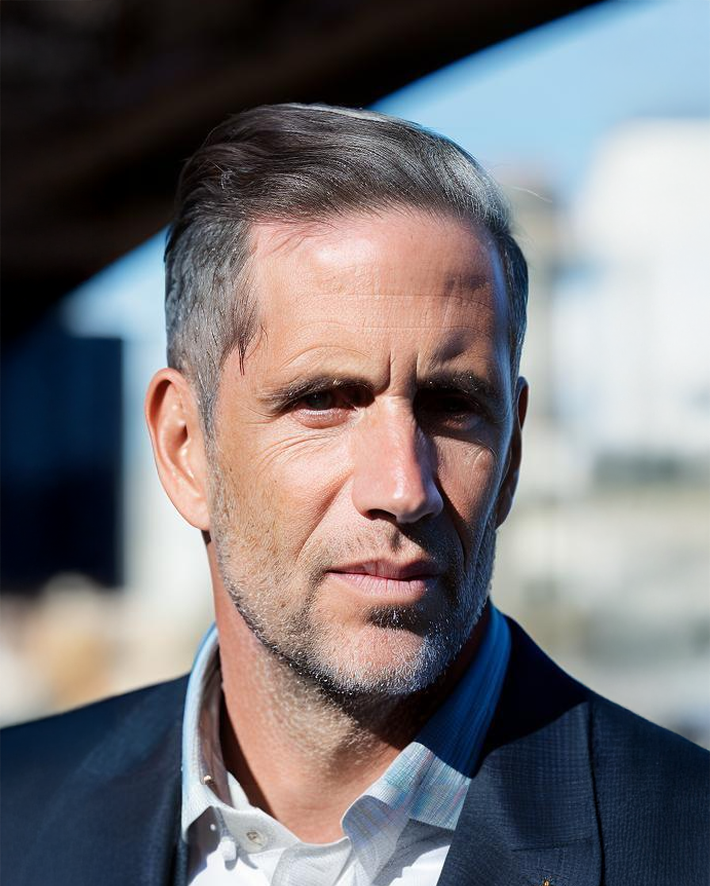
Coburn's career maps neatly onto the platforms that defined each stretch of the modern internet. RateItAll arrived during the UGC moment, when the bet was that the crowd would write the encyclopedia. It became one of the early consumer review properties and grew nicely on the back of search traffic - which is the same thing as saying it grew nicely until search traffic decided otherwise. In 2010, Google rolled out an algorithm change. Rankings reshuffled. Traffic evaporated. A profitable business stopped being a business inside of a week.
He tells the story without much drama. The point is the lesson: do not build your house on land you do not own. It is a lesson he repeats to founders now, and it appears to be the reason Ambient cares so much about being the system of record for its users rather than a feature inside someone else's.
DoubleDutch came next, in 2011. Mobile event apps were a real product category for about a decade, and DoubleDutch was, by most accounts, the company that defined the upper end of it. Deloitte Fast 500. Inc. 5000. Business Travel News Most Influential in 2016. Cvent bought it in 2019, which closed the loop in the tidy way that good outcomes sometimes do.
Then twine, which Coburn launched in 2020 - timing that looks either prescient or unavoidable, depending on whether you remember what March 2020 felt like. Twine helped remote and hybrid teams form actual connections rather than the simulated ones that came in calendar invites. From twine to Ambient is a short hop conceptually. Both are about the texture of work that does not show up in dashboards.
Three workflows, roughly weighted
Illustrative split, based on the three workflows Coburn has described publicly.
In 2010 he qualified for Red Bull King of the Rock, the streetball tournament that ran out of Alcatraz. He still plays pickup ball in the Mission.
He hires for entrepreneurial range over experience fit. The implied promise to new hires is that the job is a stepping stone toward their own thing.
Once watched Google's algorithm dissolve RateItAll's traffic overnight. He has been wary of dependencies he cannot see ever since.
Four hundred interviews with chiefs of staff before shipping. That is a research budget most founders skip on the way to a demo.
Lives in the Mission with his wife Lilia and daughter Lucia. Says it like the neighborhood is part of the operating system.
UGC. Mobile. AI. Few founders ride three distinct platform shifts and stay sharp through each one.
Maven Ventures, Moment Ventures, and AI Sprouts. A cap table that prefers building over branding.
Nortel Networks across Latin America. HR role in Brazil. Then runs HR at Larscom.
Founds RateItAll, an early consumer review site that becomes a top-ten property in its category.
RateItAll's traffic collapses after a Google algorithm change. Same year, he qualifies for Red Bull King of the Rock.
Co-founds DoubleDutch. Mobile event apps become a real category. The company makes the Inc. 5000 and Deloitte Fast 500.
Named to Business Travel News Most Influential list.
Cvent acquires DoubleDutch.
Launches twine, an employee connection platform for remote and hybrid teams.
Starts Ambient as Co-Founder and CEO with Brandon Catcho and Taylor McLoughlin.
Appears on the AI for Founders podcast to explain the AI chief of staff thesis.
Before writing a line of product, the Ambient team ran one of the larger structured interview campaigns into the chief of staff role anyone has done in public.
His corporate education happened partly in Portuguese. He spent years inside Nortel's Latin America operations before he ever sat through a board meeting in English.
Basketball is not a hobby for him so much as a recurring engagement. The Red Bull tournament was the visible proof; the Mission courts are the rest of it.
Ambient's stated ambition is a future where leadership teams operate in deep partnership with AI. The unglamorous version of that vision is the part Coburn seems most interested in: faster execution, better decisions, and an operating model that does not depend on a single heroic operator burning out gracefully.
Coburn has been clear that the value lives at the boundary of new technology and personal pain. He has watched founders try to staff their way out of the same problem for two decades. The wager is that a quiet machine, well placed inside the workflow, beats one more headcount.
If twine was about helping distributed teams feel like teams, Ambient is the more direct ask. It is about helping the people running those teams think clearly, often, and on time.
Filed under Founders / AI / Office of the CEO