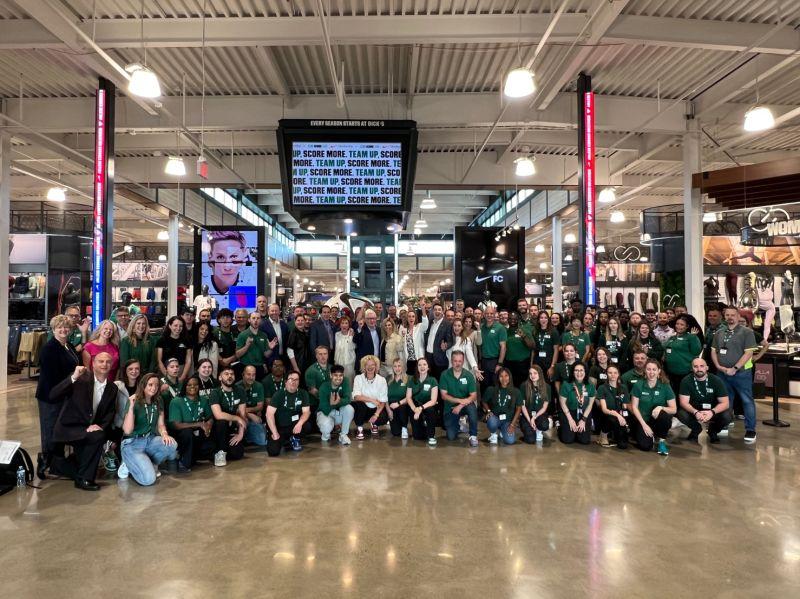
In August 2023, Lauren Hobart celebrated a new House of Sport in Johnson City, New York. The night before, she had visited “Store 1,” the reminder of a business that began in nearby Binghamton in 1948. Her public message thanked Ed Stack, his family and the employees who had made the opening happen. A company anniversary can produce a great deal of ceremonial language. Here, at least, there were two actual places to compare.
One was the beginning. The other contained a proposition about what a shop might become. House of Sport puts activities such as climbing, batting and golf alongside merchandise. Customers can do something with the equipment before deciding whether to take it home. For a business whose products promise movement, this seems a reasonable concession. Standing still in an aisle has never been much of a sport.
Hobart became president and CEO of DICK’S Sporting Goods on February 1, 2021, succeeding Stack. She was its third chief executive, its first woman in the job and its first CEO from outside the founding family. Those distinctions belong in the record. The more revealing question is how a former banker and soft-drinks marketer came to oversee a retailer experimenting with how much playing belongs inside a place of business.
Her career offers an answer in stages. She learned finance, then brands, then the operations behind the promise on the advertisement. Today, the store is where those disciplines have to agree. The customer has other shops to visit and a phone that can furnish an alternative price in seconds. A warm corporate intention is unlikely to make the trip worthwhile on its own.
A banker discovers the speed of a shop
Hobart earned her undergraduate degree at the University of Pennsylvania and her MBA at Stanford. Her early working life was in commercial banking, with jobs at the organizations now known as JPMorgan Chase and Wells Fargo. She spent five years in that world before business school. The progression toward sporting goods was hardly a straight line, although careers tend to acquire suspiciously tidy shapes once someone writes the biography.
PepsiCo followed. Over 14 years, she worked in finance, strategic planning and marketing, eventually becoming chief marketing officer for its US carbonated soft-drink portfolio. That sequence matters: a brand has to attract people, but someone also has to understand the economics underneath it. Advertising alone cannot rescue every decision made elsewhere in a business. Banking alone does little to explain why someone wants one product more than another.
When she joined DICK’S as chief marketing officer in February 2011, one difference delighted her. Retail could move quickly. A decision might produce visible change within a week, rather than working its way through the longer processes of packaged goods. She also liked the passion that customers brought to sport. Demand came with an emotional charge already attached. The marketer’s task was to understand it and give it a useful destination.
Her early influences included Pepsi leaders Dawn Hudson and Dave Burwick. Asked in 2011 what she would change if she could do things again, Hobart chose more time off after business school. This is a reassuringly ordinary regret for someone whose subsequent job descriptions became steadily longer. The climb up an organization chart does not necessarily improve one’s holiday arrangements.
“For a marketer, the power that sports gives you is enormously seductive.”
Lauren Hobart · 2011
The advertisement becomes an operating job
At DICK’S, Hobart helped develop and launch CALIA with Carrie Underwood. It was a practical exercise in connecting a customer, a product and a recognizable point of view. The business was selling clothing, with all the decisions about fit, positioning and presentation that entails. The celebrity name could attract attention; the merchandise still had to justify its place in a wardrobe.
Her remit expanded. She became executive vice president and chief marketing officer in 2015, then chief customer and digital officer in April 2017. A month later, she became president. The responsibilities included stores, marketing, e-commerce and technology, along with people, legal and strategy functions. She joined the company’s board in January 2018. By the time she became CEO, she had spent almost a decade inside the business.
This is the less glamorous part of succession, and arguably the most useful. Someone has to learn how the parts interact before taking responsibility for the whole. A promise made online needs to survive a store visit. A product launch needs staff who can explain it. Expanding the remit also expands the number of ways a seemingly excellent idea can become inconvenient in practice.
Hobart has said she never began with a plan to become CEO. The opportunities widened as she took on more work. That gives her career a different texture from the familiar childhood-destiny account. There was no need for the undergraduate to foresee the executive office. There was a need for the executive to keep learning beyond the boundaries of the job she had originally accepted.
- 2011Chief marketing officer
- 2017President
- 2018Board director
- 2021President & CEO
Two people can leave a meeting disagreeing
Stack stayed on as executive chairman when Hobart took the CEO role. She described him as a mentor in the succession announcement. The arrangement preserved a relationship developed over years, while putting the chief executive’s responsibilities in her hands. In a family-founded company, that is a considerable transfer of trust, even when the familiar figure remains close enough to offer an opinion.
Their working relationship allows for disagreement. Hobart has described debates that end without a shared conclusion, followed by another conversation a day or two later. If a proposal matters to her, she returns to it. The pause is part of the process. It gives a strongly held view time to become a better argument, rather than requiring either person to win the meeting before leaving the room.
A sporting-goods business supplies an abundance of competitive metaphors. This particular habit is refreshingly unheroic: go away, think, come back. It makes room for persistence without pretending every decision is a final whistle. For Hobart, whose role grew across functions, persuasion has a practical purpose. A strategy needs people in different jobs to understand what they are being asked to make happen.
A climbing wall is a fairly literal invitation
The first House of Sport opened in Victor, New York, in April 2021, followed by Knoxville, Tennessee, in May. Both were roughly 100,000 square feet. The timing put the format near the beginning of Hobart’s CEO tenure, although the work behind it predated her appointment. A large store does not materialize simply because a new name appears at the top of the organization chart.
The format changes the visit. A batting cage lets a shopper test equipment through an action that resembles its eventual use. A climbing wall gives a family a reason to spend time in the building. Golf technology can help turn a purchase into a discussion about performance. Each activity asks more of the store than shelving goods neatly and keeping the checkout queue moving.
In Boston, House of Sport occupied the former Lord & Taylor building on Boylston Street. The conversion offered an unusually visible version of the same argument: an existing retail address could accommodate a different kind of visit. A department store’s old shell became a place to experiment with equipment and play. The building stayed in the business of attracting people, with a revised invitation.
These spaces also make Hobart’s emphasis on staff more consequential. An experience depends on the person who helps a customer use it. The attraction might bring someone inside; the conversation can determine whether the visit works. A climbing wall is easy to photograph. Knowledge, patience and a sensible recommendation are harder to put on a property brochure, though a customer will usually notice when they are missing.
An athlete needs a team to join
Hobart also serves as president of The DICK’S Sporting Goods Foundation. Its Sports Matter program began in 2014, supporting access to youth sports. By its tenth anniversary in 2024, DICK’S and the foundation said they had committed more than $100 million through the program and helped more than two million children. The support covers concrete obstacles, including equipment, registration fees, league costs and places to play.
In 2023, the company’s seventy-fifth anniversary brought 75 grants of $75,000 for youth-sports organizations. Hobart celebrated that work publicly, along with the foundation’s progress beyond its original participation goal. The arithmetic gives the anniversary a purpose beyond a commemorative badge. Local organizations have expenses that persist long after the celebration is packed away.
Her stated ambition for women is similarly broad, extending across careers, sport and life. It connects her own place in leadership with the opportunities the company can help provide elsewhere. There is a straightforward commercial relationship here as well: a sporting-goods retailer needs people to have sports to participate in. A bat without a team, a fee paid or a field available has limited prospects.
Committed by DICK’S and its foundation through Sports Matter since 2014, supporting equipment, fees, leagues and playing fields.
The next door opens onto a harder test
The scale changed in September 2025 when DICK’S completed its acquisition of Foot Locker. At closing, the combined business had more than 3,200 stores across 20 countries, alongside digital operations. Stack took the lead on the global Foot Locker businesses with new regional leadership. Hobart remained president and CEO of DICK’S. The partnership now had a much larger map to work across.
By August 2026, the two businesses were delivering different results. The DICK’S business reported second-quarter comparable sales growth of 4.9 percent. Foot Locker’s comparable sales, presented on a pro forma basis, declined 3.6 percent. The company revised its annual outlook amid pressure in athletic footwear and apparel. Those figures describe different operating businesses; combining them into one cheerful expansion story would conceal the work ahead.
Hobart continued to emphasize House of Sport, GameChanger and the company’s media network as growth opportunities. The picture is larger than a store fleet: it includes buying equipment, participating in youth sport and following the game digitally. Yet the expanding reach brings a familiar obligation. Each new connection has to give people a reason to use it again.
In 2011, Hobart named never having worked outside North America as a professional disappointment. The company she now leads has an international footprint. That change makes a neat bookend, though the ending is still being written. Her job is to make the widening business useful to the people arriving at its doors. At the first store and the newest one, someone still has to welcome them in.