The first DICK'S was small enough to fit inside a family story. In 1948, 18-year-old Richard “Dick” Stack proposed selling fishing tackle at the Army surplus shop where he worked. His boss dismissed the idea. Stack's grandmother asked what it would cost to open a shop himself, reached into the cookie jar where she kept her savings and handed him $300. The bait-and-tackle store that followed in Binghamton, New York, eventually became a public retailer whose fiscal 2025 sales reached $17.22 billion.
Scale, though, is the least curious part of the modern company. DICK'S is trying to stretch the definition of a sporting-goods retailer in several directions at once. Its House of Sport stores can contain a climbing wall, batting cages, golf simulators, a running track and an outdoor turf field. GameChanger, its youth-sports app, scores, schedules and streams more than 9 million games a year. Foot Locker, acquired in September 2025, brought roughly 2,400 stores at closing and a route into sneaker culture across several continents.
These pieces solve related problems. Shoppers need confidence that a glove, driver or pair of cleats will work. Brands need a retailer that can present technical products with some authority. Teams need equipment, coordination and access to play. DICK'S can now meet a family before practice, during the game and on the phone held by a relative watching from another state.
The store that asks you to play
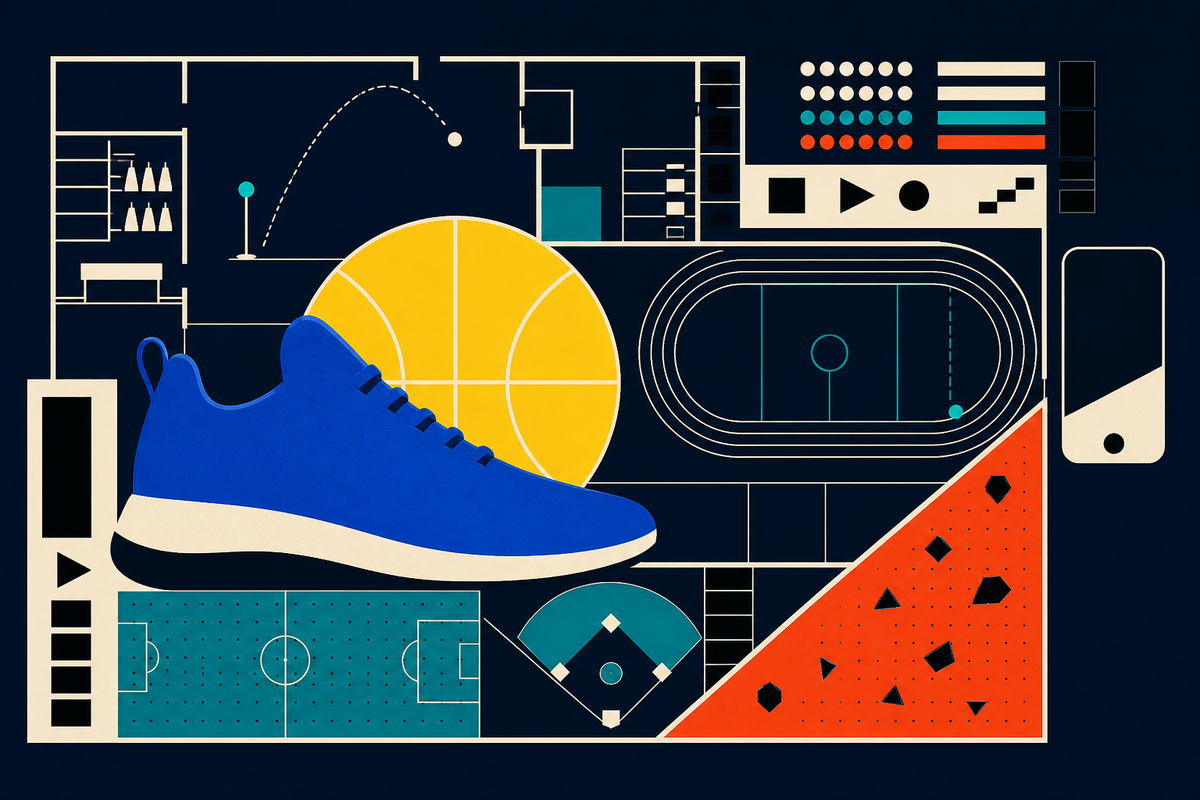
A normal sporting-goods trip is practical: find the size, compare the price, get home before practice. House of Sport makes that errand porous. The first format, unveiled in 2021, included a 17,000-square-foot outdoor field and track, a climbing wall, a HitTrax batting cage, TrackMan golf bays, a putting green and work areas for services such as glove breaking, lacrosse-stringing and bicycle repair. Features vary by location, and some fields can become ice rinks in winter.
The spectacle has a sober retail purpose. A shopper can test a bat against a measured pitch or watch a ball fly inside a simulator. Skilled staff can turn a complicated product into a decision. A local team can use the field for a clinic. Each activity reduces one of physical retail's weaknesses: shelves take up space, while a website can display almost endless inventory. DICK'S makes the square footage perform another job.
“The field is not decoration. It is a demo, a service desk and a neighborhood invitation sharing the same patch of turf.”YesPress analysis
At the end of fiscal 2025, DICK'S had 35 House of Sport locations after opening 16 during the year. It planned about 14 more in 2026, alongside roughly 22 additional Field House stores - a smaller next-generation format used to update the core fleet. The bet is not that every purchase needs theater. It is that a store people choose to visit can support better service, newer brands and a stronger relationship than an interchangeable box.
A platform hiding in the equipment aisle
DICK'S still makes most of its money in a familiar way: buy footwear, apparel and equipment from suppliers, then sell them through stores, websites and apps. It sourced from roughly 1,500 vendors in fiscal 2025. Nike alone represented about 31 percent of merchandise purchases, a concentration that gives both companies reason to keep the relationship productive.
The assortment ranges from mass-recognized names such as Nike, adidas, Hoka, Callaway and The North Face to DICK'S own or licensed vertical brands. CALIA covers women's activewear; DSG is the accessible house label; VRST addresses men's active apparel; Top-Flite, Tommy Armour, Walter Hagen and MAXFLI deepen the golf shelf. Together, those vertical brands generated $1.8 billion, or about 13 percent of DICK'S Business sales, in fiscal 2025. In the company's vendor ranking, its own portfolio was second only to the largest outside supplier.
That private-brand engine is less photogenic than the climbing wall, but economically important. Exclusive products are harder to price-compare and generally produce higher gross margins than similar national brands. The national names bring demand and credibility; house labels give the retailer something shoppers cannot buy at the competitor across town.
Foot Locker changes the map
Before 2025, DICK'S was principally an American sports retailer with a strong suburban footprint. Buying Foot Locker changed its geography and its customer vocabulary. The acquired portfolio includes Foot Locker, Kids Foot Locker, Champs Sports, WSS and atmos, serving sneaker shoppers across North America, Europe, Asia and Australia, plus licensed stores elsewhere.
The logic is reach plus specialization. DICK'S brings operating scale, supplier relationships and a record of investing in store formats. Foot Locker brings global locations and credibility in footwear launches, basketball and streetwear. Their customers overlap, but they do not arrive with identical intent: a parent assembling a youth-soccer kit is not the same shopper as a collector following a limited sneaker release.
The acquisition also brought repair work. Total consideration was reported at $2.5 billion. Foot Locker contributed $3.1 billion of sales from the September closing through the fiscal year-end, along with a $60 million net loss for that partial period. DICK'S began reviewing underperforming stores and inventory while expanding “Fast Break,” a Foot Locker store initiative that had reached about 100 locations by May 2026 and was targeting about 250 by back-to-school. First-quarter pro forma comparable sales returned to modest growth. The strategy may be coherent; execution still has to earn the result.
The game continues after checkout
GameChanger is the odd object in a retail portfolio, which is why it matters. Acquired in 2016, the platform gives coaches and families scorekeeping, statistics, schedules, team communication and live streams. It covers more than 1 million teams each year, with deeper scoring tools for baseball, softball, basketball and volleyball and broader management features across youth sports.
A retailer normally sees the customer when something is needed: the child outgrows skates, the season changes, the tent zipper fails. GameChanger stays present during the activity itself. It knows the rhythms of a season and makes DICK'S useful to coaches, parents and distant relatives who may never enter the store together. The app is not simply an ecommerce funnel; its strongest reason to exist is the job it already performs.
Around that relationship sits a broader claim about access. Since launching Sports Matter in 2014, DICK'S and its Foundation have committed more than $200 million to barriers such as equipment, registration fees, safe places to play and league costs. The company calls shoppers “athletes” and employees “teammates.” It says sports change lives. Those words become credible only when matched by useful programs, and they also happen to align with a durable market: families repeatedly organizing time and money around participation.
Where DICK'S fits - and where it can slip
DICK'S occupies the middle of a crowded court. Walmart, Target and Amazon can win on convenience and price. REI owns a strong outdoor identity. Academy Sports + Outdoors competes directly on sporting goods. Nike, adidas and other manufacturers can sell through their own stores and apps. Local specialists can know a single sport more deeply. In sneakers, JD Sports and brand-direct channels contest Foot Locker's territory.
DICK'S difference is the combination: broad assortment, technical services, community-scale physical stores, exclusive labels and an omnichannel network that can move inventory between digital and physical demand. House of Sport adds trial and gathering. Foot Locker adds global sneaker reach. GameChanger adds a recurring digital utility. No single piece is impossible to copy; operating all of them without blurring their distinct purposes is harder.
The risks are equally concrete. Consumer spending on apparel and equipment is discretionary. Big experiential stores require capital and productive traffic. Foot Locker integration can absorb management attention. Supplier concentration makes access to sought-after products especially important. A playground is still real estate, and a platform is still a collection of businesses that must work.
The company has begun adding another layer: media. Cookie Jar & A Dream Studios, launched in 2025 and named for the grandmother's savings, produces sports films and branded stories. Its soccer documentary Summer of '94 premiered at SXSW in 2026. This can look far from the bait shop, but the thread is recognizable. DICK'S is selling the objects of sport, hosting places to use them, recording the games and telling stories about why people play.
The $300 origin tale survives because it contains the entire proposition in miniature: someone wants to participate, somebody else supplies belief and equipment, and a modest physical place becomes the start of something larger. Seventy-eight years later, DICK'S is trying to make that place large enough to hold a field, a phone screen and several thousand sneaker stores. The measure will not be how impressive the wall looks. It will be whether people keep climbing.