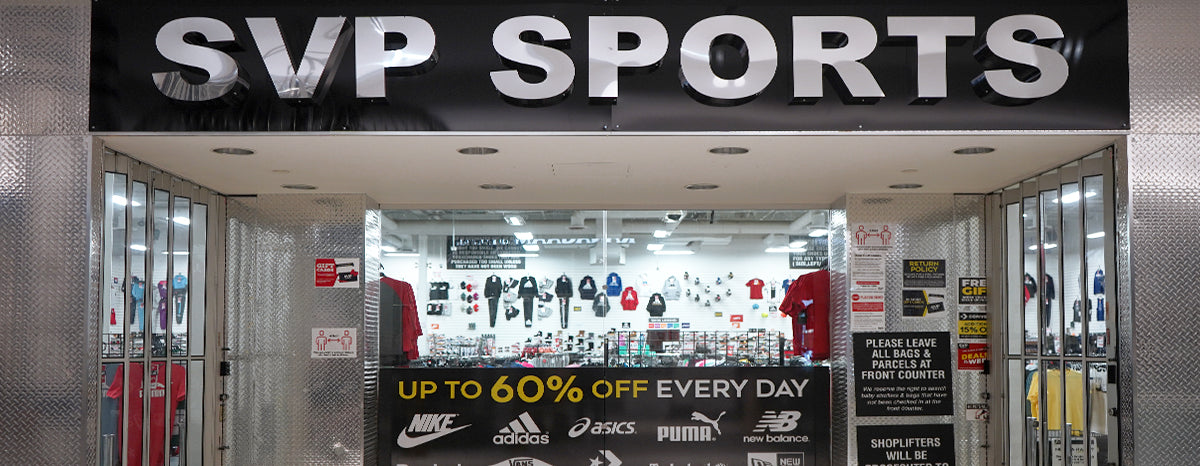
Walk into SVP Sports looking for one exact shoe in one exact colour and you may be using the store incorrectly. The better move is to look sideways. There is the running shoe you came for, perhaps, but beside it sits last season's football boot, a stack of Canada soccer jerseys and a Puma bag whose price makes the planned purchase feel suddenly negotiable. This is not a cathedral to the new release. It is a warehouse-minded argument for the perfectly good thing that happens to be available now.
SVP Sports is a Canadian value retailer of authentic brand-name athletic footwear, clothing, fanwear and accessories. It began in Etobicoke in 1984 and now operates a dense Ontario network, supported by a Shopify store that ships across Canada. The current store locator names 13 locations, from Vaughan and Scarborough to Niagara Falls, Kingston, Whitby and Kitchener, with Burlington marked for fall 2026 and Peterborough for 2027.
The company lives in a peculiar strip of retail territory. Sport Chek can promise breadth. A Nike outlet can promise one brand. Winners can promise general surprise. SVP is narrower than a full-line sporting-goods chain and more concentrated than a general off-price store. Its promise is sports-specific treasure hunting: recognizable labels, changing availability and prices intended to justify the detour.
01 / The machinery
The buyers are the product managers
SVP calls its merchants “opportunity buyers.” That phrase is the company in miniature. The team looks for attractive deals from suppliers, buys in large volumes and uses that scale to negotiate. The merchandise is guaranteed authentic, an important promise in a category where a surprisingly low price can make shoppers suspicious. SVP then passes some of the purchasing advantage into the shelf price.
In a conventional chain, planning begins with the assortment a merchant wants and works backward toward orders. Opportunity buying begins with what the market offers. A supplier may have excess units, an older colourway, fragmented sizes or licensed goods whose season is passing. The buyer's job is to judge whether the discount is deep enough, the volume movable and the product legible to customers. Inventory risk does not disappear. SVP is paid for taking it.
The opportunity-buying loop
This explains both the charm and the irritation. The exact assortment can vary by store. Sizes sell through. Some products are online exclusives; others are exclusive to physical locations. The homepage trains customers to check back with “new styles added weekly” and “great deals added weekly.” What looks like inconsistency from a catalogue perspective becomes freshness from a bargain hunter's perspective.
The shelf is familiar. The deal is the surprise.The operating idea behind SVP Sports
02 / What it costs
The price tag does most of the advertising
The numbers make the pitch faster than a campaign can. On an August 2026 sale page, an adidas women's Samba OG was listed at CA$79.99 against a displayed comparison price of CA$129.99. A Nike women's Canada soccer jersey appeared at CA$29.99 against CA$119.99. A Dickies tube top was CA$4.99 against CA$24.99. These are snapshots, not permanent promises - the assortment and prices move - but the spread is the point.
Three tags from the rack / Canadian dollars
Widths use $129.99 as the common maximum. Prices observed on SVP sale listings in August 2026 and may change.
The customer's total cost includes friction. Canada-wide shipping is free from CA$99.99 for qualifying orders. Below that line, the published flat rate starts at CA$9.99 for Ontario and Quebec, rises to CA$14.99 for several provinces, CA$19.99 for Newfoundland and Labrador and the territories except Nunavut, and CA$29.99 for Nunavut. Free store pickup avoids the fee but can take five to 10 days.
Returns also reward reading before clicking. The standard window is 30 days, but hats, socks, water bottles, shoe-care items and other listed categories are final sale. Nike bought online must be returned through the online process, not carried into a store. Customers mailing a return generally bear that shipping cost. A bargain can survive those conditions, but only if the shopper knows the size and understands the policy.
03 / The change
Thirty-six years before the first online cart
SVP spent roughly 36 years as a physical retailer before it began online shopping in spring 2020. The date matters. A store model built on browsing, irregular inventory and local word of mouth suddenly gained a national window at the moment physical retail was under unusual pressure. Ecommerce did not replace the hunt; it translated it into filters, crossed-out prices, online-only drops and stock alerts.
The hybrid is still visibly imperfect, which makes it more interesting. Store pickup is not instant because distribution may move the order. Digital gift cards work online only, while physical cards can work in stores and online. Certain Nike returns stay in the ecommerce lane. This is not one magically unified pool of inventory. It is an old retail operation stitching a new channel to a physical network, policy by policy.
SVP begins in Etobicoke with brand-name athletic goods and a value proposition.
Online shopping launches for the first time in company history.
The Queen Street West location closes after the lease is not renewed; the city later turns the building toward a music use.
A Kingston opening takes the store network farther into Eastern Ontario.
Burlington and Peterborough appear on the expansion board.
The Queen Street closure is a useful counterweight to clean growth charts. Stores are leases, traffic patterns and local economics, not dots that only move upward. Yet the broader network kept changing: Dufferin, Kingston, Whitby and Kitchener joined the map, while Burlington and Peterborough became the next public commitments. The company is testing whether a GTA bargain habit can travel without losing its local density.
04 / Who it serves
Smart shoppers, team parents and jersey opportunists
The central customer is not defined by one sport. It is defined by price sensitivity plus brand preference. A parent needs kids' turf shoes that will be outgrown. A runner wants last year's dependable model. A football supporter wants an authentic Canada jersey without paying launch-week money. A casual shopper wants adidas or Puma but is flexible on the colour. SVP solves the gap between “I recognize this” and “I can justify this.”
That customer is also willing to trade certainty for value. Someone who requires a precise current-season SKU tomorrow may be better served by a full-price specialist. Someone shopping for highly technical advice, custom fitting or the deepest equipment range may find SVP too apparel-heavy. The model performs best when shoppers have options and can substitute across styles.
What a retailer can copy
Build buying expertise before brand theatre. Use visible reference prices. Turn new arrivals into a recurring content rhythm. Concentrate locations enough to share awareness and operations. Make authenticity explicit.
When it breaks
Low order volume weakens negotiation. Weak supplier trust reduces access. Slow inventory turns eat the discount. Customers demanding a complete, stable assortment will experience the treasure hunt as simple unreliability.
05 / The less visible moat
Relationships compound when the billboard cannot
The obvious assets are stores and stock. The quieter ones are relationships. Suppliers need a buyer able to evaluate and absorb volume. Customers need confidence that a cheap jersey is real. Employees need managers who can teach a first job. None of those advantages looks dramatic in a product photograph, but each becomes more useful with repetition.
One unusually concrete example is SVP's work with JVS Toronto. The employment organization says the partnership has lasted more than 18 years, connecting young people from the Jane-Finch community with store jobs, training and coaching. Some participants remained with the retailer. SVP's careers material describes promotion from within and profit sharing for qualified staff; the JVS account shows what the first rung can look like on an actual sales floor.
The public numbers are modest by national-chain standards and meaningful by local-retailer standards. LinkedIn places the team in the 201-to-500 range. The company website displays a 4.7-star aggregate from more than 21,000 verified reviews. Its 2025 Kingston launch used a mobile LED campaign reported to deliver 65,900-plus impressions. The picture is not venture-fuelled blitzscaling. No public funding round defines the story. It is the slower accumulation of stores, buyers, customer memory and supplier calls returned.
A crossed-out price is not a moat. The ability to keep finding inventory worth crossing out might be.The part competitors cannot copy with CSS
06 / The playbook
Steal the discipline, not the discount sticker
For operators, the useful lesson is not to become an outlet overnight. Start with a narrow category where products remain useful after the hype cycle, brand recognition matters and customers can substitute. Build a supplier map. Define the minimum gross margin after freight, handling, returns and markdowns. Decide how much size fragmentation your customer will tolerate. Then make one buyer accountable for saying no.
Next, treat inventory change as media. SVP's weekly new-style and extreme-value messages convert buying activity into a reason to revisit. The content calendar follows the goods, which is cheaper and more believable than inventing a lifestyle campaign every Tuesday. Crossed-out prices help, but only when the comparison is credible and the saving is material.
Finally, state the catch. Opportunity buying will not work for a retailer whose customer expects every size and colour, whose category expires quickly, or whose capital cannot wait through a slow sell-through. It will not work without supplier access or enough volume to earn a deal. And it will fail if “discount” becomes permission for dubious provenance. SVP's authenticity promise is not decoration; it closes the psychological gap created by the low price.
The company name spells out Service, Value, Product. In practice, the order may be Product, Value, Service: secure something people already trust, price it so the trip feels intelligent, then use the store and support operation to bring them back. Simple is not the same as easy. Forty years of buying suggests SVP understands the difference.