There is a useful clue to Marc MacRae’s career in the way he described its rewards. Telling an employee that they had earned a promotion, he said, brought the same feeling as winning a football championship. One happened inside an office, the other on a field. For MacRae, both were evidence that a person had been prepared, placed and trusted well enough to move forward.
That comparison has followed him through sporting-goods retail for more than four decades. He began after graduating from Durham College’s Sports Administration program in 1984, then moved through the operating layers of the business: store management, district leadership, merchandising, national operations, sales, marketing and brand development. His résumé includes Foot Locker, Champs Sports, Athletes World, Game Day Face, Athletic Locker and, since 2021, SVP Sports, where he serves as Chief Merchant Officer.
The corporate names changed. The central problem stayed recognizable. A retailer has products, prices, locations and plans, but none of them execute themselves. Someone has to decide who belongs where, what they need, how the pieces connect and when a person is ready for more responsibility. MacRae brought a coach’s vocabulary to that work long before leadership became a genre of online advice.
Three finds, one career
In 2013, MacRae laid out his formula with unusual economy. First, find your passion. Then find an environment where you can act on it. Finally, find the people you want to be successful with. He called them the three “finds.” It reads less like a motivational slogan than a diagnostic tool. If work feels wrong, the problem may sit in any one of the three places: the activity, the setting or the company you keep.
MacRae had found a durable overlap. He liked sports from an early age. Retail gave him a commercial environment built around sports, and coaching gave him a way to extend the work into family and community life. “My career has in essence been my hobby,” he said, “and it has extended to my family and life outside of work.”
The right-fit formula
His path through retail suggests a willingness to learn the business from several angles. At Foot Locker he earned rookie manager and manager recognition. At Champs Sports he worked as a divisional sales merchandiser and received district-level awards. At Athletes World he moved from senior district management to national operations. He then led Game Day Face before beginning a 17-year run in sales and marketing for Athletic Locker North America within goba Sports Group.
- Foot Locker and Champs Sports
- Athletes World
- Game Day Face
- Athletic Locker
- SVP Sports
That range matters. Merchandising can look like a matter of taste from the outside. In practice it sits at the junction of numbers, timing, brand relationships, store constraints and customer behavior. MacRae’s responsibilities at Athletic Locker included brand building, business analytics, retail marketing and profit building. A Kitchener store project placed him in the physical details too: fixtures, window graphics, stock-room racking and store-in-store presentations for more than a dozen brands.
The work is both broad and stubbornly specific. A strategy can say that a brand deserves more visibility. An operator still has to decide where the rack goes, what hangs on it and whether the sign can be read from the entrance. MacRae’s career moved between those scales, from company direction to the details that make a sales floor function.
The merchant in the middle
Sporting-goods merchants operate between several constituencies that rarely want exactly the same thing at exactly the same time. Brands want a coherent presentation. Stores need assortments that fit their space and customers. Finance needs inventory to move at an acceptable margin. Shoppers want the right product, size and price when they arrive. The merchant turns those competing demands into a buy, a floor plan and, increasingly, a digital catalogue.
MacRae’s route prepared him for that middle position. Store management exposed him to the last few feet between product and customer. District and national operations widened the frame to labor, execution and consistency across locations. Merchandising added assortment and presentation. Sales and marketing brought brands, messages and demand into the same conversation. The progression is less a ladder than a widening field of view.
It also clarifies why his coaching language belongs in a merchandising story. Product has to be put in the right role too. A shoe can be desirable and still fail if the price, season, location or presentation is wrong. Retailers often call this allocation. MacRae called the human version fit. Both require the same habit of attention: judge performance in context before judging the performer.
At a value retailer, the tension becomes sharper. The customer expects recognizable brands and a meaningful deal. The operator has to preserve that equation while managing availability and the economics of the assortment. MacRae’s combination of analytics, marketing and store experience is useful precisely because no single discipline can solve the whole puzzle. The numbers reveal what moved. The floor reveals why it may have moved. The team determines what gets learned before the next buy.
“One of the things we do here is setting someone up to be successful.”Marc MacRae
The promotion is the product
MacRae’s most repeated idea is “right fit.” He used it for jobs and lives, for companies and teams. The phrase can sound soft until it is translated into operational terms. Fit determines whether talent becomes performance. Put a capable person in a role with mismatched incentives, weak support or unclear authority and the result may look like an individual failure. Change the conditions and the same person can look newly skilled.
“Set them up to win and they will win,” MacRae said. The manager’s task, in that view, begins before the result. It includes role design, preparation and judgment. It also includes the humility to admit when an assignment is wrong. Coaching is not merely encouragement from the sideline. It is the continuous arrangement of people and responsibilities so that effort has somewhere productive to go.
By the time Durham College recognized MacRae as a 2012 Alumnus of Distinction, he had hired and trained fellow graduates who continued into careers at Fila, Adidas and Nike. The accomplishment reveals a second kind of retail output. Stores move footwear and apparel; organizations that develop talent also move people through increasingly demanding work.
That may explain why promotions stayed vivid for him. Sales are recorded and replaced by a new target. A promoted employee carries the training into another team, store or company. The result compounds beyond the quarter. Former colleagues described MacRae as a mentor and a practitioner of servant leadership, someone comfortable with both company-level questions and the small execution problems that can derail a plan.
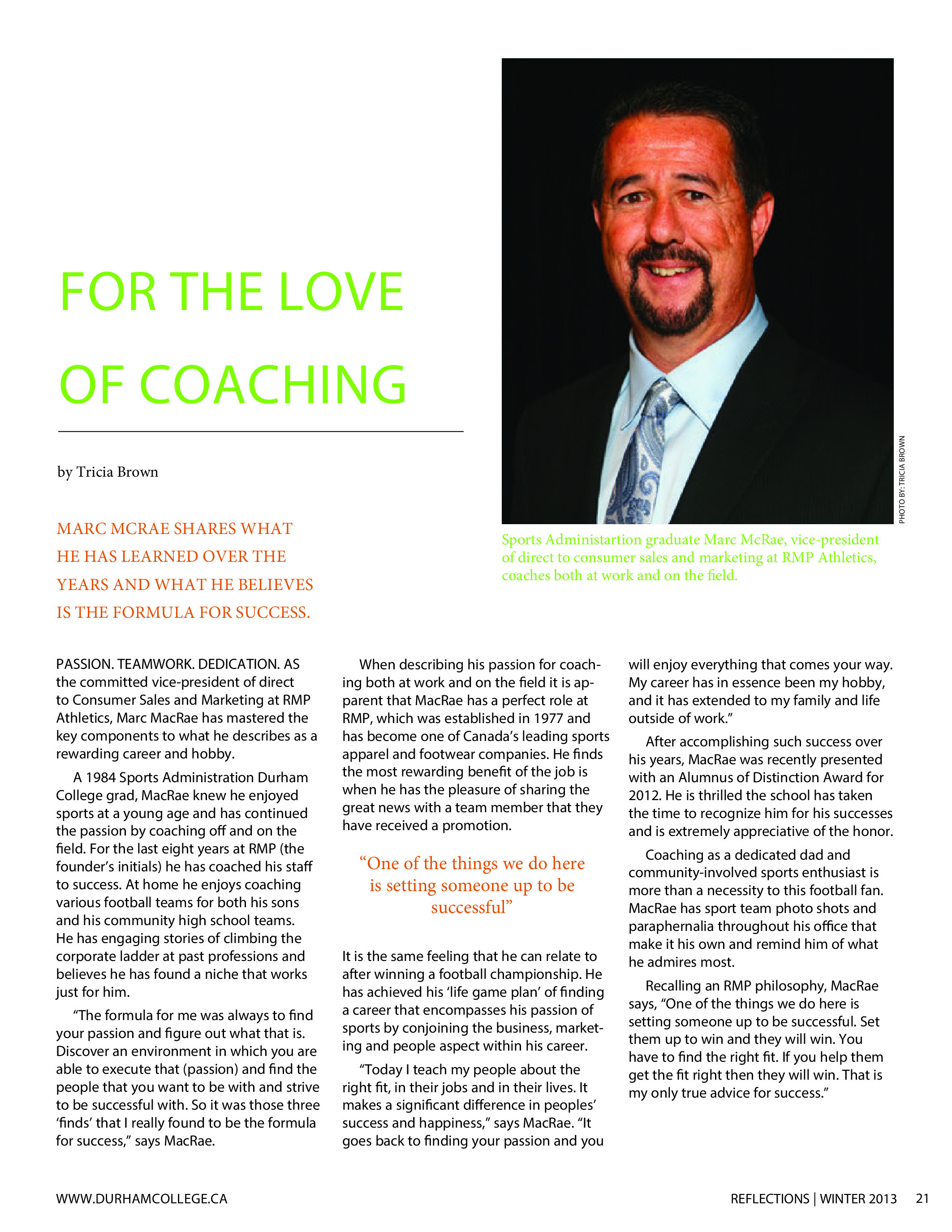
A desk that looked like a locker room
His office offered a physical version of the philosophy. Team photos and sports memorabilia covered the space. They were reminders of what he admired, but they also collapsed the distance between his formal role and the field. On weekends and evenings he coached football teams involving his sons, community high-school teams and rep hockey. He volunteered in youth sports as a public relations and fundraising director. He also served as a coach with the Hamilton Hurricanes, whose 2014 team won a provincial football championship.
By 2012, his youth teams had reached four provincial championship games and won two. The number is less interesting than the recurrence. MacRae kept choosing activities that required him to assemble a group, teach a system and watch individual progress become a collective result. Retail management and amateur coaching were not identical, but they exercised the same part of his attention.
The pattern also gives texture to a career that could otherwise be summarized as a sequence of executive titles. He is a Montreal Canadiens fan who enjoys golf, gardening, travel and attending games. His sports involvement reached from store plans to football practices and league committees. The through line was participation. He did not simply work near athletics; he organized much of his life around teams.
What carries into SVP Sports
SVP Sports is a Toronto-area value retailer built around branded footwear, apparel and sporting goods. Its current operation spans physical stores and e-commerce, which adds another layer to the merchant’s job. Product decisions must travel across racks, search results, category pages, promotions and fulfillment systems while keeping the value promise legible to a customer.
MacRae arrived as Chief Merchant Officer in February 2021 after nearly 17 years with Athletic Locker North America. The role fits the arc: part product, part numbers, part brand judgment and part coordination. It also returns him to the work he has discussed most consistently. Merchandise needs the right placement, but so do the people making decisions about it.
A four-decade career makes no promise that every decision was correct. It does show which idea MacRae found durable enough to reuse. Find the work, setting and people that fit. Prepare someone for the assignment. Treat advancement as a shared win. Then repeat the process when the formation changes.
The lesson is modest enough to be useful. Organizations often ask whether a person is good. A coach asks a more precise question: good at what, with whom, under which conditions? MacRae built his retail life around answering that question on sales floors, in offices and on fields. The merchandise kept changing. The work of positioning people did not.