Before Corie Barry sold technology, she helped sell art. At 12, she was working alongside her self-employed artist parents, unloading their things and assembling and dismantling booths as the family traveled during the summer. Her first workplace had to be put together before anybody could buy anything. It is a useful beginning for a retail executive: commerce, seen from the end of the day when somebody still has to pack up.
Barry grew up in Cambridge, Minnesota. The familiar executive biography begins with an ambitious child who always wanted to run something. Hers takes a more interesting turn. She went to college wanting structure and stability. Accounting offered both. A balance sheet has the considerable social advantage of telling you when something does not add up. Art fairs, and careers, are less obliging.
The connection between those worlds is her work ethic. Watching her parents taught her that self-employment did not come with an off switch. It also showed her people taking their work seriously because they believed in its value. Her later interest in purpose has that practical origin. Long before purpose became a boardroom word, it was something her family loaded and unloaded.
By October 2026, Barry is preparing to leave the CEO role at Best Buy after seven years. The distance between an art booth and a retailer with more than 80,000 employees is enormous. The question that connects them is surprisingly ordinary: how do you persuade someone that what you offer will be useful in their life?
A rugby player chooses order
At the College of Saint Benedict, Barry double-majored in accounting and management, worked on campus and played rugby. The rugby is a welcome detail in a biography otherwise crowded with financial responsibilities. There are many ways to learn cooperation; some involve rather more mud than others. She graduated summa cum laude in 1997. She also met her husband, Martin, a Saint John’s University graduate, on campus.
The education she describes is broader than professional preparation. She values the liberal arts for teaching people to reason, communicate and stay with an uncomfortable problem. That helps explain why she still returns to speak with prospective students. The subject she returns to is the support around a person, rather than the person’s solitary determination.
In February 2025, talking with college president Brian Bruess at Best Buy’s Richfield headquarters, she described that support as “scaffolding.” Faculty, friends and other people helped her understand her strengths and find opportunities. The image makes room for achievement without requiring the achiever to pretend she constructed herself. It is also an unusually workmanlike description of belonging.
Her first professional stop was Deloitte & Touche, where she worked from 1997 to 1999. Then came Best Buy. The early chapter is reassuringly unglamorous: a graduate with accounting training joins a Minnesota retailer and begins learning its business. The eventual CEO title can make that entry look inevitable. Nothing in her account suggests she experienced it that way.
- 1997Graduates; joins Deloitte
- 1999Joins Best Buy
- 2016Becomes CFO
- 2019Becomes CEO
- 2026Prepares CEO handoff
The people who kept moving the goalposts
Best Buy gave Barry financial and operational jobs, in the field and at headquarters. Her responsibilities eventually included domestic finance, an interim turn running services, and strategic growth. Those moves matter because a retailer is experienced differently by the people who sell, repair, deliver and count. Learning across those jobs gives the numbers a set of human consequences.
Sharon McCollam, who became Best Buy’s CFO in 2012, was an influential mentor. She gave Barry detailed, direct feedback. Hubert Joly, then CEO, kept offering difficult assignments. The arrangement sounds less comfortable than the word mentoring sometimes implies. Someone believed Barry could do more, and the evidence was another demanding job.
Barry became CFO in 2016. Joly then raised the possibility of her succeeding him. She resisted. By December 2018, he asked her to evaluate the opportunity and write down her reservations. Her memo laid out objections, including work-life balance and comparisons with Joly; its last page explored why she might want the job. After conversations, she decided to become a candidate.
It is an instructive selection process. A company can miss a capable candidate if it treats hesitation as a verdict. Barry’s reservations deserved answers. Working through them helped her decide how she would lead, rather than merely whether she would accept. The memo was doing something a résumé cannot: making the future job specific enough to consider.
The job arrives, and keeps changing
Barry became Best Buy’s fifth CEO in June 2019, and its first woman in the role. She had spent two decades inside the company. Her previous title, chief financial and strategic transformation officer, already joined financial discipline with the less tidy work of changing a business. She had helped develop and execute its Building the New Blue growth strategy.
That preparation is central to understanding her appointment. Best Buy was choosing someone who knew its operations and had worked on its next stage. The accountant had acquired a much larger brief. Strategic growth requires judging possibilities before all the evidence arrives; financial leadership requires asking what those possibilities will cost. A CEO has to keep both questions in the room.
Barry’s public explanation of leadership repeatedly returns to learning. In a 2020 conversation, she said, “CEOs now more than ever need to be in constant learning mode.” She also discussed receiving difficult feedback early in her career and making an action plan in response. Her version of humility has a next step: identify what needs work, then do something about it.
There is a certain relief in that account. The senior person can admit a gap without turning the admission into a performance. Surrounding herself with people from different backgrounds, as Barry advocates, gives that admission a practical consequence. Other people must be able to change the answer. Otherwise, a listening exercise is simply a meeting with better manners.
“I did it with help.”
Corie Barry · 2025 college conversation
A retailer translates the machine
Barry’s account of technology is grounded in what people do with it. A device can enable work, entertainment or a connection with somebody else. That perspective makes room for the less glamorous part of electronics retail: helping a customer choose, put things together and keep them working. The box is often the easiest part of the purchase to understand.
In a February 2025 conversation with Chris Farrell, she discussed treating different stores differently. Some locations might serve more pickup demand; others could offer a more immersive shopping experience. That is an operational choice with a human premise. The customer arriving to collect an order has a different afternoon planned from the customer who wants someone to explain several options.
She described using artificial intelligence to personalize the app experience, including home pages informed by customer history. Her expectations were incremental. Useful applications could improve over time. That is a less theatrical approach than demanding a revolution from every software release, and rather easier to assess: does the experience become more useful to the person using it?
Her other boardroom, at Domino’s Pizza, supplies an interesting parallel. She joined its board in 2018 and spoke about following the company as both a businessperson and a parent seeking a convenient dinner. The connection is interpretive, but plain: ordering a pizza and buying electronics both expose the gap between an impressive system and an experience that actually works for a busy household.
The habit of taking notes
Barry has described writing down what she took from good and bad days at work. Over time, those lists helped her understand which kinds of work mattered to her. It is a small habit with a useful discipline. A job title can tell you where you sit in an organization; a record of your days can tell you what you enjoy doing there.
The practice also puts some distance between an unpleasant afternoon and a career decision. Patterns have to accumulate. For someone whose career widened through unfamiliar assignments, that seems especially apt. You need a way to distinguish the discomfort of learning from the dissatisfaction of doing work that no longer fits. The distinction takes observation, rather than a slogan.
Outside work, Barry has listed reading, watching the Food Network and spending time with her husband and children among her interests. Those are ordinary pleasures, which is their appeal in this story. An executive biography can make a person seem permanently available for a keynote. Barry’s own account leaves room for the person who goes home afterward.
Leaving the pen for someone else
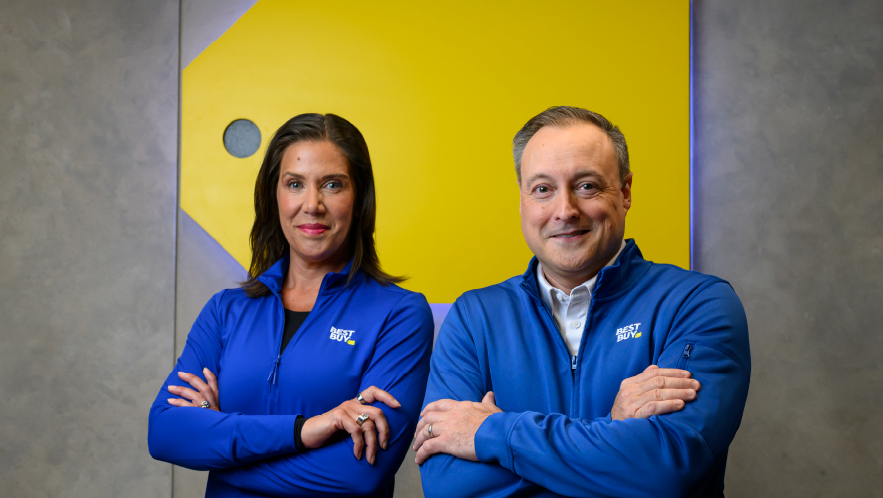
On April 22, 2026, Best Buy announced that Jason Bonfig would succeed Barry. She is scheduled to step down as CEO and a director at the end of October 31; Bonfig takes over on November 1. Barry will remain a strategic adviser for six months. As of this profile’s October 21 publication date, the handoff is still ahead.
Bonfig also joined Best Buy in 1999. His responsibilities have included merchandising, ecommerce, supply chain and marketing, along with the company’s Marketplace and advertising businesses. The succession brings another long-serving insider to the role. Barry’s departure also places her second in tenure among Best Buy’s CEOs, a substantial stretch at a company founded in 1966.
The latest reported quarter gives the transition a specific business context. On August 27, Best Buy reported $9.779 billion in second-quarter fiscal 2027 revenue and 4.1 percent comparable-sales growth. It raised its annual guidance. Those figures describe one quarter and an outlook, rather than a final judgment on seven years of leadership. They do give the incoming CEO something concrete to build from.
Barry’s story begins with helping put a shop together and reaches a moment when she is helping someone else take charge of one. Between those points sit an accounting education, several people who challenged her judgment about her own abilities, and years of learning a business from different positions. The reluctant candidate did take the job. Now comes another decision about when to let it go.
Continue the conversation
Read and watch more from Barry and the people around her.