The loan came with a number that made no sense. Laurel Taylor was applying to finance business school. Her credit score was above 800, the sort of figure lenders usually greet with polished rates and agreeable paperwork. The offer she recalls receiving carried 9 percent interest. Taylor could have read it as a nuisance, signed, and moved on. Instead, she read it as a product brief. Here was a system with abundant data and a poor understanding of the person sitting in front of it.
There was a longer story inside that rate. Taylor grew up in a small Texas town, in a family where college was understood as the route to mobility. Scholarships, grants, federal loans, private loans, and a Parent PLUS loan taken on by her mother assembled that route one obligation at a time. The education did what it promised. Taylor studied Organizational Communication at Texas State University, earned an MBA from MIT Sloan, and went on to lead a global business unit at Google. The repayment schedule kept its promise too.
Between Taylor and her mother, the family carried roughly $200,000 in student debt. In testimony before the Department of Education in 2021, Taylor described $150,000 of her own loans as both a source of socioeconomic mobility and an intensely stressful financial burden. That tension became the founding material for FutureFuel.io, launched in 2016 and later renamed Candidly. Education had opened the door. Debt had followed her through it.
“What I've built, what we've built as an organization is everything I wish I would have had.”Laurel Taylor
The expensive order of operations
Personal finance is full of orderly instructions. Pay off debt. Establish a buffer. Save for retirement. Invest. The advice reads cleanly because life has been edited out. For a borrower with a decade or more of payments, the order can turn into a queue: no serious saving until every loan is gone. Taylor's objection is not simply that debt lasts too long. It is that the future waits behind it.
She talks about the missing decades of compounding that she and her mother experienced while directing money toward repayment. The invisible bill arrives later, in retirement balances that had fewer years to grow and savings goals repeatedly deferred. Candidly's central idea is “simultaneous progress.” Help a person improve the debt side of the balance sheet while beginning to build on the asset side. The phrase lacks the stern glamour of austerity. It is also much closer to how people want their lives to work.
This is where Taylor's career before Candidly becomes useful. She had worked in revenue leadership at the technology and engineering firm TEECOM, then at Google, where she was responsible for an eight-figure business target. She understood the employee side of the problem and the employer side of the purchase. Student-debt support could relieve a real household constraint while giving companies a benefit tied to recruiting, retention, and engagement.
Find the person who can pay
Candidly's early decision was a distribution argument disguised as a benefits product. Millions of borrowers did not need one more consumer app asking to be discovered, downloaded, trusted, and funded. Employers already had a relationship with them. Retirement providers and financial institutions did too. Candidly could enter through those channels, with the institution paying and the employee using the service without charge.
In 2019, Taylor described the difficulty of creating a category before buyers had a familiar budget line for it. Student-loan roundups, repayment assistance, and refinancing had to be explained while the product itself was still being iterated. Her aspiration was plain: put student-debt benefits at the core of financial-wellness packages, much as the 401(k) had become an expected workplace fixture. Category creation, in this case, meant teaching benefits leaders to see a liability on an employee's kitchen table as part of the company's benefits architecture.
Policy gradually made the architecture more useful. The CARES Act enabled tax-advantaged employer contributions toward student loans. SECURE 2.0 allowed employers to count qualified student-loan payments when making retirement matches. An employee paying a lender could begin receiving retirement contributions without first finding extra cash for a 401(k). The sequence finally bent.
Candidly's 2025 impact report says the platform generated $2.3 billion in projected student-debt impact, $66 million in additional projected annual retirement savings, and a 121 percent increase in new employers offering the service. These are company-reported figures, and the careful word is projected. Yet they reveal what Taylor has chosen to measure: days and dollars removed from debt, plus the first stirrings of wealth on the other side.
A founder enters the rulebook
Taylor has not confined her work to product demos and employer sales. At a Department of Education public hearing in June 2021, she introduced herself in three roles: advocate for borrowers, innovator proposing better uses of data, and technology operator ready to join future rulemaking. She argued that digital systems could help eligible borrowers find and enroll in income-driven repayment and Public Service Loan Forgiveness, reduce default risk, and understand the basics without becoming part-time experts in federal paperwork.
Four years later, she joined a negotiated-rulemaking session representing the public-interest and taxpayer perspective. By then, Candidly said it had generated $2 billion of impact and was reaching borrowers as an employer-paid benefit. The continuity is striking. The personal account did not remain a decorative origin story. It became a position from which Taylor could argue about data access, automation, and the rules that products must interpret.
That position also gives her a specific view of shame. Families often treat student debt as an individual mistake, although the machinery around it involves schools, lenders, servicers, employers, tax policy, and federal programs. Taylor wants the conversation moved away from guilt and toward useful action. Shame makes a terrible interface. It turns questions into secrets, discourages people from opening benefit emails, and gives complexity more room to charge interest.
“We’re always going to have problems to solve. We want those problems to be higher quality over time.”Laurel Taylor
From a loan tool to a financial conversation
Over the past decade, the company widened its frame. Student debt remains the entry point, but the surrounding questions now include paying for college, building emergency savings, understanding workplace benefits, and preparing for retirement. In 2025, Candidly launched its Intelligence Center, a system that coordinates specialized AI components across financial domains. Its conversational tool, Cait, is one doorway into that system.
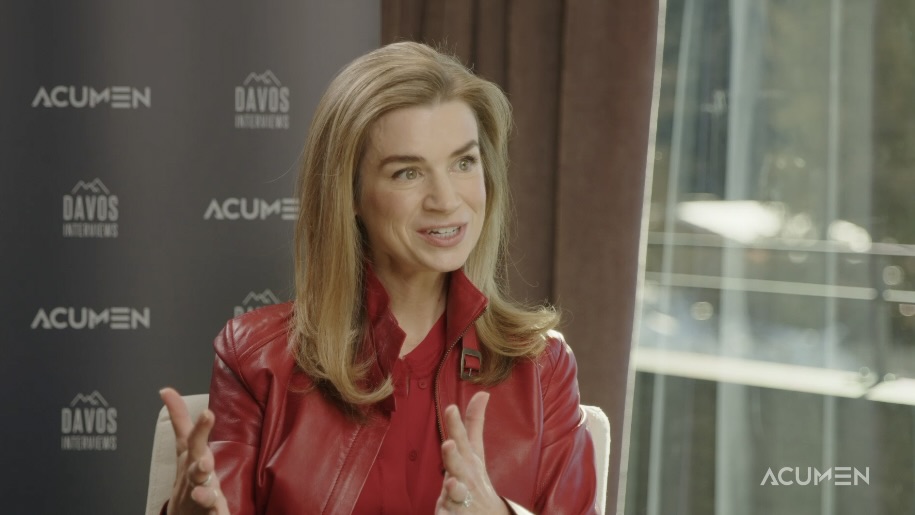
Taylor's pitch for AI is grounded in context. A generic page can explain an HSA or a repayment plan. Personalized guidance can consider a person's loans, available employer contributions, savings goals, and changing policy together. At Davos in 2025, she described student debt as a useful application for a hyper-personalized experience because borrowers begin from markedly different situations and receive different benefits at work.
The ambition comes with an unglamorous constraint: financial guidance has to be accurate. Candidly describes its approach as combining specialized agents, deterministic reasoning, and current data, a design intended to make an answer more than fluent. For Taylor, the website filled with static product pages is giving way to a conversation that can move across the whole balance sheet. The borrower should not have to know which departmental door contains the answer before asking the question.
The founder behind the system
Taylor is unusually willing to leave a little awkwardness in her public stories. On a podcast hosted by Damon Lembi, who gave her an early sales job, she admitted she was nervous. She also told the story of leaving a job at Dell after one day and eventually reducing entrepreneurial risk to a bracing sentence: she had little to lose but her pride. The detail is funny because it punctures the tidy résumé. Careers look deliberate after the fact. Up close, they contain wrong doors and very short tenures.
Her more recent anecdotes preserve that eye for value outside a spreadsheet. Asked in 2026 about a purchase she was still thinking about, Taylor chose a trip to Mexico with her teenage niece. She called it an investment in their relationship and remembered the nerves before five days together. A founder who spends her days talking about compounding had found a form of return that resists a dashboard.
Candidly reached its tenth year in 2026. It had moved from FutureFuel.io's student-debt focus to a broader claim about AI-native financial guidance, collected recognition from Forbes, Fast Company, Inc., and the World Economic Forum, and continued selling through the institutions already attached to people's financial lives. Taylor's original problem did not disappear beneath the expanded platform. It became the reason expansion made sense.
The most useful idea to borrow from her is not a feature. It is a question about sequence. Which milestone is forcing a customer to postpone every other kind of progress? Taylor found her answer in a loan statement and in the missing years of her family's compounding. Then she built the benefit backward from the life that statement had interrupted. The debt still has to be paid. The future no longer has to wait politely behind it.