At Colony Park, the future once came with a string attached. Helium balloons marked the locations of proposed parks, and children went looking for them. Adults studied the plans. A family event turned an abstract proposal into something people could locate with their own feet. Laura J. Cortez and her University of Texas team helped put the gathering together. A planning process had acquired a useful accessory: a little fun.
The detail survives because it explains something about Cortez’s work. Public engagement can sound like an activity performed around a conference table, preferably with a slide deck and a dependable supply of acronyms. At Colony Park, people also walked across a large printed plan taped to the floor, finding their homes and tracing proposed routes. The scale of a neighborhood became the scale of a person. Residents could ask a more immediate question: where would I go?
Cortez, the founder and CEO of Austin’s Cortez Consulting, has built a career around making that question possible. Her route took her through environmental science, business school, higher education and a postdoctoral fellowship before she opened her firm in 2015. The recurring subject is participation: how people enter an institution’s conversation, and whether the conversation makes room for their knowledge once they arrive.
The door before the meeting room
In 2013, the Colony Park engagement effort included a door-to-door survey. The collaboration brought together the city, Austin Community College, UT and the neighborhood association. Questions covered housing preferences and desired park amenities. These were decisions with consequences for daily life, and the way the questions reached residents mattered.
Cortez explained that many people in the area lacked access to certain technologies. There was also no library available across all five census tracts in the study area. An online invitation could travel very efficiently past the very people the project needed to hear. “That’s why we want to go door-to-door,” she said.
There is an entire professional philosophy inside that practical choice. A participation process has an entrance, even when nobody has bothered to label it. The entrance might require a computer, transport, free time or confidence in speaking before strangers. Change the entrance and the conversation changes with it. In Colony Park, knocking on doors gave the survey a route through the neighborhood.
Three documented ways the planning conversation met everyday life. A sequence of examples, rather than a measured formula.
A route through Iowa, Spain and Austin
Long before she was organizing conversations about development, Cortez was a student figuring out where she belonged. She grew up in San Benito in the Rio Grande Valley and once imagined becoming a lawyer. College took her to Drake University in Iowa. Leaving South Texas proved difficult enough that she nearly transferred after her first semester.
Friendships and campus involvement helped her establish a community. Her education also took her to Spain. In September 2026, she revisited that journey on The Way to College Podcast, discussing changing majors, studying abroad and learning to advocate for herself. The story includes decisions to change direction, as well as people who recognized possibilities she had yet to recognize herself.
She earned a bachelor’s degree in environmental science, then arrived in Austin in 1999 as an AmeriCorps VISTA volunteer. Her service began with the National Hispanic Institute. An MBA at St. Edward’s University followed, and then a doctorate in higher education at UT Austin. The degrees span different disciplines, but each offers a way to think about the same difficult relationship: individuals trying to navigate larger systems.
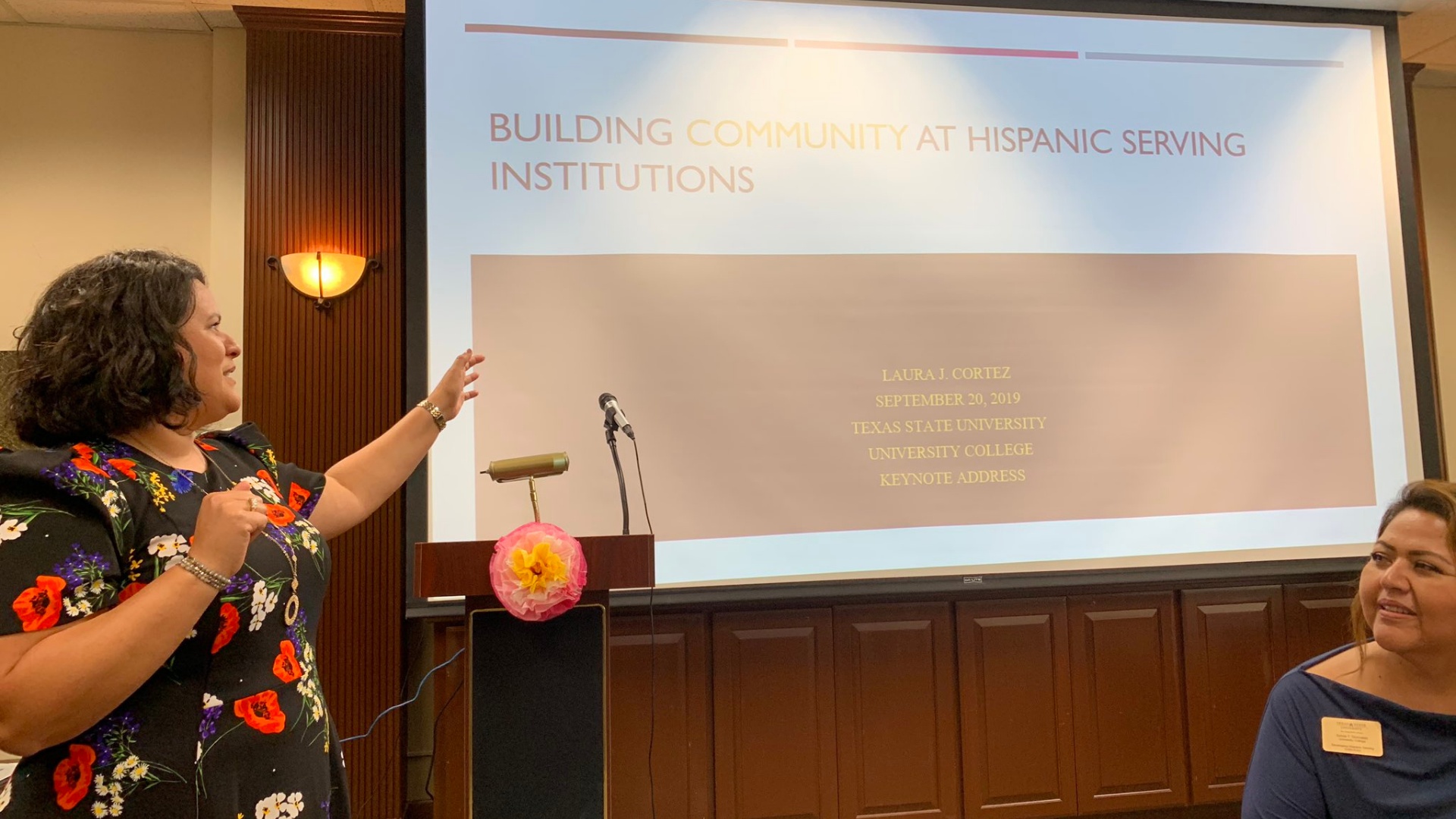
Her dissertation examined the campus climate of a border Hispanic-serving institution and Latino student success. Her published work also includes research on Latino parents’ perceptions of college readiness and a chapter about leadership at Hispanic-serving institutions. The subject of belonging had a place in her scholarship before it became part of her consulting practice. Questions about who feels able to participate have followed her across the campus boundary.
Over fourteen years in higher education, she worked with students at St. Edward’s, UT San Antonio, Texas State and UT Austin. That career gives her later consulting work an educational dimension. Explaining a planning process requires attention to what people already understand, what an institution assumes they understand, and the sometimes considerable distance between the two.
The neighborhood that changed her job
In 2012, Cortez served as a postdoctoral fellow at UT’s Community Engagement Center and led engagement for the Colony Park Sustainable Community Initiative. She credits that experience with changing her professional direction. The move into consulting grew from a particular assignment, with particular residents and a particular piece of Austin at stake.
Colony Park’s scale helps explain why the assignment could change a career. The initiative concerns 208 acres of city-owned land in northeast Austin. Its planning process began in 2012, and the initial master plan and zoning were adopted in 2014. Residents helped define a vision through meetings, workshops and collaboration with city staff.
A leadership group called the Colony Park Core Team carried community priorities through the process. The city signed a development agreement in August 2024. Those dates are a reminder of the time involved: a neighborhood plan can spend years moving between the first conversation and the agreements that make development possible. A successful meeting is only one small part of the calendar.
In northeast Austin, these conversations also carry a history. Barbara Scott, the longtime Colony Park Neighborhood Association president, has described the neglect residents experienced compared with communities west of Interstate 35. Cortez has spoken about the history of neglect across Austin’s eastern crescent. A request to comment on a new plan arrives against that background. People are entitled to bring their memories of earlier decisions into the room. For a consultant, understanding the place includes understanding why another invitation may need more than an appealing announcement.
Cortez’s role belongs within that collective effort. Residents already had priorities and advocates; the engagement work helped connect them to the planning process. That distinction matters in a story about a consultant. A community is full of people who have been thinking about its future long before a contract appears.
- 1999Arrives in Austin through AmeriCorps VISTA.
- 2012Postdoctoral work at UT and leadership of Colony Park engagement.
- 2015Founds Cortez Consulting.
- 2024Colony Park reaches a development agreement with the city.
What a neighborhood can change on paper
At the St. John redevelopment project, Cortez’s engagement work produced another way to judge participation: look at what changed in the plan. Between 2021 and 2023, the outreach included newsletters, public meetings, online information and signs at the site. She also recruited and directed a community advisory committee that included neighborhood association members.
Small-group conversations gathered feedback on architectural elements. The resulting improvements included more family-friendly units and better connections between the residential buildings and the park. Here, engagement could be traced into the layout. A resident’s contribution had a destination beyond a meeting’s closing remarks.
That is a useful test for any invitation to participate. People can give their time, explain their lives and still wonder what happened afterward. At St. John, the relationship between feedback and design supplied something concrete to point to. The park connection was a change someone could eventually use.
The room she learned to make
Cortez’s interest in participation has a family history. Her grandmother Petra organized voter registration drives and taught religious education, surrounded by women involved in their community. Petra also admired John F. Kennedy and Elvis Presley. Civic duty evidently allowed room for a decent soundtrack.
Cortez carried that example into college, where she became president of La Fuerza Latina. In business, she has spoken about learning to narrow her focus after initially considering research, grant writing and outreach together. She has also described the challenge of asserting women’s place in project environments shaped by engineering and architecture.
Her preferred measure of engagement is personal: people should feel heard, seen and loved. It is an unusual standard to bring into a planning assignment, and a demanding one. Attendance can be counted from a sign-in sheet. Whether a person felt welcome calls for closer attention to the experience inside the room.
“The people of the community are there to tell me how to do it.”
Laura J. Cortez
Her civic commitments have extended beyond client work. She completed Leadership Austin’s Essential program in the class of 2018, then joined its board in 2020. In announcing that appointment, she expressed a hope that her presence would help other Latinas and Latinos envision themselves in leadership. Mentoring was part of the ambition.
Now, the invitation goes inside
Cortez Consulting’s current direction brings its attention to relationships inside organizations. After a decade of public engagement and communications work, the firm now offers executive advisory services for mission-driven organizations. Its menu includes fractional strategy, operations and chief-of-staff support, alongside project planning and facilitated retreats.
The proposed arrangements are practical: three, six or twelve months of support, with on-site participation one to three days a week. The firm describes a familiar consulting problem: completing a project can consume the attention that might otherwise go toward strengthening the people responsible for carrying it forward.
The shift gives Cortez a different room to work in. A leadership team needs a way to turn discussion into decisions, just as a planning process needs a way to turn residents’ knowledge into usable input. Her firm’s stated aim remains to educate, inform and empower. The immediate audience now also includes the people doing the organizing.
Back at Colony Park, the balloons had done a modest, memorable job. They gave an idea a location. Children could find it. Adults could examine what was proposed. Across Cortez’s career, that remains an appealing description of useful engagement: bring a decision close enough for someone else to have a say.