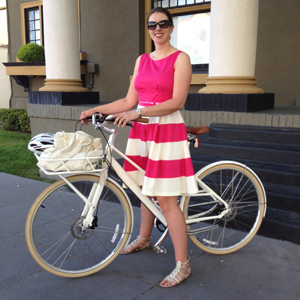
Corinne Winter’s first transportation problem came with a shopping list. She wanted to bicycle to work in San Jose, but the sprawling city made the prospect intimidating. A colleague helped her find a road bike, a rack, and the right panniers. The journey became manageable. For years, she rode to work, sometimes putting the bicycle on a train for part of the ten-mile trip.
It is a useful beginning for someone whose later work would involve helping people participate in transportation decisions. Before the policy language came equipment, advice, and a route through an actual city. A person who knew how to do the trip helped another person begin. The bicycle needed a rack; the newcomer needed someone to ask.
Winter eventually became executive director of the Silicon Valley Bicycle Coalition, then founded the community engagement company that bears her surname. Her working territory now includes public agencies, community organizations, transit services, and residents. The question running through that career is how the experience of getting around reaches the people deciding what happens next.
The equipment came before the argument
As a child, Winter rode for fun. At school and university, cycling became an inexpensive, enjoyable way to travel. Commuting added another advantage: moving past traffic rather than sitting inside it. By 2012, her account of riding included longer recreational trips and a folding bicycle that had accompanied her through parts of Europe and the Caribbean.
In Sicily, she recalled, a local elder invited her into his home and shared brandy and stories. That is an unusually sociable accessory for a bicycle trip. Her account connected the vehicle with a way of encountering people, beyond simply arriving at a destination.
She also acknowledged driving when it was the convenient choice. Her ambition was practical: make riding convenient for more journeys. That distinction matters in a career spent discussing transportation choices. A journey has to work on the day someone needs to make it.
A city you can get to know
Winter studied physics and environmental studies at the University of California, Santa Cruz. After graduation, she spent six months backpacking through South America. Back in the Bay Area, she entered an engineering master’s program at San Jose State and worked designing systems in the solar industry. A connection with a bicycle coalition board member brought her into advocacy.
“I’m biking, so I like to localize my life,” she said in 2013. Her descriptions of San Jose were specific: downtown flowers, the Rose Garden, the road toward Mount Hamilton. She recalled a staff meeting held on the grass. The office was close enough to make the park a reasonable meeting room, with rather better scenery.
There was also the lunch with transportation official Hans Larsen, when they discussed improving downtown bicycle routes despite constrained city finances. She connected that conversation with the buffered lanes that followed. It was an account of advocacy conducted through relationships and concrete opportunities, at the scale of a city she knew.
Four hundred people, then two thousand
Winter joined SVBC in 2005 as its first full-time executive director. At the beginning, the organization had 400 members, no other paid staff, and no office. By the December 2014 announcement of her planned departure, membership had reached 2,000 and the organization had ten employees. It occupied an office in downtown San Jose near City Hall.
Membership at the start of her tenure and at the December 2014 departure announcement. Endpoints only.
The coalition’s account of those years included an annual bicycle summit, bike-share advocacy, education programs, and new bicycle infrastructure. Winter was leaving an organization with staff and a broader funding base. Building that capacity belongs alongside the visible street changes in her career: a membership organization also needs people who can keep the work going.
Her earlier duties could be thoroughly hands-on. She coordinated Bike to Work Day in Santa Clara County, developed bicycle skills education, and volunteered to park bicycles. At the Guadalupe River Park opening in September 2005, she coordinated bike parking. Even a celebration needs somewhere to put the bikes.
Beyond SVBC, she served on the Bay Area Bicycle Coalition board and San Jose’s Bicycle and Pedestrian Advisory Committee. Her work moved between the regional conversation and the local detail. Both scales appear repeatedly in the record of her advocacy.
When the bicycle becomes ordinary
At the 2012 Silicon Valley Bike Advocacy Summit, Winter described increasing involvement from individuals, institutions, and organizations. She was watching different kinds of bicycles appear around San Jose, alongside the growth of Bike Party. The subject was becoming part of everyday city life, with public officials and major employers entering the conversation.
That same spring, San Jose approved six projects adding eight miles of downtown bicycle lanes. The proposals included removing vehicle lanes, without the opposition transportation officials had encountered in earlier years. The moment provides context for Winter’s organizing: the public conversation around street space was changing.
Her interest extended to businesses using bicycles. In 2014, she welcomed the arrival of Cowgirl Bike Courier in the South Bay and encouraged community support. A courier service offered another everyday use for the vehicle, joining commuting and recreation. The bicycle could carry a delivery as readily as an argument about transportation.
In 2015, she also spoke in favor of more affordable, sustainable transportation as Bay Area bike-share expansion was proposed. These were related efforts, involving different organizations and practical ways of making travel choices available.
Her relationship with the coalition continued after she left its staff. At its annual dinner later in 2015, Winter and Carl Guardino led the paddle raise. More than 400 guests attended the evening; the paddle raise brought in over $30,000, including a matching contribution from the organization’s boards. Here was another piece of the work behind bicycle advocacy: asking people to pay for the organization that carried it forward. The bicycle could attract people to a cause. Keeping an advocacy staff working required a budget, and an evening at the microphone was part of that effort.
The coalition gets a different address
Winter announced her SVBC departure in December 2014, explaining that she would leave in 2015 to build a consultancy and consider other opportunities. She founded Winter that year. The transition carried her experience with elected officials, agency staff, developers, businesses, and community leaders into a different organizational setting.
Born and raised in the Bay Area, she had worked within its transportation networks for years. Her company’s stated purpose placed particular emphasis on communities historically underrepresented in planning. Her biography connects sustainable transportation with racial and social equity. Who participates is part of the work itself.
The company offers engagement planning, budgeting, facilitation, and reporting. Its methods include workshops, intercept surveys, online listening sessions, advisory groups, and pop-up events. It also works on transit marketing for services including ACE Rail and Amtrak San Joaquins. Public participation and encouraging people to use a service require different conversations, even when both concern the same railway.
The invitation is part of the plan.
An observation on Winter’s engagement practice
The regional Equity Bench catalog describes a multilingual team working with community-based organizations and public agencies. Those partnerships provide a route to people who have often been left out of planning. The organization already trusted in a neighborhood becomes part of the connection with the planning team.
Who gets an invitation?
Consider the company’s 2023 work supporting Commute.org’s Equity Action Plan in San Mateo County. Engagement included interviews, focus groups, and a survey. Discussions took place in English and Spanish; the survey was available in English, Spanish, Chinese, and Tagalog. The assignment sought transportation concerns and needs in equity priority communities.
Winter’s documented 2023 engagement for Commute.org’s Equity Action Plan.
On San Jose’s Better Bike Plan 2025, Winter brought community-based organizations onto the project team and held a workshop entirely in Spanish. These examples give the firm’s purpose a concrete form. Participation involves decisions about the team, the format, and the language before anyone answers the first question.
Her own name appears in a public Stevens Creek Corridor proposal as deputy project manager, alongside transportation specialists. It places community engagement within a wider project team. The work calls for coordinating expertise and local experience, with someone responsible for keeping that conversation organized.
The clipboard years
On June 16, 2025, Winter addressed a closing plenary at MTC’s Accessible Futures conference. She was summarizing what participants had said in breakout sessions. There had been a great deal to collect. The equipment this time was clipboards, covered with notes.
“We have been lurking in the corner of the room just paying attention,” she said. The phrasing was cheerful; the task was exacting. She needed to bring separate discussions back into a shared conversation, with colleagues contributing more detailed summaries.
Among the themes she raised was the need for a feedback loop: people who tell an agency about a problem want to know where that information goes. Collecting comments is one stage. Explaining what happens to them is another. The observation returns her story to the relationship between a person with experience and an organization with the power to respond.
Years earlier, a colleague had helped Winter make a commute possible by answering ordinary questions about bicycles and equipment. Her later career would involve many more people and larger plans. The recurring work remains recognizable: make the connection, attend to the details, and give people a useful way into the conversation.
Follow the route
Profiles, conversations, and public work.