Larry Gies began with a loan from a friend, ten credit cards and a wife working three jobs. It is an origin story with the ingredients of a business-school case study and the financial arrangements of a very nervous household. The loan was $50,000. The friend had played high-school football with him. Madison began in 1994, with more confidence than cash.
Years later, recalling that beginning, Gies supplied the sensible footnote: “I don’t recommend this approach.” The warning deserves a place beside the success. Beth Gies’s work and a friend’s willingness to lend money belong in the story before the acquisitions, the naming ceremonies or the stock-exchange ticker. An entrepreneurial leap can involve several people, even when only one of them gets called the founder.
But the interesting part of Gies’s career came after he learned to buy businesses. He had to decide what to do when he became good at selling them. An exit could deliver a return and still leave him dissatisfied. The companies had people in them. He knew those people. Saying goodbye became the problem.
A small town, a larger map
Gies grew up in Mendota, Illinois, where work arrived in practical forms: detasseling corn, baling hay, mowing lawns and helping with cattle. He played football, wrestled and ran track. The town was small enough for people to know one another. Your reputation had a local address and could get home before you did.
He applied to one university, Illinois. His accountancy degree followed in 1988; an MBA from Northwestern’s Kellogg School followed in 1992. Those dates draw a neat line on a résumé. The experience behind them was less tidy. Before Illinois, he had never flown and had traveled to only a few states. College expanded the territory he could imagine entering.
The university’s 2019 commencement program recalled his habit of returning to give guest lectures nearly every semester after graduation. There is something revealing about that particular form of loyalty. Writing a check takes a decision. Returning to a classroom for years takes repeated decisions, travel arrangements and enough curiosity to keep the conversation alive.
For Gies, Illinois became both an education and a continuing relationship. A place that had enlarged his world kept drawing him back into the worlds of students just beginning to enlarge theirs.
Accountancy
MBA
Founded
The education after the education
His early career took him to Touche Ross, the professional-services firm now part of Deloitte. After Kellogg, he worked with Michael Heisley, buying and operating businesses. Heisley’s industrial interests gave the young accountant exposure to companies as working organizations, with products to make and decisions to carry out.
The distinction matters. An acquisition looks elegantly contained in a spreadsheet. A factory on Monday morning has other opinions. Gies’s experience included running a business he had bought for Heisley, an apprenticeship that put the purchase and its consequences in the same pair of hands.
When he founded Madison Capital Partners in 1994, its approach was to buy, build and sell. Investors needed returns. Selling was part of the arrangement, rather than an unfortunate clerical detail. By the time Kellogg interviewed him in 2014, the businesses associated with the investment firm generated more than $5 billion in revenue.
Yet Gies had changed the arrangement. Madison Industries would acquire companies and keep them for the long term. “We’d rather keep those businesses for the long term,” he said. In a profession with a considerable vocabulary for departures, he was trying to make staying a business proposition.
An unusual exercise in succession
In his 2019 Illinois commencement address, Gies described an exercise with friends: they wrote their own eulogies and read them aloud. It is a fairly demanding lunch activity. Most people can barely agree on where to eat; this group considered how it would like to be remembered.
When the discussion reached their professional lives, making money for investors did not supply the answer they wanted. Gies connected that exercise to the formation of Madison Industries. He wanted a company capable of surviving its founders, with a culture that could continue after the people who established it had gone.
The thought gives his preference for long ownership a human scale. A business that lasts has to do more than retain its original shareholder. It needs people who can make decisions, successors who can assume responsibility and customers who still have reasons to buy. The future cannot depend indefinitely on one person answering the telephone.
Gies’s aspiration was a Madison that would exist two centuries later. That is a useful rebuke to the usual planning calendar. It also raises a question that no annual report can settle: what habits can a founder establish now that strangers will still find useful long after his departure?
What habits can a founder establish now that strangers will still find useful long after his departure?A question of succession
Let the person near the product decide
Madison’s portfolio has included industrial equipment, instruments and controls, marine businesses, and firefighting and rescue equipment. The products are often things people use without learning the name of the holding company behind them. There is limited celebrity potential in a control mechanism. There is plenty of scope for knowing exactly what a customer needs.
Gies’s approach gives that knowledge weight. He has argued that people close to a product should make decisions about it. Madison offers entrepreneurs capital and support while allowing them to keep building the businesses they understand. Ownership, in this telling, works through a relationship with operators.
The arrangement does not imply an absent owner. A May 2026 account described Gies as closely involved in financial reviews and quarterly business reviews, while leaving daily operating decisions to others. He has brought speakers including Nick Saban and Condoleezza Rice into the company’s cultural conversations.
That combination is more demanding than a slogan about empowerment. The owner must pay attention without taking every decision away. The operator must have room to act and accept responsibility for the result. Trust becomes something tested through the work, rather than something printed on the office wall.
A name on the door, students inside
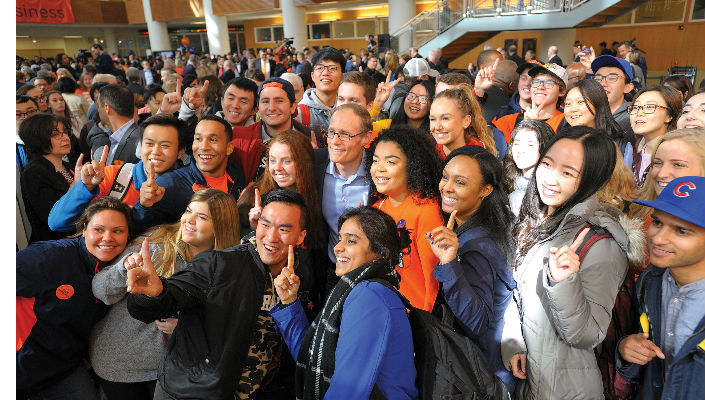
In October 2017, Larry and Beth Gies committed $150 million to the University of Illinois College of Business. The college became Gies College of Business. Their stated intent was an immediate and lasting effect on current and future students, with support for undergraduate education, graduate programs, research and wider access through technology.
The university’s Senate paperwork made the access question explicit: affordability for generations of students, together with the faculty to support them. The figure was large, but the problem it addressed was familiar. A capable student can still face a price that puts a particular education beyond reach.
Names on buildings are easy to photograph. Scholarship support and faculty capacity are less convenient subjects for a camera. They determine who gets inside and what happens after arrival. That is where a donation moves from an announcement to an institution’s daily life.
His involvement in education also reaches Chicago’s West Side. Larry, Beth and the Gies Foundation have supported Chicago Jesuit Academy’s founding and growth. The campus was named for them in 2015. The school, which began in 2005 with nineteen fifth-grade students in rented classrooms, later extended its reach to younger grades. A 50,000-square-foot expansion opened in fall 2023, enabling it to serve more girls and boys in grades three through eight.
A university college and an elementary school work on different scales. Both ask a patient question: what becomes possible when a student can enter an environment that would otherwise be out of reach? Gies has put resources behind that question at more than one stage of a child’s education.
The front door his father opened
In September 2025, Gies announced a $100 million gift to Illinois athletics, dedicated to his late father, Larry Gies Sr., a United States Army veteran. Memorial Stadium became Gies Memorial Stadium. A family connection returned to a place where a father had once taken his son to watch football.
Gies explained the connection through a house: academics are its foundation, while sports are the front door through which many people first encounter the university. He had told athletic director Josh Whitman that he would never donate to the athletic department. Friendship and confidence in Whitman’s team changed his mind.
The gift also carried a naming question. A memorial has obligations that a commercial venue does not. In an October 2025 interview, Gies acknowledged criticism and emphasized keeping the memorial’s meaning visible. Honoring his veteran father was part of that intention.
Then there was the ordinary fan beneath the benefactor. He admitted watching the end of an Illinois game on a phone while attending a wedding, with other Illini peering over. A nine-figure donation does not necessarily improve a supporter’s manners when a field goal is pending. It does, however, help explain why his metaphor begins with a door: football had let him into a community he kept returning to.
Forever meets the public market
The recent chapter complicates any tidy description of Gies as a buyer who never sells. In November 2025, Madison agreed to sell Filtration Group to Parker-Hannifin for $9.25 billion. Parker announced completion on August 13, 2026. Madison’s announcement said the Facet business would remain with Madison and presented Parker as a next home offering scale and investment.
The sale is a substantial qualification to the earlier language of holding companies forever. The historical change remains part of Gies’s story, but it cannot stand in for every later decision. A profile that stopped at the appealing promise would miss the choices he is making now.
Madison Air supplied another change in April 2026. Its initial offering was priced at $27 a share, with 82,692,308 Class A shares offered and trading scheduled to begin under MAIR. An entity controlled by Gies also agreed to buy $100 million of Class B stock in a concurrent private placement. Bringing a business to public markets creates a different ownership setting for its next phase.
For Gies, the durability question now includes succession, capital and what happens under other owners. The ambition can be consistent while the structures change. Whether those structures produce enduring businesses will be answered through their performance over time.
The unfinished part
Illinois awarded Gies an honorary Doctor of Humane Letters in 2025. In 2026 he received the Order of Lincoln, recognizing professional achievement and public service. These honors place his business career beside the institutions he has supported, rather than treating philanthropy as a footnote to a balance sheet.
He has continued the conversation too. A June 2026 appearance on The Gies Download covered education access, athletics, taking a company public and the implications of artificial intelligence for educators and business leaders. The subjects suggest someone still considering how organizations should adapt, even after decades spent acquiring and building them.
The early loan has long since ceased to define the scale of his work. It still offers a useful opening scene: a friend willing to lend, Beth willing to work, and a founder trying to turn borrowed money into something that could stand on its own. The later story asks more of him. A business can survive its first financing. An institution has to survive its founder.
Gies’s career is interesting at that meeting point between ownership and letting other people carry things forward. The next generation will decide what survives. He has spent years trying to give it something worth keeping.