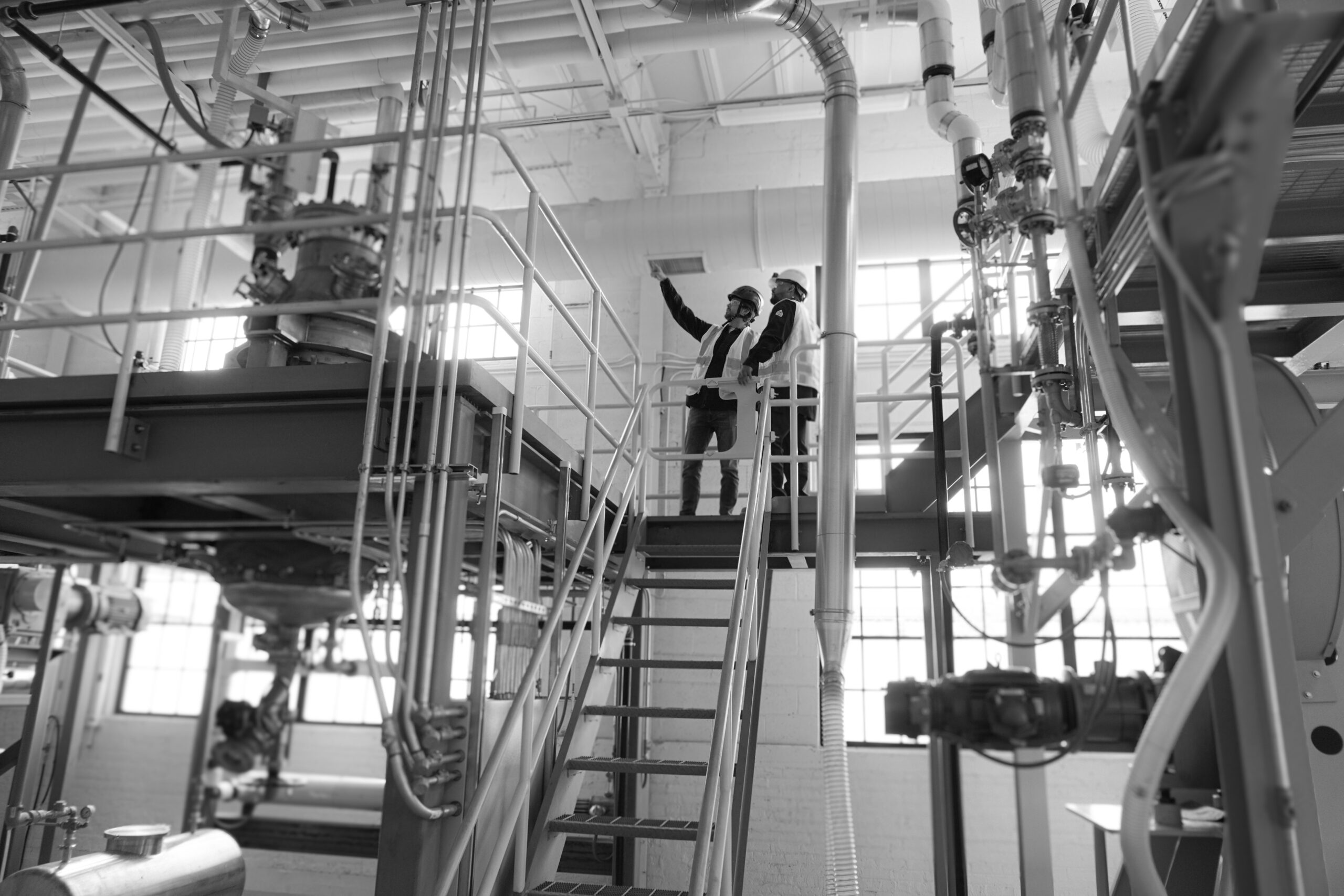
On the West Side of Chicago, inside a brick foundry that once poured molten metal a century ago, machines now produce a powder that is mostly empty space. That is the joke and the point of Numat. The company makes materials defined by their holes. And those holes, arranged with atomic precision, are turning out to be worth a great deal of money.
Numat builds with metal-organic frameworks, or MOFs - crystalline lattices stitched from metal nodes and organic struts, riddled with pores so small and so numerous that a single gram can unfold to the surface area of a football field. Numat is the first company to commercialize them at industrial scale. Today it employs roughly 66 people, runs the world's first MOF-dedicated nanofoundry, and counts semiconductor fabs, defense agencies, and energy firms among its customers.
"Our solutions change the way industries around the world capture and separate hazardous chemicals." - Numat, company statement
01 / THE PROBLEMThe chemistry industry has a containment problem
Modern life runs on dangerous molecules. The arsine and phosphine that dope silicon wafers are lethal in tiny doses. The chemical agents a soldier might face in the field are designed to kill. The carbon dioxide pouring out of industrial stacks is slowly rearranging the climate. In each case, the engineering question is the same and stubbornly hard: how do you grab one specific molecule, hold it, and let it go on command, without grabbing everything else?
Conventional materials are blunt instruments. Activated carbon and zeolites have been doing this work for decades, more or less the way a net catches fish - effective, but not exactly selective. For a long time, that was simply the deal. You accepted the leaks, the bulky storage cylinders, the wasted energy, and you moved on.
A material that traps one molecule and ignores the rest sounds like a wish. MOFs are the engineering version of granting it. - the central bet
02 / THE BETTwo founders, one academic breakthrough
The science came out of Northwestern University, where chemist Omar Farha had spent years designing MOFs that could be tuned, almost like software, to target particular gases. In 2012 he co-founded Numat with Ben Hernandez to drag that chemistry out of the lab and into the real economy. Farha became Chief Scientific Officer; Hernandez took the CEO seat and the harder job of convincing the world that a material most people had never heard of was worth building factories for.
The bet was unfashionable. Hard tech is slow, capital-hungry, and unglamorous next to software. MOFs had been an academic darling for years with precious little to show commercially - plenty of papers, almost no products. Numat's wager was that the gap between "interesting in a journal" and "shipping on a loading dock" was an engineering and manufacturing problem, not a scientific dead end.
"Numat is the first company to successfully commercialize MOFs." - the line everyone else was trying to write first
03 / THE PRODUCTProgrammable sponges, shipped
Numat's first commercial product, ION-X, tackled one of the semiconductor industry's quiet nightmares: storing the extraordinarily toxic gases used to make chips. ION-X uses MOFs to hold gases like arsine and phosphine sub-atmospherically - below atmospheric pressure - so that if a cylinder is breached, the gas wants to stay put rather than rush out. It is a safer answer to a problem that has historically been managed mostly by hoping nothing goes wrong.
Then came SENTINEL, an advanced decontamination and filtration line aimed at chemical-threat protection, including gear for soldiers operating in contaminated environments. Same underlying science, very different battlefield. Around both products sits Numat's real moat: a digital, data-driven design platform and an ISO 9001:2015-certified manufacturing campus that lets the company move a new MOF from concept to high-volume production faster than a traditional materials company ever could.
// The Numat Timeline
04 / THE PROOFThe money, and the validation
Skeptics of hard tech ask one fair question: does anyone actually pay for this? Numat's funding chart is its answer. The company has raised more than $72M across its life, with the curve bending sharply upward in 2025 when Aramco Ventures led a $40M Series C - the kind of check a global energy giant writes only when it sees a supply chain it wants to own.
Funding by round
The validation is not only financial. CEO Ben Hernandez was named by Goldman Sachs among its "100 Most Exceptional Entrepreneurs." A defense advisory board of retired U.S. generals helps steer the company's chemical-protection work. And in October 2025, the Nobel Committee handed the Chemistry prize to the pioneers of metal-organic frameworks - a field Numat had quietly been building factories for over a decade. It is rare for a startup's entire premise to get a Nobel-shaped stamp of approval mid-stride.
Most companies wait years for the market to agree with them. Numat got the Nobel committee to do it. - October 2025
05 / THE MISSIONChemistry, made programmable
Numat's stated mission is to "drive industrial efficiency through chemistry innovation" - which is the polite, boardroom version of a more interesting idea: that chemistry should be programmable. That you should be able to design a material atom by atom for one job and then manufacture it reliably, the way a chip designer lays out a circuit. The company's four values - Be Future Driven, Do the Right Thing, Learn & Evolve, Get It Done - read like a startup's, but the work is firmly industrial.
The throughline across semiconductors, defense, and decarbonization is not the markets, which could hardly be more different. It is the problem: hazardous molecules that have to be captured, held, or destroyed without collateral damage to people or the planet. Numat sells precision against that problem.
06 / WHY IT MATTERSThe material the world didn't know it needed
If MOFs do what their backers believe, the next decade gets quietly cleaner. Cheaper, safer toxic-gas handling means fewer industrial accidents. Selective capture means carbon pulled from flue gas or air without ruinous energy cost. Better filtration means soldiers and first responders who survive chemical exposure. None of it makes for a flashy consumer launch. All of it matters.
Numat's real contribution may be proving that a material can be a platform - that you can build a durable business not on one product but on the ability to design and manufacture matter to order. A second high-volume facility in Wisconsin suggests the company believes demand is only going one way.
Back in that century-old Chicago foundry, the machines keep producing powder that is mostly holes. The building once shaped the physical economy by pouring metal. Now it shapes a different one, molecule by molecule, by leaving exactly the right spaces empty. Same address. Entirely new idea about what manufacturing is for.