Lisa Skeete Tatum had spent more than a decade in venture capital. Then she reached a career crossroads and discovered that an impressive résumé does not come with instructions for what happens next.
- Employers sponsor personalized career development, combining a playbook with human coaching.
- NerdWallet’s 2022 program paired coaching with workshops, peer learning and leadership visibility.
- Copy the weekly accomplishment log. A career conversation improves when you bring the receipts.
The embarrassment mattered. People expected her to know the answer; she expected it of herself. In a 2018 interview, she described talking to other women, from fellow alumnae to mothers at her sons’ school, and finding the same uncertainty. An apparently private predicament began to look like a product opportunity. Accomplishment and direction, it turned out, were quite different possessions.
Landit, cofounded in 2014 with Sheila Marcelo, approaches that gap through personalized career development. Marcelo, the founder of Care.com, had met Tatum at Harvard Business School. Their proposition was practical: assemble the advice, professional connections and tools a person needs into something they can actually use. The resulting business now sells coaching and career pathing to employers, with an enduring interest in women and underrepresented talent.


A career needs more than a course catalogue
There is a familiar workplace ritual: an employee wants to progress, and someone points them toward a library of training courses. The library may be excellent. It still leaves the employee to decide which skill matters, whom to ask for help and how to turn learning into a credible case for a new role. Landit’s product addresses those connecting tasks.
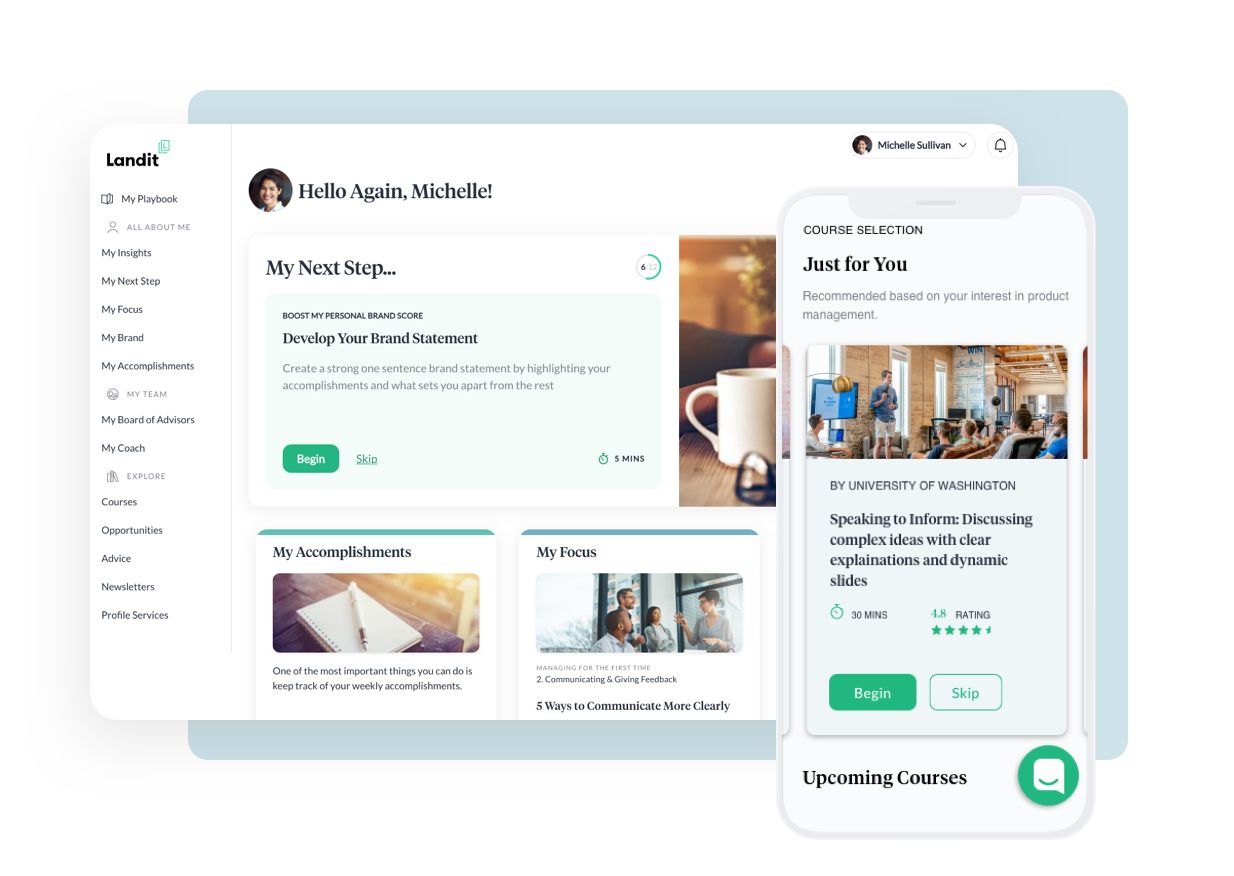
Its personal playbook organizes an individual action plan. Coaching adds a human conversation. Other components cover a personal board of advisors, professional brand, selected skill development, focused content and accomplishment tracking. Together, they treat career management as a continuing practice. Finishing a course is one activity within it, rather than the whole occasion.
The accomplishment tracker deserves attention precisely because it sounds so ordinary. In a 2017 podcast interview, Tatum named it her favorite feature. At review time, memory tends to favor what happened recently. Keeping a weekly record gives an employee material for a negotiation or appraisal before the pressure arrives. The office is full of people doing useful work; fewer maintain a usable account of it.
Six months, six sessions, eighteen people
NerdWallet offers a useful glimpse of the platform inside an actual employer. Its 2022 ESG report describes a Leadership Empowerment Accelerator Program for women, developed with Landit. Launched that July, the six-month program combined six workshops with six sessions with a certified coach. Eighteen employees had participated at the time of the report.
The design went beyond private coaching. It included peer learning and greater visibility with senior leadership, with the aim of moving underrepresented women into leadership positions. That combination is revealing. A person can improve their presentation skills alone, but advancement also depends on who sees them, which assignments they receive and whether somebody is prepared to advocate for them.
The report documents participation rather than proving a promotion effect. It supplies a schedule, repeated coaching and a connection to opportunity. Copying this approach requires time as well as money.
The employer picks up the conversation
Landit sits in the enterprise coaching and talent-development market. Employers buy a way to support employees; employees use the service to work on their own careers. Workday identifies itself as a customer as well as an investor and partner. Landit’s customer materials also name Pfizer, MetLife and Inmar, while its broader offering addresses large companies, growing businesses and nonprofits.
The commercial logic is straightforward. An employer has an interest in developing and keeping capable people. A worker has an interest in finding a path forward. Their interests overlap when internal opportunities exist. Coaching cannot manufacture a vacancy or compel a manager to share responsibility.
Landit’s early public identity centered on women. By 2019, WeWork’s account described a broader approach following its 2017 official launch. Today its homepage addresses everyone in the workplace. The documented change is an expansion of audience; it should not be mistaken for evidence that the original audience was a failed experiment.
A 2021 Jobs for the Future market scan described a freemium individual membership, with paid additions such as coaching and résumé services, alongside an enterprise offering. Today the public site leads with employer inquiries. That historical distinction matters to anyone shopping for access: an earlier individual membership model does not establish today’s availability or price.
“Where do I start?”Lisa Skeete Tatum, describing the shared career question, 2018
Thirteen million dollars is capital, not a price tag
In February 2019, Landit announced a $13 million Series A led by WeWork. Backers reported with the round included NEA, Valo Ventures, Workday Ventures and Gingerbread Capital. Fast Company reported that Landit already had a presence in more than 20 countries and intended to use the funding to scale. This was money raised by the business, rather than the cost of purchasing its service.
Buyers need to establish who qualifies, how many sessions are included and how success is measured. Promotion, retention and engagement measure different things.
BetterUp is an adjacent alternative in employer-sponsored coaching; Workday’s own writing describes both businesses in its investment ecosystem. Independent executive coaches and internal mentoring programs offer other routes. Landit’s distinctive proposition is the combination of human coaching with a career playbook, advisor relationships and a record of progress. Buyers should compare the actual package and delivery, rather than assume one supplier owns personalization.
Keep the receipts. Recruit the advisors.
There are pieces of this approach a reader can copy immediately. Make a weekly record of contributions while the details are fresh. Identify people who can offer different kinds of help, rather than asking one mentor to perform every role. Choose a specific next career question before buying another course. These are practical interpretations of Landit’s tools, not promises of equivalent results.
The conditions matter. A development program needs time, participation and opportunities where new skills can be used. If an organization rewards familiarity over contribution, coaching the employee leaves that obstacle in place. A thoughtful buyer will ask how managers and senior leaders participate, alongside asking how the platform works.
The original insight survives the broader business. Tatum’s credentials had not prevented uncertainty, and her conversations showed that uncertainty was shared. Landit packages a response around repeatable actions and access to people. Its most interesting wager is that employers will make room for those habits before an employee concludes that the only available career move is out the door.
Follow the conversation
Landit website · Company news · LinkedIn · X · Facebook
Watch: Build your dream team
Watch: Nasdaq Boardroom Talks
Read: the founder’s product conversation